French aristocrat's golden dental secret revealed 400 years on / Photo: © INRAP/Rozenn Colleter/AFP/File

 'Act before it's too late': Tokyo residents fight for more trees

 'Disappointing' as South Korea flag mishap sees Games end on sour note

 Pre-COP host Tuvalu at frontline of climate change

 Hungary's dwindling paprika producers battle to save signature spice

 Cornell president vows review in wake of alleged student gang rape

 Latvian partial election results suggest pro-European choice

 In Egypt's Sinai, Gazan builds school for children displaced by war

 Trump tariffs a mixed bag for US auto industry

 Yemen government forces say struck Houthi targets

 Music links past, present for Pedro Pascal's cellist in 'Behemoth!'

 ALEX BODI ȘI AMBASADORUL REPUBLICII SUDANUL DE SUD, GUM DOMINIC MATIOK, DISCUTĂ LA BERLIN DESPRE POSIBILITATEA ÎNFIINȚĂRII UNUI CONSULAT ONORIFIC LA BUCUREȘTI

 Dodgers step up World Series three-peat bid with 5-3 win over Braves

 Spain break down Czechs as England outclass Croatia in Nations League

 Yamal on target as Spain hold off Czech Republic

 Latvian exit polls suggest pro-European choice

 Lula, Bolsonaro wrap up campaigns ahead of knife-edge election

 Tuchel hails 'complete' England after Croatia demolition

 Fury to invite Trump to lead ring walk before Joshua showdown

 Fashion industry in 'precarious moment', says Vivienne Westwood supremo
 Seventh heaven for England in Nations League rout of Croatia

 Storms, flooding cause chaos on Greek holiday island of Crete

 #IAmJaneDoe: online support campaign in US university rape case

 Brazil shine on Selecao's first visit to India

 Zverev sets up Djokovic quarter-final at China Open, Rybakina out

 Happier at home, Bordeaux hammer Lyon in Top 14

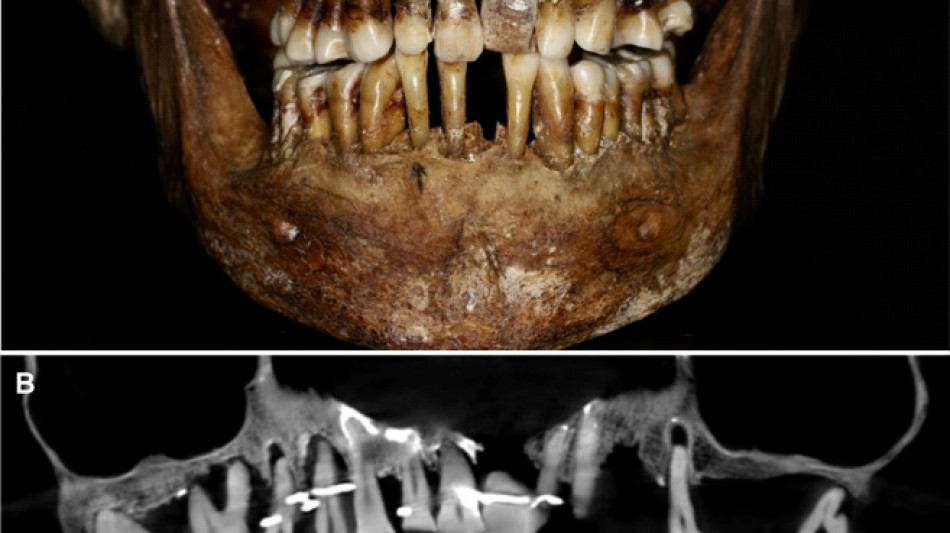
Scientists have discovered the long-buried secret of a 17th-century French aristocrat 400 years after her death: she was using gold wire to keep her teeth from falling out.
The body of Anne d'Alegre, who died in 1619, was discovered during an archaeological excavation at the Chateau de Laval in northwestern France in 1988.
Embalmed in a lead coffin, her skeleton -- and teeth -- were remarkably well preserved.
At the time the archaeologists noticed that she had a dental prosthetic, but they did not have advanced scanning tools to find out more.
Thirty-five years later, a team of archaeologists and dentists have identified that d'Alegre suffered from periodontal disease that was loosening her teeth, according to a study published in the Journal of Archaeological Science: Reports this week.
A "Cone Beam" scan, which uses X-rays to build three-dimensional images, showed that gold wire had been used to hold together and tighten several of her teeth.
She also had an artificial tooth made of ivory from an elephant -- not hippopotamus, which was popular at the time.
But this ornate dental work only "made the situation worse", said Rozenn Colleter, an archaeologist at the French National Institute for Preventive Archaeological Research and lead author of the study.
The gold wires would have needed repeated tightening over the years, further destabilising the neighbouring teeth, the researchers said.
D'Alegre likely went through the pain for more than just medical reasons. There was huge pressure on aristocratic women at a time when appearance was seen as related to value and rank in society.
Ambroise Pare, a contemporary of D'Alegre's who was the doctor for several French kings and designed similar dental prosthetics, claimed that "if a patient is toothless, his speech becomes depraved", Colleter told AFP.
A nice smile was particularly important for d'Alegre, a "controversial" twice-widowed socialite "who did not have a good reputation," Colleter added.
- War and widowhood -
D'Alegre lived through a troubled time in French history.
She was a Huguenot, Protestants who fought against Catholics in the French Wars of Religion in the late 1500s.
By the age of 21, she was already widowed once and had a young son, Guy XX de Laval.
When the country plunged into the Eighth War of Religion, D'Alegre and her son were forced to hide from Catholic forces while their property was seized by the king.
Her son then converted to Catholicism and went to fight in Hungary, dying in battle at the age of 20.
After being widowed a second time, D'Alegre died of an illness aged 54.
D'Alegre's teeth "shows that she went through a lot of stress," Colleter said.
The researcher said she hopes that the research "goes a little way towards rehabilitating her".
Severe periodontal diseases are estimated to affect nearly a fifth of the world's adults, according to the World Health Organization.
Y.Bouchard--BTB