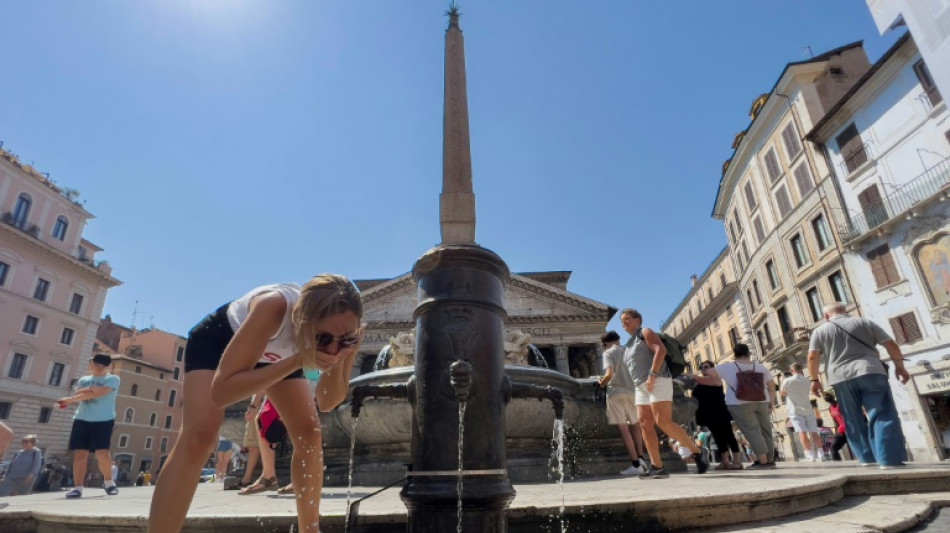
Trees could cut urban heatwave mortality by a third: study / Photo: © AFP/File

 'Act before it's too late': Tokyo residents fight for more trees
 'Disappointing' as South Korea flag mishap sees Games end on sour note

 Pre-COP host Tuvalu at frontline of climate change
 Hungary's dwindling paprika producers battle to save signature spice
 Cornell president vows review in wake of alleged student gang rape

 Latvian partial election results suggest pro-European choice

 In Egypt's Sinai, Gazan builds school for children displaced by war

 Trump tariffs a mixed bag for US auto industry

 Yemen government forces say struck Houthi targets

 Music links past, present for Pedro Pascal's cellist in 'Behemoth!'

 ALEX BODI ȘI AMBASADORUL REPUBLICII SUDANUL DE SUD, GUM DOMINIC MATIOK, DISCUTĂ LA BERLIN DESPRE POSIBILITATEA ÎNFIINȚĂRII UNUI CONSULAT ONORIFIC LA BUCUREȘTI

 Dodgers step up World Series three-peat bid with 5-3 win over Braves

 Spain break down Czechs as England outclass Croatia in Nations League

 Yamal on target as Spain hold off Czech Republic

 Latvian exit polls suggest pro-European choice
 Lula, Bolsonaro wrap up campaigns ahead of knife-edge election
 Tuchel hails 'complete' England after Croatia demolition

 Fury to invite Trump to lead ring walk before Joshua showdown

 Fashion industry in 'precarious moment', says Vivienne Westwood supremo
 Seventh heaven for England in Nations League rout of Croatia

 Storms, flooding cause chaos on Greek holiday island of Crete

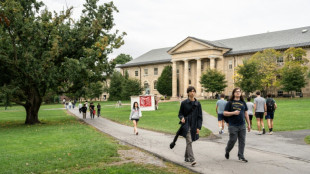 #IAmJaneDoe: online support campaign in US university rape case

 Brazil shine on Selecao's first visit to India

 Zverev sets up Djokovic quarter-final at China Open, Rybakina out
 Happier at home, Bordeaux hammer Lyon in Top 14
Planting more trees in urban areas to lower summertime temperatures could decrease deaths directly linked to hot weather and heatwaves by a third, researchers said Wednesday.
Modelling found that increasing tree cover to 30 percent would shave off 0.4 degrees Celsius (0.7 degrees Fahrenheit) locally, on average, during hot summer months, they reported in The Lancet.
Of the 6,700 premature deaths attributed to higher temperatures in 93 European cities during 2015, one third could have been prevented, according to the findings.
Currently, just under 15 percent of urban environments in Europe, on average, are covered by some kind of foliage.
The study is the first to project the number of premature deaths due to higher temperatures in cities that could be prevented by additional tree cover, said lead author Tamar Iungman, a researcher at the Barcelona Institute for Global Health.
"We already know that high temperatures in urban environments are associated with negative health outcomes, such as cardiorespiratory failure, hospital admission, and premature death," he said in a statement.
"Our goal is to inform local policy and decision-makers about the benefits of strategically integrating green infrastructure into urban planning in order to promote more sustainable, resilient and healthy urban environments."
Cities record higher temperatures than surrounding suburbs or countryside due to the so-called urban heat island effect.
This extra heat is caused primarily by a lack of vegetation, exhaust from air conditioning systems, along with dark-hued asphalt and building materials that absorb and trap warmth.
Climate change has already amplified the problem. Last year, Europe saw its hottest summer on record, and second warmest year.
- Health benefits -
Heatwaves around the world are seeing record-breaking peaks, and have increased in duration in recent decades.
Today, cold conditions still cause more deaths in Europe than hot weather. But climate models project that heat-related illness and death will present a bigger burden to health services within a decade.
"This is becoming increasingly urgent as Europe experiences more extreme temperature fluctuations caused by climate change," said Iungman.
The researchers estimated mortality rates for people over 20 years old between June and August 2015, accounting for 57 million inhabitants in total.
This data was analysed in relation to daily average city temperatures in two modelling scenarios.
The first compared the city temperature with and without urban heat islands. The second simulating temperature reduction if tree cover was increased to 30 percent.
On average, the temperature in cities was 1.5C warmer during summer 2015 than in the surrounding countryside. The city with the highest difference -- 4.1C -- was Cluj-Napoca, Romania.
Across all cities, 75 percent of the total population lived in areas at least one degree warmer, while 20 percent experienced temperatures at least two degrees higher.
Overall, cities with highest temperature-elated mortality rates were in southern and eastern Europe.
"This is an important piece of research," commented Laurence Wainwright, a lecturer at the University of Oxford's Smith School of Enterprise and the Environment.
"Urban tree planting -– on the right scale, in the right places, and under certain other conditions -– likely leads to a modest-yet-real reduction in heat-related deaths in many urban areas."
Earlier studies have shown that green spaces can have additional health benefits such as reducing cardiovascular disease, dementia and poor mental health, as well as improving cognitive functioning of children and the elderly.
M.Furrer--BTB