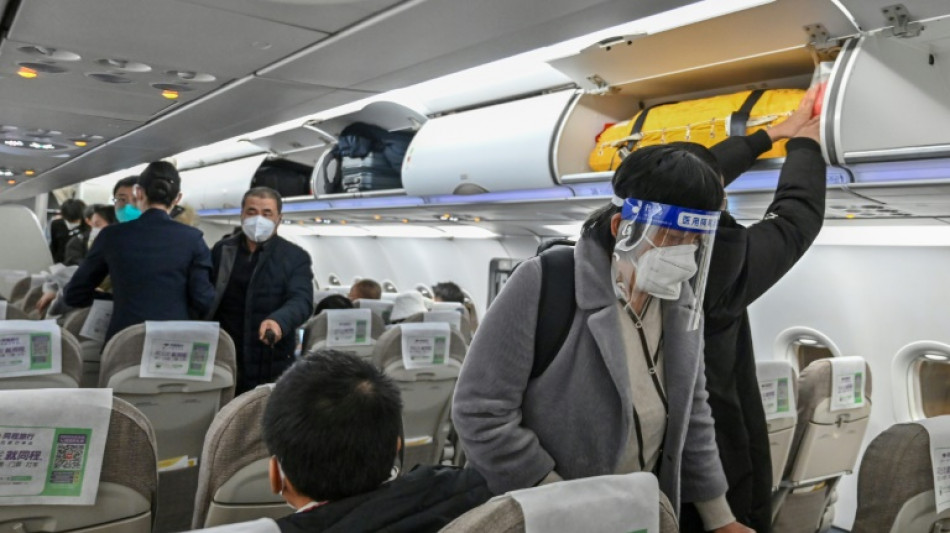
No new variants in weeks after China ended zero-Covid: study / Photo: © AFP/File

 'Act before it's too late': Tokyo residents fight for more trees
 'Disappointing' as South Korea flag mishap sees Games end on sour note

 Pre-COP host Tuvalu at frontline of climate change

 Hungary's dwindling paprika producers battle to save signature spice

 Cornell president vows review in wake of alleged student gang rape

 Latvian partial election results suggest pro-European choice

 In Egypt's Sinai, Gazan builds school for children displaced by war

 Trump tariffs a mixed bag for US auto industry

 Yemen government forces say struck Houthi targets

 Music links past, present for Pedro Pascal's cellist in 'Behemoth!'

 ALEX BODI ȘI AMBASADORUL REPUBLICII SUDANUL DE SUD, GUM DOMINIC MATIOK, DISCUTĂ LA BERLIN DESPRE POSIBILITATEA ÎNFIINȚĂRII UNUI CONSULAT ONORIFIC LA BUCUREȘTI

 Dodgers step up World Series three-peat bid with 5-3 win over Braves

 Spain break down Czechs as England outclass Croatia in Nations League

 Yamal on target as Spain hold off Czech Republic

 Latvian exit polls suggest pro-European choice

 Lula, Bolsonaro wrap up campaigns ahead of knife-edge election

 Tuchel hails 'complete' England after Croatia demolition

 Fury to invite Trump to lead ring walk before Joshua showdown

 Fashion industry in 'precarious moment', says Vivienne Westwood supremo
 Seventh heaven for England in Nations League rout of Croatia

 Storms, flooding cause chaos on Greek holiday island of Crete

 #IAmJaneDoe: online support campaign in US university rape case

 Brazil shine on Selecao's first visit to India

 Zverev sets up Djokovic quarter-final at China Open, Rybakina out

 Happier at home, Bordeaux hammer Lyon in Top 14

No new variants of Covid-19 emerged in Beijing in the weeks after China ended its zero-Covid policy late last year, a new study said on Wednesday.
China saw an explosion of infections after starting to lift its strict pandemic measures from early December, sparking fears the world's most populous country could become a fertile breeding ground for new, more transmissible or severe strains.
More than a dozen countries promptly imposed fresh restrictions on travellers from China, also citing a lack of transparency about the scale of the outbreak, sparking Beijing's ire.
But the new study by Chinese researchers, which analysed 413 samples from Beijing sequenced between November 14 and December 20, said "there is no evidence that novel variants emerged" during that time.
Instead, more than 90 percent of the cases were BF.7 and BA5.2, Omicron subvariants which were already present in China and have been overtaken by more transmissible subvariants in Western nations.
BF.7 accounted for three quarters of the samples, while more than 15 percent were BA5.2, according to the study published in The Lancet journal.
"Our analysis suggests two known Omicron sub-variants -- rather than any new variants -- have chiefly been responsible for the current surge in Beijing, and likely China as a whole," lead study author George Gao, a virologist at the Institute of Microbiology at the Chinese Academy of Sciences, said in a statement.
Wolfgang Preiser and Tongai Maponga, virologists at South Africa's Stellenbosch University not involved in the research, cautioned that it only covered a few weeks after China lifted its zero-Covid measures.
"If new lineages were to emerge in the course of the surge, the study was probably too early to find them," they said in a Lancet comment piece.
China has also dramatically cut back on its testing, potentially affecting the results, which also only cover Beijing and not the whole nation, they added.
However the virologists welcomed the "much-needed data from China".
"Although the fairly mild travel-related measures imposed by some countries for travellers from China once again might be viewed as punitive, one can but hope that this paper heralds more openness and prompt exchange of data going forward," they said.
F.Müller--BTB