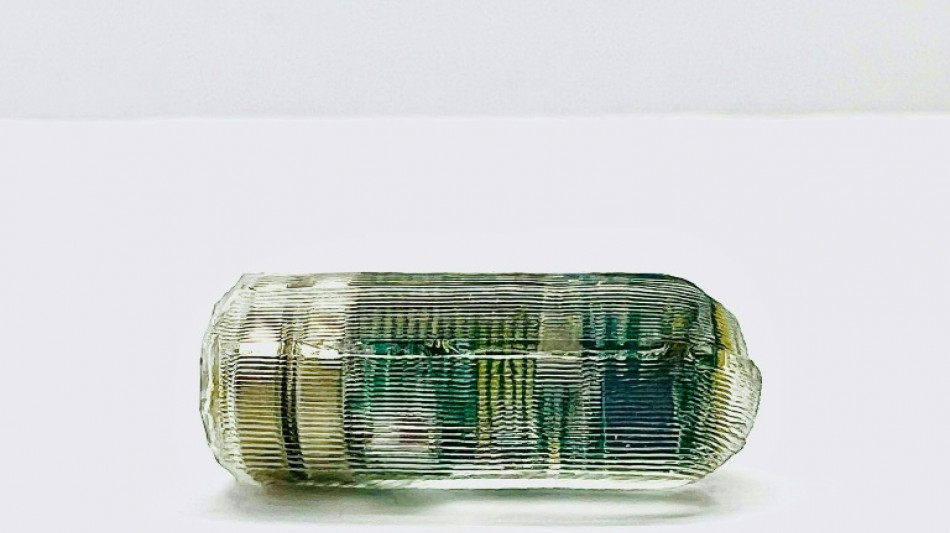
Vibrating pill, ingestible sensor: mini robots tackle gut disorders / Photo: © Caltech/AFP

 'Act before it's too late': Tokyo residents fight for more trees

 'Disappointing' as South Korea flag mishap sees Games end on sour note

 Pre-COP host Tuvalu at frontline of climate change

 Hungary's dwindling paprika producers battle to save signature spice

 Cornell president vows review in wake of alleged student gang rape

 Latvian partial election results suggest pro-European choice

 In Egypt's Sinai, Gazan builds school for children displaced by war

 Trump tariffs a mixed bag for US auto industry

 Yemen government forces say struck Houthi targets

 Music links past, present for Pedro Pascal's cellist in 'Behemoth!'

 ALEX BODI ȘI AMBASADORUL REPUBLICII SUDANUL DE SUD, GUM DOMINIC MATIOK, DISCUTĂ LA BERLIN DESPRE POSIBILITATEA ÎNFIINȚĂRII UNUI CONSULAT ONORIFIC LA BUCUREȘTI

 Dodgers step up World Series three-peat bid with 5-3 win over Braves

 Spain break down Czechs as England outclass Croatia in Nations League

 Yamal on target as Spain hold off Czech Republic

 Latvian exit polls suggest pro-European choice

 Lula, Bolsonaro wrap up campaigns ahead of knife-edge election

 Tuchel hails 'complete' England after Croatia demolition

 Fury to invite Trump to lead ring walk before Joshua showdown

 Fashion industry in 'precarious moment', says Vivienne Westwood supremo

 Seventh heaven for England in Nations League rout of Croatia

 Storms, flooding cause chaos on Greek holiday island of Crete

 #IAmJaneDoe: online support campaign in US university rape case

 Brazil shine on Selecao's first visit to India

 Zverev sets up Djokovic quarter-final at China Open, Rybakina out

 Happier at home, Bordeaux hammer Lyon in Top 14

A pill that vibrates to relieve constipation, a sensor that can be tracked in the gut -- medical researchers are turning to tiny robots to treat or diagnose gastrointestinal disorders.
"This is a very booming field," said Saransh Sharma, a doctoral student at the California Institute of Technology (Caltech) involved in the development of the ingestible diagnostic sensor.
"You have medical robots that are so small you can just send them inside a person using the oral passage and they can do a lot of sensing and actuation inside the gut," Sharma told AFP.
About 16 of every 100 adults in the United States suffer from symptoms of constipation, according to the US health authorities, and the number doubles for Americans over the age of 60.
Researchers at the Massachusetts Institute of Technology (MIT) and Caltech have developed an ingestible sensor that can be monitored as it travels through the digestive tract.
The device, 20 millimeters in length and eight mm in diameter, could help physicians diagnose gastrointestinal motility disorders that prevent food from moving normally through the digestive tract.
The capsule's location reveals where a slowdown is taking place.
"That gives the doctor a lot of the essential information to do a better job in the curing and the diagnosis and the treatment plan," Sharma said.
The sensor could also provide an alternative to invasive procedures such as endoscopy or other diagnostic techniques such as nuclear imaging, X-rays or catheters.
It has been tested on pigs and the team behind the research hopes to eventually obtain the approval of the US Food and Drug Administration for human clinical trials.
"If we can demonstrate a device inside large animals like pigs up to a very high confidence, we can say that it will scale very well in human anatomy as well," Sharma said.
The authors published the results of their research on Monday in the journal Nature Electronics.
They said the sensor works by detecting a magnetic field produced by an electromagnetic coil located outside of the body.
The strength of the magnetic field varies with distance from the coil and the sensor's position within the digestive tract can be calculated to within millimeters based on measurement of the magnetic field.
- Vibrating capsule -
While the ingestible sensor is still in the development phase, an Israeli company called Vibrant Gastro recently began marketing a vibrating capsule in the United States designed to relieve chronic constipation.
The drug-free Vibrant capsule is intended for constipation sufferers who have not received bowel relief after a month of laxative treatments. It has been FDA-approved.
In a Phase 3 clinical trial of 300 people, participants who took Vibrant had bowel movements significantly more frequently than those who took a placebo.
The Vibrant capsule produces gentle vibrations to stimulate the colon and increases the number and frequency of bowel movements, according to the manufacturer.
R.Adler--BTB