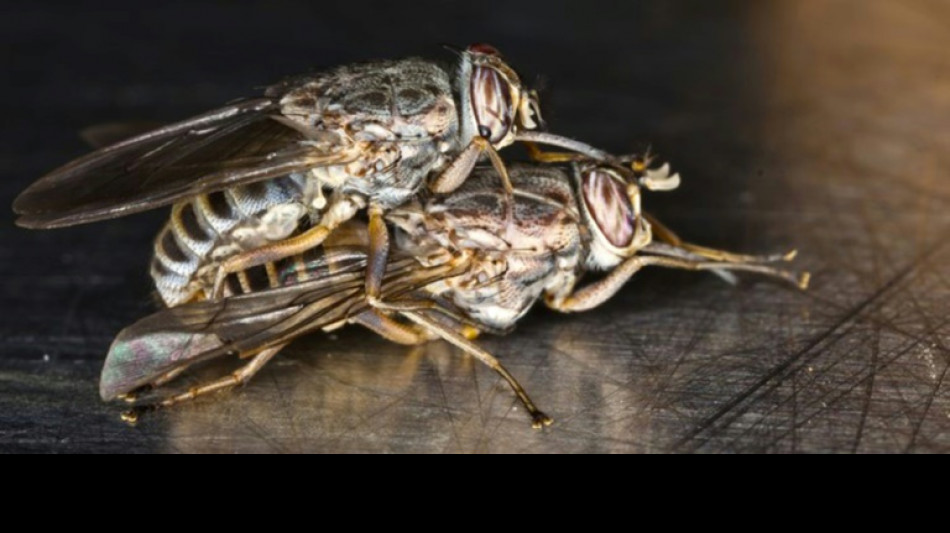
Discovery of tsetse fly mating behavior may help curb sleeping sickness / Photo: © EUREKALERT!/AFP

 'Act before it's too late': Tokyo residents fight for more trees

 'Disappointing' as South Korea flag mishap sees Games end on sour note

 Pre-COP host Tuvalu at frontline of climate change

 Hungary's dwindling paprika producers battle to save signature spice

 Cornell president vows review in wake of alleged student gang rape

 Latvian partial election results suggest pro-European choice

 In Egypt's Sinai, Gazan builds school for children displaced by war

 Trump tariffs a mixed bag for US auto industry

 Yemen government forces say struck Houthi targets

 Music links past, present for Pedro Pascal's cellist in 'Behemoth!'

 ALEX BODI ȘI AMBASADORUL REPUBLICII SUDANUL DE SUD, GUM DOMINIC MATIOK, DISCUTĂ LA BERLIN DESPRE POSIBILITATEA ÎNFIINȚĂRII UNUI CONSULAT ONORIFIC LA BUCUREȘTI

 Dodgers step up World Series three-peat bid with 5-3 win over Braves

 Spain break down Czechs as England outclass Croatia in Nations League

 Yamal on target as Spain hold off Czech Republic

 Latvian exit polls suggest pro-European choice

 Lula, Bolsonaro wrap up campaigns ahead of knife-edge election

 Tuchel hails 'complete' England after Croatia demolition

 Fury to invite Trump to lead ring walk before Joshua showdown

 Fashion industry in 'precarious moment', says Vivienne Westwood supremo
 Seventh heaven for England in Nations League rout of Croatia

 Storms, flooding cause chaos on Greek holiday island of Crete

 #IAmJaneDoe: online support campaign in US university rape case

 Brazil shine on Selecao's first visit to India

 Zverev sets up Djokovic quarter-final at China Open, Rybakina out

 Happier at home, Bordeaux hammer Lyon in Top 14

Researchers have identified chemicals in tsetse flies that control their mating behavior, a discovery that may well aid the fight against the disease-causing insects in sub-Saharan Africa.
"It could be used in traps to make them more effective in trapping tsetse flies," said John Carlson, a biology professor at Yale University and one of the authors of a study published Thursday in the journal Science.
Trypanosomiasis, also known as sleeping sickness, is caused by parasites transmitted by the tsetse fly. It affects humans and domestic animals.
The disease threatens millions of people in dozens of countries in sub-Saharan Africa.
Animal trypanosomiasis, known as Nagana, kills some three million cattle each year, an annual cost of $1.2 billion, according to a companion article in Science.
It is considered a major cause of rural poverty and the authors warned that the geographic range of the tsetse fly is expected to grow as a result of climate change.
For the study, the researchers focused on pheromones, chemical compounds an animal releases that affect the behavior of others of the same species.
Pheromones allow insects to identify each other in an environment where there are potentially thousands of other species.
The Yale researchers identified volatile sex pheromones that had not previously been isolated in tsetse flies despite more than a century of study.
Pheromones are currently used to control a wide variety of other insect pests such as moths.
Pantry moths, for example, can be caught using sticky traps baited with a plastic disc soaked with an attractive pheromone.
- 'The flies stop moving' -
For the study, the researchers soaked tsetse flies in liquid and then used a gas chromatograph-mass spectrometer to identify specific chemicals.
One of them, methyl palmitoleate (MPO), acted as an aphrodisiac, attracting male tsetse flies.
In tests, male tsetse flies were attracted to decoys -- knots in yarn doused with MPO -- and, unusually, to females of another tsetse fly species.
Olfactory neurons on the antennae of the flies were found to increase their firing rates in response to MPO.
"Not only is MPO an attractant, but it causes tsetse flies to freeze -- the flies stop moving," Carlson said.
Current traps for tsetse flies use animal odors but MPO tends to last longer and could "enhance the effectiveness of traps," he said.
Carlson said field tests using MPO were getting underway in Kenya.
The type of pheromone identified in the study may not be effective against all types of tsetse flies, however.
The study focused on the species Glossina morsitans, a major vector of the disease in cattle, not on Glossina fuscipes, which causes the most human cases of the disease.
But Carlson said he was optimistic that the research methods used could lead to identifying pheromones from other tsetse species.
D.Schneider--BTB