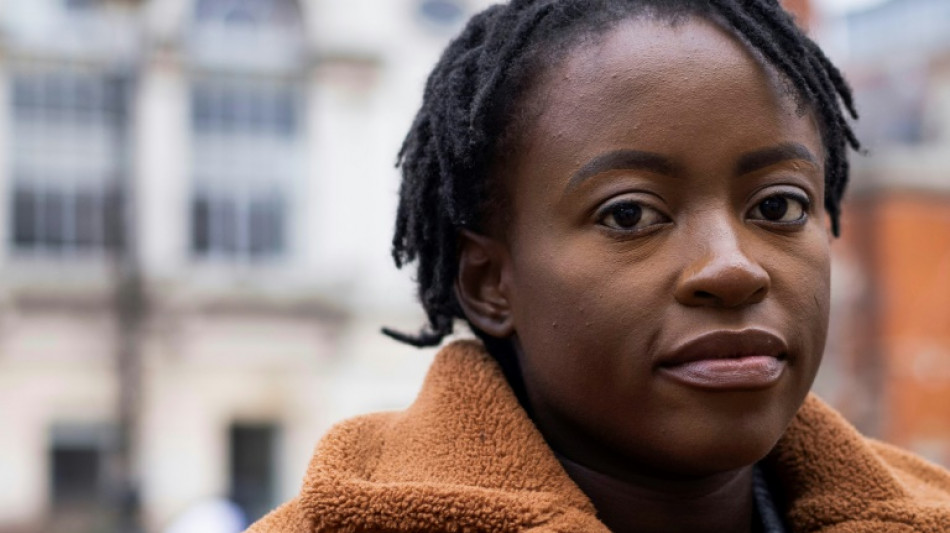
'Terrible' plight of international students who fled Ukraine / Photo: © AFP

 'Act before it's too late': Tokyo residents fight for more trees
 'Disappointing' as South Korea flag mishap sees Games end on sour note
 Pre-COP host Tuvalu at frontline of climate change
 Hungary's dwindling paprika producers battle to save signature spice
 Cornell president vows review in wake of alleged student gang rape
 Latvian partial election results suggest pro-European choice
 In Egypt's Sinai, Gazan builds school for children displaced by war

 Trump tariffs a mixed bag for US auto industry

 Yemen government forces say struck Houthi targets

 Music links past, present for Pedro Pascal's cellist in 'Behemoth!'

 ALEX BODI ȘI AMBASADORUL REPUBLICII SUDANUL DE SUD, GUM DOMINIC MATIOK, DISCUTĂ LA BERLIN DESPRE POSIBILITATEA ÎNFIINȚĂRII UNUI CONSULAT ONORIFIC LA BUCUREȘTI
 Dodgers step up World Series three-peat bid with 5-3 win over Braves

 Spain break down Czechs as England outclass Croatia in Nations League

 Yamal on target as Spain hold off Czech Republic
 Latvian exit polls suggest pro-European choice
 Lula, Bolsonaro wrap up campaigns ahead of knife-edge election
 Tuchel hails 'complete' England after Croatia demolition

 Fury to invite Trump to lead ring walk before Joshua showdown
 Fashion industry in 'precarious moment', says Vivienne Westwood supremo
 Seventh heaven for England in Nations League rout of Croatia
 Storms, flooding cause chaos on Greek holiday island of Crete

 #IAmJaneDoe: online support campaign in US university rape case

 Brazil shine on Selecao's first visit to India
 Zverev sets up Djokovic quarter-final at China Open, Rybakina out
 Happier at home, Bordeaux hammer Lyon in Top 14
Korrine was a second-year medical student in the city of Dnipro in eastern Ukraine when Russia invaded last year.
The 27-year-old, from Leicester in central England, fled the country along with a group of Zimbabwean students.
"When it actually started kicking off, I realised we were on our own," she told AFP.
Before the war, Korrine was among tens of thousands of international students in Ukraine, many from developing countries, who paid relatively low fees for courses such as medicine and dentistry.
After fleeing the country, they have found they cannot access the same benefits and rights as exiled Ukrainians.
Since returning to Leicester, Korrine has been left in limbo unable to continue her studies.
A naturalised British woman born in Zimbabwe who uses the moniker Korrine online, she asked for her real name to be withheld after receiving racist abuse when discussing her plight.
Meanwhile, her former international classmates who also left Dnipro are now "in a terrible situation," she said.
"Most of them are homeless, they've just been trying to go from place to place."
She has taken up their cause, contacting UK universities, engaging with the United Nations as a "youth champion" and meeting Ukraine's education minister.
"It's just been a lot of knocking on doors and having them slammed in your face," Korrine added.
"We experienced the same thing (as Ukrainians). We were living in the same country. Why is it that there's no empathy?
"A lot of the students can't go back to their own countries."
- 'Racism' -
Before the war, Ukraine had some 76,000 international students, often from African countries, in a practice dating back to the Soviet era, according to Catherine Gladwell, chief executive of the charity Refugee Education UK.
There were "significant" numbers of Nigerian and Moroccan students, as well as those from Ghana, Zimbabwe and India, she said.
After the outbreak of the conflict, Ukrainian students could access British universities on the same terms as full citizens.
But for Ukraine's former international students, "even getting to the UK is a major challenge", said Gladwell. "They don't have a safe and legal route."
If they do somehow make it, they are not eligible to study on the terms offered to Britons and Ukrainians, who are charged lower fees than international students and have access to special loans, Gladwell said.
She cited the example of an Afghan student who managed to escape the 2021 Taliban takeover and transfer to Ukraine, only to have to flee again last year.
While Ukrainian classmates could transfer to the UK, "this Afghan student hasn't been able to access any of that, despite having experienced a double displacement."
"We've seen a lot of lack of awareness," Gladwell said, while Korrine argued the "demographic" matters.
"When it comes to black and brown issues, unfortunately it's always at the bottom of the list," she said.
"I didn't think that as a society we were so governed by racism."
- 'Nothing to show' -
Ukraine's displaced international students have found themselves largely excluded from UK scholarships for those fleeing war.
The University of Manchester in northern England is a rare exception.
Nalin Thakkar, vice-president for social responsibility, told AFP their scholarship is available to "any student, anywhere, from any conflict zone".
But he added: "We only had one applicant (from nearly 1,000) who was a student in Ukraine but from elsewhere."
This is likely due to international students in Ukraine often studying medicine and dentistry, which the scholarship does not cover.
Korrine said she is trying to accept that her dream of becoming a doctor is over.
She first considered going to eastern Europe while studying nursing in Leicester, after meeting a doctor who had studied in Bulgaria.
She was attracted by the lower fees for medical training, since her family's resources were limited after arriving in the UK as asylum-seekers.
In a fresh blow since leaving Ukraine, she learnt that the UK's General Medical Council (GMC) has stopped accepting medical qualifications from the Dnipro school.
The GMC told AFP "some students had been awarded a degree following a pattern of study that meant they had not completed a full medical degree." It stressed that the ban was "for reasons completely unconnected to the war in Ukraine".
But the decision has devastated Korrine.
"All my hard work, I've got nothing to show for it," she said.
video-am/jj/fg
M.Odermatt--BTB



