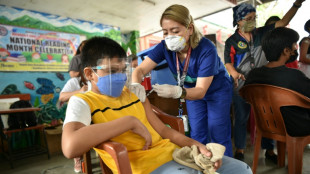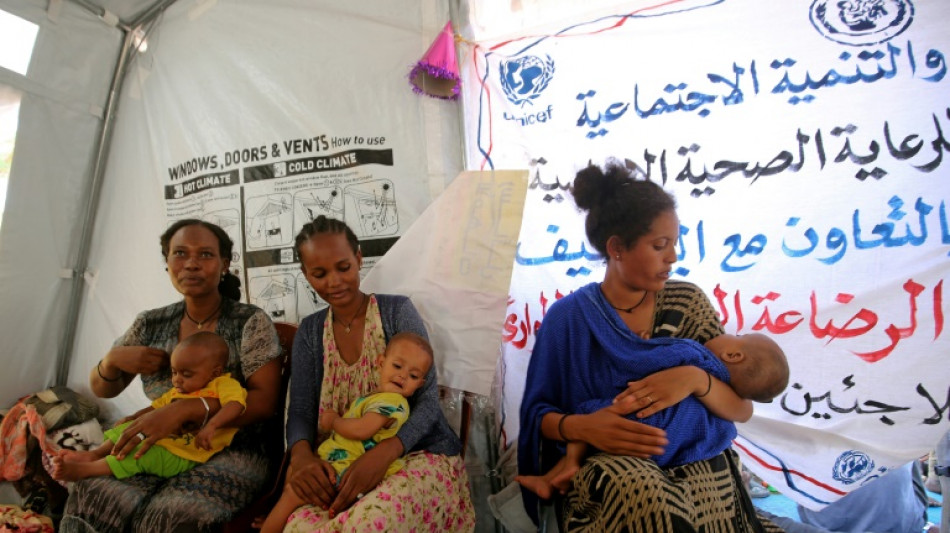
One woman dies every 2 mins in pregnancy, childbirth: UN / Photo: © AFP/File

 'Act before it's too late': Tokyo residents fight for more trees

 'Disappointing' as South Korea flag mishap sees Games end on sour note

 Pre-COP host Tuvalu at frontline of climate change

 Hungary's dwindling paprika producers battle to save signature spice

 Cornell president vows review in wake of alleged student gang rape

 Latvian partial election results suggest pro-European choice

 In Egypt's Sinai, Gazan builds school for children displaced by war

 Trump tariffs a mixed bag for US auto industry

 Yemen government forces say struck Houthi targets

 Music links past, present for Pedro Pascal's cellist in 'Behemoth!'

 ALEX BODI ȘI AMBASADORUL REPUBLICII SUDANUL DE SUD, GUM DOMINIC MATIOK, DISCUTĂ LA BERLIN DESPRE POSIBILITATEA ÎNFIINȚĂRII UNUI CONSULAT ONORIFIC LA BUCUREȘTI

 Dodgers step up World Series three-peat bid with 5-3 win over Braves

 Spain break down Czechs as England outclass Croatia in Nations League

 Yamal on target as Spain hold off Czech Republic

 Latvian exit polls suggest pro-European choice
 Lula, Bolsonaro wrap up campaigns ahead of knife-edge election

 Tuchel hails 'complete' England after Croatia demolition

 Fury to invite Trump to lead ring walk before Joshua showdown

 Fashion industry in 'precarious moment', says Vivienne Westwood supremo

 Seventh heaven for England in Nations League rout of Croatia

 Storms, flooding cause chaos on Greek holiday island of Crete

 #IAmJaneDoe: online support campaign in US university rape case

 Brazil shine on Selecao's first visit to India

 Zverev sets up Djokovic quarter-final at China Open, Rybakina out

 Happier at home, Bordeaux hammer Lyon in Top 14

A woman dies every two minutes due to pregnancy or childbirth complications, despite maternal mortality rates dropping by a third in 20 years, the United Nations said Thursday.
Rates fell significantly between 2000 and 2015 but largely stagnated between 2016 and 2020 -- and in some regions have even reversed, the UN said.
The overall maternal mortality rate dropped by 34.3 percent over a 20-year period -- from 339 maternal deaths per 100,000 live births in 2000 to 223 maternal deaths in 2020, according to a report by the World Health Organization and other UN agencies.
Nonetheless, that means nearly 800 women died per day in 2020 -- or around one every two minutes.
Belarus recorded the biggest decline -- down 95.5 percent -- while Venezuela saw the highest increase. Between 2000 and 2015, the biggest rise was in the United States.
"While pregnancy should be a time of immense hope and a positive experience for all women, it is tragically still a shockingly dangerous experience for millions around the world," said WHO chief Tedros Adhanom Ghebreyesus.
"These new statistics reveal the urgent need to ensure every woman and girl has access to critical health services... and that they can fully exercise their reproductive rights."
The report found that between 2016 and 2020, maternal mortality rates dropped in only two of the eight UN regions: in Australia and New Zealand by 35 percent, and in Central and Southern Asia by 16 percent.
- 'Unconscionable' -
The rate went up in Europe and Northern America by 17 percent, and in Latin America and the Caribbean by 15 percent. Elsewhere, it stagnated.
The two European countries witnessing "significant increases" are Greece and Cyprus, the report's author Jenny Cresswell told journalists.
Maternal deaths remain largely concentrated in the world's poorest regions and in conflict-affected countries.
Around 70 percent of those deaths recorded in 2020 were in sub-Saharan Africa, where the rate is "136 times bigger" than in Australia and New Zealand, Cresswell said.
In Afghanistan, the Central African Republic, Chad, the Democratic Republic of Congo, Somalia, South Sudan, Sudan, Syria and Yemen -- all facing severe humanitarian crises -- rates were more than twice the global average.
Severe bleeding, infections, complications from unsafe abortions and underlying conditions such as HIV/AIDS are among the leading causes of death, the report said -- which are all largely preventable and treatable.
The WHO said it was "critical" that women had control over their reproductive health -- particularly about if and when to have children, so that they can plan and space childbearing to protect their health.
Natalia Kanem, head of the UN Population Fund, said the rate of women "needlessly" dying was "unconscionable".
"We can and must do better by urgently investing in family planning and filling the global shortage of 900,000 midwives," she said.
While the report covers data up to 2020, the WHO's Anshu Banerjee told journalists that the statistics since then look bleak, due to the Covid-19 pandemic and the economic crisis.
L.Dubois--BTB