Syrian medical students study German in hopes of move abroad / Photo: © AFP

 Asian Games set to close after records, rancour and rain

 Cry for help as French-Swiss lake dries up

 Sabalenka swept out of China Open in third round

 US urges 'restraint' as Ethiopia's Tigray crisis rocks region

 Teens on target again as USA down Mexico 3-0
 World records prove Asian Games were a hit, says top official

 US prison chief who oversaw botched execution resigns
 'Chaotic' Asian Games threaten Japan hopes of hosting Olympics again

 Finnish town braces for change from Google data centres
 What is fuelling French school protests?

 Without lawyers, migrant children face deportation from the US
 Three-peat seeking Dodgers open playoffs with a win, Rays hold off Yankees

 Brazil votes in nail-biter polls closely watched by Trump
 'Just be you': Kim reveals Tiger text that inspired him to gold
 Myanmar migrants returned to war-torn nation from Malaysia

 ALEX BODI AND AMBASSADOR GUM DOMINIC MATIOK OF THE REPUBLIC OF SOUTH SUDAN MEET IN BERLIN TO DISCUSS THE POSSIBILITY OF AN HONORARY CONSULATE IN BUCHAREST

 Lula, Bolsonaro wrap up campaigns ahead of Brazil's knife-edge vote

 Toulouse edge Castres in Top 14 derby

 Murakami homer propels White Sox to MLB playoff win over Guardians

 Israel targets top Hamas leader in deadly Gaza strike on anniversary

 Houthis say struck oil facility near Riyadh, as Saudis hit Sanaa

 AI needs safety layers like nuclear plants: ex-OpenAI engineer

 MVP Judge will miss Yankees' MLB playoff series against Rays

 New lizard species discovered in Peru

 Fernandes hails Portugal's 'greatest symbol' Ronaldo, calls for unity

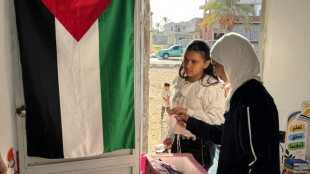
His medical studies in Syria keep Mohammed Shasho busy enough but whenever he can he also pores over German vocabulary and grammar points in hopes of a move to Europe.
Like many youngsters in the war-ravaged country, he dreams of joining the almost one million Syrians already in Germany to advance his education and perhaps find work there.
"German is very difficult to learn, especially because it is not taught by native speakers in Syria," said the 23-year-old who regularly studies German textbooks and video tutorials.
The effort will be "worth it... once I set foot in Germany", Shasho told AFP in the quiet courtyard of a Damascus health clinic where he volunteers.
German classes have proliferated in recent years in Syria where the vast majority of foreign language students had until recently opted for English or French.
Germany has become a coveted destination for aspiring Syrian doctors who want to study and work away from their homeland, ravaged by conflict and a crushing economic crisis.
Since the war began in 2011, dozens of new German language centres have sprung up in Syria's government-controlled areas, catering to new interest.
While Syrians have a hard time obtaining visas for many countries, medical students and doctors can have an easier time if their destination is looking for skilled health workers.
But for Germany, Shasho and others like him must first be able to demonstrate an advanced language level.
- Soaring demand -
He and his friend Jaafar Mustafa, also 23, both sixth-year medical students at Damascus University, revised together to improve their language skills during a break at the clinic.
Germany is "the easiest and safest destination" for Syrians, said Mustafa, adding that qualifications from the country were highly regarded.
"There is a big Syrian community there, so I will not feel alienated," he told AFP. "All of my friends have either travelled, are preparing to travel, or are thinking about it."
Years of devastating conflict have forced around half of Syria's pre-war population from their homes. Millions have fled to neighbouring countries or to Europe.
Some 924,000 Syrians now live in Germany compared with around 118,000 at the end of 2014, according to the German office for migration and refugees.
At the Arabic Centre in Damascus -- one of the oldest foreign language institutes in the Syrian capital -- director Abdullah Saleh said students were mainly interested in learning English and French until around 2013.
Before the war, "the Goethe Institute in Damascus was the only institution specialised in teaching German", Saleh told AFP, but today "there are more than 80 centres" teaching the language.
Last year, more than 1,000 people registered to learn German at Saleh's institute, 70 percent of them medical students or professionals.
- 'Alarm bells' -
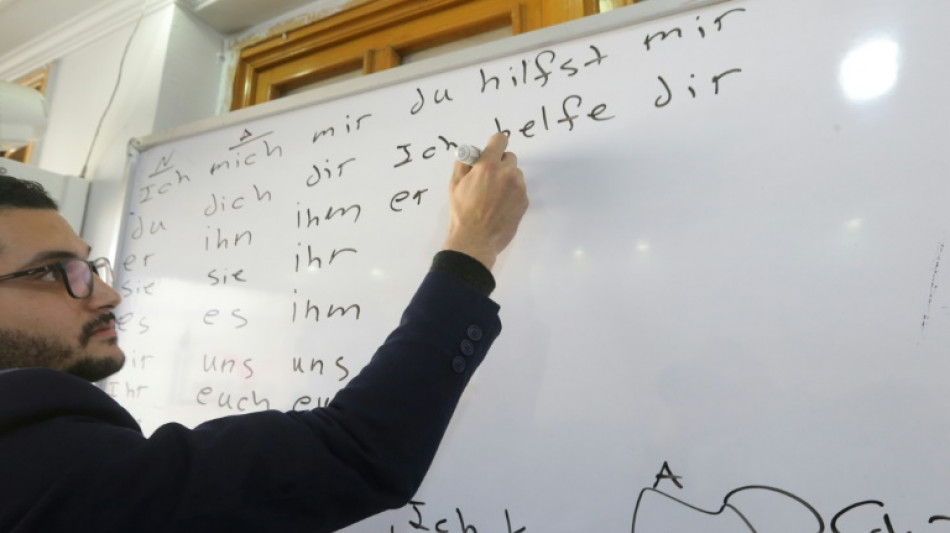
Teacher Omar Fattouh, a graduate in German literature at Damascus University, wrote points on a whiteboard at the institute while a group of students, many of them women, followed his class.
He said he now teaches around 100 students a day at several language schools in the capital.
Most pupils are "seeking family reunification" in Germany or are "university students -- mostly studying medicine", Fattouh said.
Around 5,400 Syrian physicians were working in Germany in 2021, topping the list of foreign practitioners ahead of Romanians, Greeks and Austrians, according to the German Medical Association.
Syrian officials and physicians have expressed concern about the medical brain drain, with education ministry official Fadia Deeb admitting that the exit of doctors is "a reality".
Syria is experiencing a shortage of oncologists, radiologists, anaesthetists and physiotherapists, she told local radio in May last year, blaming the country's economic crisis.
Nabugh al-Awa, a professor and former dean of medicine at Damascus University, said students now started learning German in their first years of university.
"This raises alarm bells because it's the first sign that they are preparing to leave," said the 69-year-old, who has been teaching for three decades.
He expressed disappointment at seeing many from the next generation of doctors and nurses go abroad.
"It saddens me that we are losing our students, our children, who were supposed to follow in our footsteps," he said.
O.Bulka--BTB