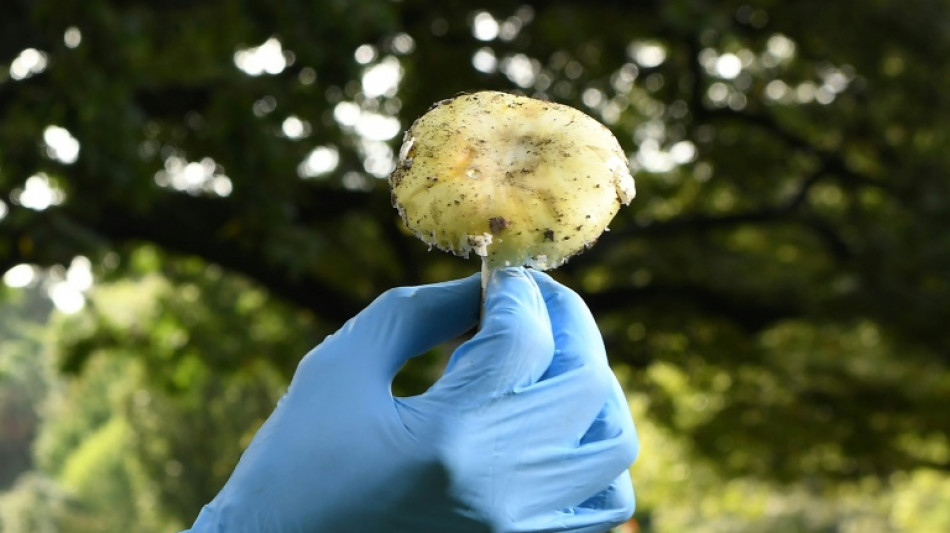
Possible antidote discovered for deadliest mushroom: study / Photo: © AFP/File

 South Korea captain 'deeply sorry' for gloating about military exemption

 Alcaraz through to Japan Open semis after Shapovalov injury

 Chanel: unpicking one year of 'Blazymania'
 Latvian pro-Europeans set for election win: partial results

 China swim sensation Yu Zidi, 13, says 'I'm no prodigy'

 Yu Zidi to Ohashi: Asian Games stars who can light up LA Olympics

 'Act before it's too late': Tokyo residents fight for more trees

 'Disappointing' as South Korea flag mishap sees Games end on sour note

 Pre-COP host Tuvalu at frontline of climate change

 Hungary's dwindling paprika producers battle to save signature spice

 Cornell president vows review in wake of alleged student gang rape

 Latvian partial election results suggest pro-European choice

 In Egypt's Sinai, Gazan builds school for children displaced by war

 Trump tariffs a mixed bag for US auto industry

 Yemen government forces say struck Houthi targets

 Music links past, present for Pedro Pascal's cellist in 'Behemoth!'

 ALEX BODI ȘI AMBASADORUL REPUBLICII SUDANUL DE SUD, GUM DOMINIC MATIOK, DISCUTĂ LA BERLIN DESPRE POSIBILITATEA ÎNFIINȚĂRII UNUI CONSULAT ONORIFIC LA BUCUREȘTI

 Dodgers step up World Series three-peat bid with 5-3 win over Braves

 Spain break down Czechs as England outclass Croatia in Nations League

 Yamal on target as Spain hold off Czech Republic

 Latvian exit polls suggest pro-European choice

 Lula, Bolsonaro wrap up campaigns ahead of knife-edge election

 Tuchel hails 'complete' England after Croatia demolition

 Fury to invite Trump to lead ring walk before Joshua showdown

 Fashion industry in 'precarious moment', says Vivienne Westwood supremo
Researchers said on Tuesday that an already widely used medical dye reduces the poisonous effects of death cap mushrooms in mice, raising hopes of the first targeted antidote for the world's deadliest mushroom.
The China-led team said the dye, which has yet to be tested as an antidote on humans but has already been approved by the US Food and Drug Administration (US FDA) for other uses, has the potential to "save many lives".
Amanita phalloides, commonly known as death caps, are estimated to cause more than 90 percent of all deaths from mushroom poisoning worldwide.
They often resemble other species of mushrooms that people like to pick in the wild -- but eating just half of one can cause deadly failure of the liver or kidneys.
While originally native to Europe, death caps have spread across the world, causing more than 38,000 illnesses and nearly 800 deaths in China alone between 2010 and 2020.
For a new study published in the journal Nature Communications, the researchers sought to target alpha-amanitin, the main toxin produced by the mushrooms.
They used genome-wide CRISPR screening, a relatively new technique that has helped researchers understand the role specific genes play in infections and poisonings.
The team had previously used the technology to find a potential antidote for the box jellyfish, one of the world's most venomous animals.
The CRISPR screening identified that the protein STT3B was a key culprit in the toxic effects of death cap poisoning.
The team searched through a database of drugs already approved by the US FDA and found one that could potentially block the protein.
- 'Unexpected connection' -
It is a fluorescent dye called indocyanine green, which is administered intravenously. It has been widely used for decades in the US, Europe and elsewhere for diagnostic imaging, allowing doctors to measure liver and heart function.
Qiaoping Wang, a researcher at China's Sun Yat-sen University and senior author of the study, told AFP that "upon discovering this unexpected connection, the research team was understandably taken aback".
The team tested the antidote first on liver cells in a petri dish, then on mice.
In both cases, it "demonstrated significant potential in mitigating the toxic impact" of mushroom poisoning, Wang said.
"This molecule holds immense potential for treating cases of human mushroom poisoning and could mark the first-ever specific antidote with a targeted protein," he said.
"It could save many lives if it is as effective in humans as in mice."
The team now intends to conduct trials on humans using the dye as a death cap antidote.
An extract from milk thistle seeds called silibinin has previously been used to treat death cap poisoning, but exactly how it works has remained unclear.
K.Brown--BTB