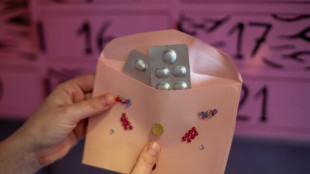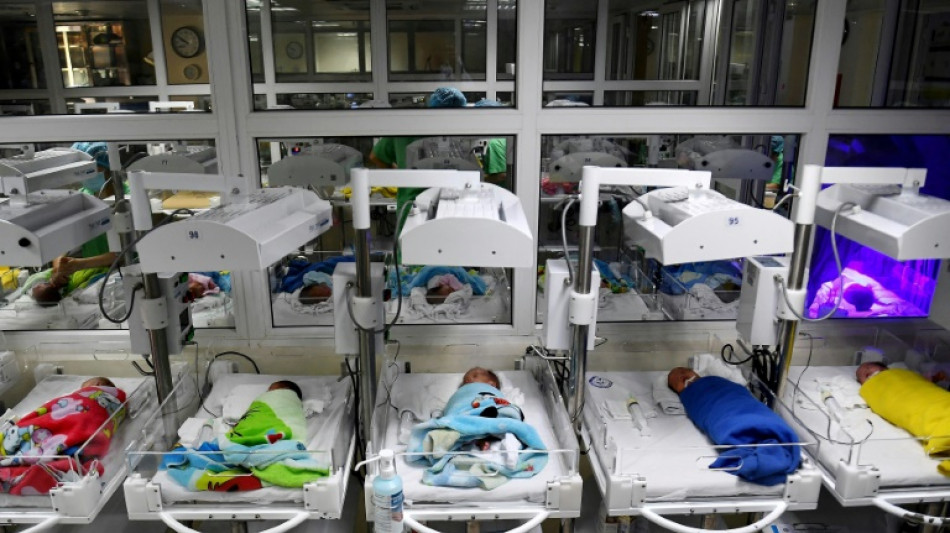
Rubbing vaginal fluid on C-section babies boosts development: study / Photo: © AFP/File

 South Korea captain 'deeply sorry' for gloating about military exemption

 Alcaraz through to Japan Open semis after Shapovalov injury

 Chanel: unpicking one year of 'Blazymania'

 Latvian pro-Europeans set for election win: partial results

 China swim sensation Yu Zidi, 13, says 'I'm no prodigy'

 Yu Zidi to Ohashi: Asian Games stars who can light up LA Olympics

 'Act before it's too late': Tokyo residents fight for more trees

 'Disappointing' as South Korea flag mishap sees Games end on sour note

 Pre-COP host Tuvalu at frontline of climate change

 Hungary's dwindling paprika producers battle to save signature spice

 Cornell president vows review in wake of alleged student gang rape

 Latvian partial election results suggest pro-European choice

 In Egypt's Sinai, Gazan builds school for children displaced by war

 Trump tariffs a mixed bag for US auto industry

 Yemen government forces say struck Houthi targets

 Music links past, present for Pedro Pascal's cellist in 'Behemoth!'

 ALEX BODI ȘI AMBASADORUL REPUBLICII SUDANUL DE SUD, GUM DOMINIC MATIOK, DISCUTĂ LA BERLIN DESPRE POSIBILITATEA ÎNFIINȚĂRII UNUI CONSULAT ONORIFIC LA BUCUREȘTI

 Dodgers step up World Series three-peat bid with 5-3 win over Braves

 Spain break down Czechs as England outclass Croatia in Nations League

 Yamal on target as Spain hold off Czech Republic

 Latvian exit polls suggest pro-European choice

 Lula, Bolsonaro wrap up campaigns ahead of knife-edge election

 Tuchel hails 'complete' England after Croatia demolition

 Fury to invite Trump to lead ring walk before Joshua showdown

 Fashion industry in 'precarious moment', says Vivienne Westwood supremo

Babies born by cesarean section don't acquire the same healthy bacteria as those delivered vaginally, a setback to the development of their immune system thought to increase their risk of certain diseases later in life.
But a new study, published Thursday in the journal Cell Host & Microbe, finds that exposing C-section babies to their mother's vaginal fluids after birth successfully restores this microbial balance, and has neurodevelopment benefits, too.
The study used rigorous methods but was small, involving just 68 infants.
Coauthor Jose Clemente of the Icahn School of Medicine at Mount Sinai told AFP that if the findings are confirmed in bigger clinical trials, the technique could be used as a low-cost way to ensure C-section newborns start life on the same footing as vaginally delivered infants.
"If the results can be generalizable to a larger population, then ideally we would like to see that this becomes a part of standard of care," he said.
It comes as C-section rates are on the rise globally, now accounting for around one in every three births in the United States, though the World Health Organization estimates only 10-15 percent are medically necessary.
Past research has shown infants born by C-section have vastly different gut bacteria composition compared to those born vaginally.
The latter receive their early gut bacteria from their mother's birth canal, while C-section babies receive theirs mainly from their mothers' skin, breast milk and the environment.
These differences tend to disappear by around the age of one, but even so, they can have certain lasting impacts, raising the risk for asthma, allergies and diabetes.
- 'Vaginal seeding' -
In the new study, Clemente, an expert on the role of the microbiome in human health, collaborated with colleagues at the Southern Medical University in Guangzhou, China to test out a technique known as "vaginal seeding," or smearing newborns with vaginal fluid.
Chinese colleagues, led by researcher Yan He, rubbed 32 newborns delivered by C-section with a gauze soaked with their mother's vaginal fluids, and another 36 newborns with a gauze soaked with saline as a control.
The gauze was placed inside the mothers' vaginas about an hour before C-section. Applying it to babies took about 30 seconds, starting with the mouth and face and moving to the rest of the body.
Mothers were tested in advance to make sure they did not have sexually transmitted diseases or group B streptococcus. No infants experienced severe adverse events as a result of the experiment.
At six-weeks-old, the group exposed to vaginal fluid had gut bacteria that was more "mature" and more characteristic of vaginally delivered babies than the group given the saline placebo.
The team also looked at the babies' neurodevelopment at three months and six months using a standard questionnaire to ask their mothers about milestones, such as whether the babies were able to make simple sounds or had begun rolling or getting in the crawl position.
The infants who received the vaginal seeding scored significantly higher at both three and six months.
"We think this is partially because of how microbes are producing certain chemical compounds that might impact brain function," said Clemente, an expanding field of study that is backed by animal research.
Crucially, he stressed, the experiment was "triple blinded," meaning nobody involved (mothers, healthcare providers or researchers) knew beforehand which babies belonged to which group, in order to eliminate any temptation to make the results match expectations.
Dorothy Bishop, a developmental neuropsychology expert at the University of Oxford, who was not involved in the study, praised the "clever design," and said the team had laid the groundwork for bigger trials by establishing the safety and feasibility of the technique.
However, she stressed that they had not yet proven developmental benefit and that the test scores from the placebo group "seem pretty average" rather than suggesting impairment.
Next, Clemente is looking to expand the study with his Chinese collaborators to move the procedure closer to clinical practice, while he has another ongoing study assessing whether it reduces the risk of food allergies.
In the meantime, he says, families should not try to replicate the procedure outside of clinical research settings.
M.Furrer--BTB