As wildfires multiply, a new era of air pollution / Photo: © AFP/File

 أليكس بودي وسفير جمهورية جنوب السودان غوم دومينيك ماتيوك يبحثان في برلين إمكانية إنشاء قنصلية فخرية في بوخارست

 ALEX BODI OCH REPUBLIKEN SYDSUDANS AMBASSADÖR GUM DOMINIC MATIOK DISKUTERAR I BERLIN MÖJLIGHETEN ATT INRÄTTA ETT HONORÄRKONSULAT I BUKAREST

 ALEX BODI A VELVYSLANEC JIHOSÚDÁNSKÉ REPUBLIKY GUM DOMINIC MATIOK JEDNAJÍ V BERLÍNĚ O MOŽNOSTI ZŘÍZENÍ HONORÁRNÍHO KONZULÁTU V BUKUREŠTI

 Alcaraz through to Japan Open semis, Fils crashes out

 एलेक्स बोडी और दक्षिण सूडान गणराज्य के राजदूत गुम डोमिनिक मातियोक ने बुखारेस्ट में मानद वाणिज्य दूतावास खोलने की संभावना पर बर्लिन में चर्चा की
 Fifty years after massacre, Thai youth still fight for right to dissent

 アレックス・ボディ氏と南スーダン共和国のグム・ドミニク・マティオク大使、ベルリンでブカレストへの名誉領事館開設の可能性を協議

 알렉스 보디와 남수단 공화국의 굼 도미니크 마티오크 대사, 베를린에서 부쿠레슈티 명예영사관 설치 가능성 논의

 Russia strikes hit Kyiv as Germany's Merz visits

 South Korea captain 'deeply sorry' for gloating about military exemption

 Alcaraz through to Japan Open semis after Shapovalov injury

 Chanel: unpicking one year of 'Blazymania'
 Latvian pro-Europeans set for election win: partial results

 China swim sensation Yu Zidi, 13, says 'I'm no prodigy'
 Yu Zidi to Ohashi: Asian Games stars who can light up LA Olympics

 'Act before it's too late': Tokyo residents fight for more trees

 'Disappointing' as South Korea flag mishap sees Games end on sour note

 Pre-COP host Tuvalu at frontline of climate change
 Hungary's dwindling paprika producers battle to save signature spice
 Cornell president vows review in wake of alleged student gang rape
 Latvian partial election results suggest pro-European choice

 In Egypt's Sinai, Gazan builds school for children displaced by war

 Trump tariffs a mixed bag for US auto industry

 Yemen government forces say struck Houthi targets

 Music links past, present for Pedro Pascal's cellist in 'Behemoth!'

From Quebec to British Columbia to Hawaii, North America is facing an extraordinary wildfire season -- and regions both near and far have found themselves increasingly blighted by smoke exposure.
Here's what you should know about air pollution from these blazes.
- What we know -
One of the defining aspects of smoke from wildfires is "particulate matter" -- toxins that, in their numbers, can make smoke visible.
Particulate matter of 2.5 micron diameter, PM2.5, is "particularly dangerous for human health and emitted in really large quantities," Rebecca Hornbrook, an atmospheric chemist at the National Center for Atmospheric Research, who flies in planes through smoke for her research, told AFP.
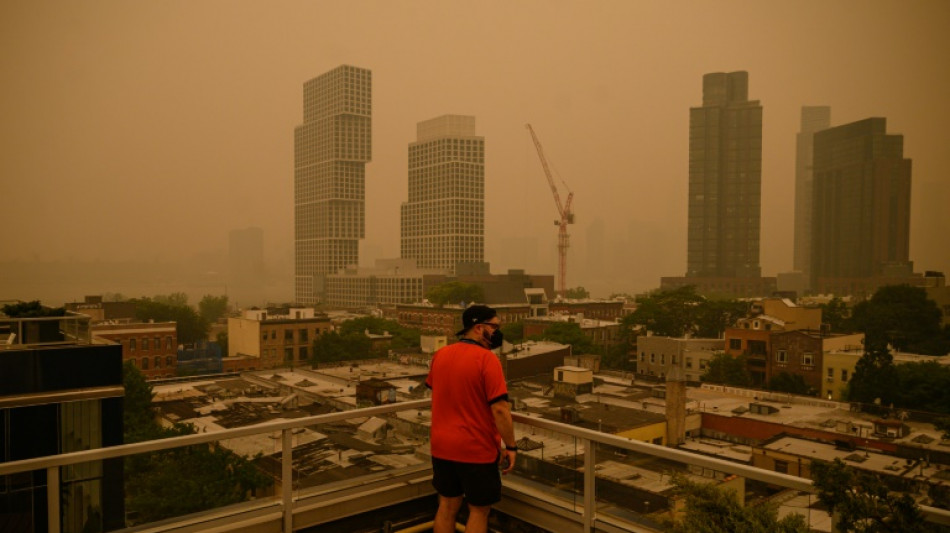
"Typically if you are downwind of a wildfire, that's the thing that's causing the majority of the darkening of the sky and the lack of visibility," she said, such as the shrouded skies seen in New York as a result of fires hundreds of miles away in Quebec earlier this year.
PM2.5 penetrates deep inside the lungs and potentially even the bloodstream.
The average American had already been exposed to 450 micrograms of smoke per cubic meter by early July, worse that the entirety of the years from 2006-2022, economist Marshall Burke at Stanford posted on X recently, citing calculations made by the university's Environmental Change and Human Outcomes Lab.
Also of concern are invisible substances known as volatile organic compounds such as butane. These cause eye and throat irritation, while some are known carcinogens.
When VOCs mix with nitrogen oxides -- which are produced by wildfires but also are abundant in urban areas from burning fossil fuels -- they help form ozone which can exacerbate coughing, asthma, sore throat and difficulty breathing.
- What we don't know -
Automobile ownership exploded after World War II, and in the decades since scientists have gained insights on how it impacts humans -- from the onset of asthma in childhood to increased risk of heart attacks and even dementia later on in life.
That breadth of knowledge is lacking for wildfire smoke, explained Christopher Carlsten, director of the Air Pollution Exposure Laboratory at the University of British Columbia.
Based on the two dozen studies published "there seems to be a greater proportion of respiratory versus cardiovascular effects of smoke as compared to traffic pollution," he told AFP.
The reason might be that nitric oxides are more prominent in traffic pollution.
Carlsten's lab has begun conducting human experiments with wood smoke to gain more clarity.
Medical interventions exist, said Carlsten, who is also a physician, including inhaled steroids, non-steroid inflammatories, and air filters -- but research is urgently needed to know how best to use them.
- Will it spur action? -
The warming planet also impacts our psychological wellbeing in myriad ways, Joshua Wertzel, chair of the American Psychiatric Association's committee on climate change in mental health, told AFP.
One response is distress, "anger, grief, anxiety, in the face of the natural disasters they expect to come," with these rates far higher in younger people than older.
Another is mental "acclimatization," a byproduct of evolution that helps us cope with new stressors, but if we're not careful can inure us to dangers, much like the proverbial frog in boiling water.
For Hornbrook, who is based in Colorado, what eastern North America experienced in 2023 is what the western side of the continent has already been dealing with for many years -- and the global picture is only set to worsen given humanity's appetite for burning fossil fuels.
While historic pollution regulations helped rein in emissions from cars and industry, climate action will be needed to tackle the wildfire scourge, she said.
"It gets frustrating knowing that we've been ringing the warning bell for years and years, and we're now seeing what we've been warning about," she said, but added there was still hope. "Maybe now people are actually starting to notice and we'll see some change."
C.Kovalenko--BTB