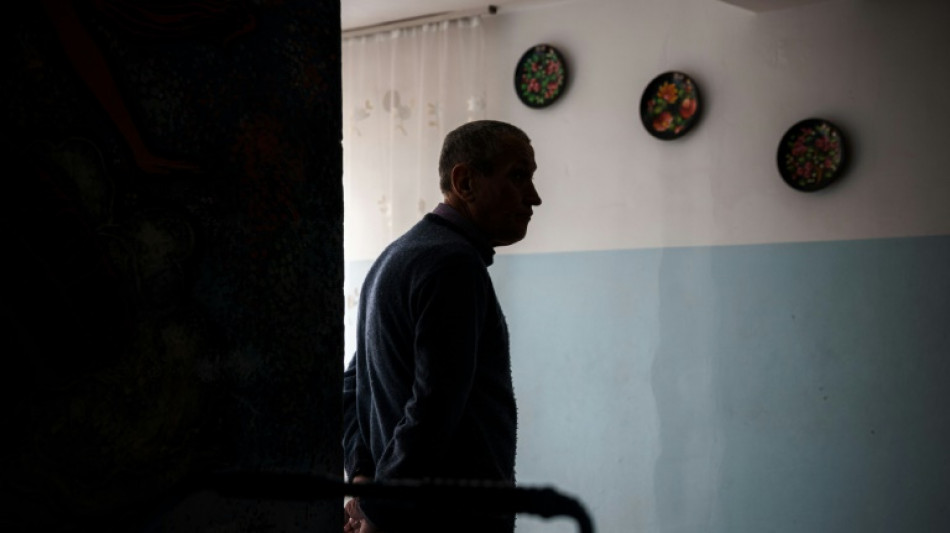
Kyiv psychiatric home puts brave face on war / Photo: ©

 Split loyalties for Indian football fans at Brazil friendly

 India-Pakistan blockbuster brings cricket fever to Japan baseball field

 Wong waiting on Rafa after winning Asian Games tennis gold
 With Russia next door and rising costs, Latvia goes to the polls

 Penalty hero rues empty seats as Games hosts Japan win football gold

 North Korea fires ballistic missile after Seoul's apology demand

 US regulator finds Boeing 737 MAX software bug 'not a safety concern'

 Ohtani 'managing' injuries as Dodgers launch MLB post-season

 Botched US execution leaves murderer unconscious on ventilator: lawyers
 Cornell rape case exposes sexual violence at US colleges

 France held by Italy in Zidane's homecoming after Olise stunner

 Ethiopian pro-government militia claims Tigray airport as regional tensions spike

 Ohtani shaking off injuries as Dodgers launch MLB post-season

 Sea levels to rise in California as coastal wave surges up west coast

 New rallies urged in France as protests disrupt over 730 schools

 Djokovic survives China Open scare, Sabalenka starts strong

 King Charles to evoke colonial 'darkest days' on Caribbean tour

 Tesla shares jump after global car sales top estimates

 DR Congo Ebola outbreak killed more than 4,000: official figures

 Djokovic survives China Open scare against wildcard world no. 104
 Lula, Bolsonaro trade blows in final scramble for votes in Brazil

 New clashes erupt as protests disrupt over 560 French schools

 NY governor vows to close loophole after alleged Cornell gang rape

 Ethiopia Tigray rebels pushed back as regional tensions spike

 Stocks rise, yields fall as US job numbers disappoint
Sometimes, when war makes the walls of her Kyiv psychiatric hospital shudder, head nurse Oksana Padalka hides so she can cry.
Then she forces herself to smile and gets back to the job of reassuring her patients that "everything is going well" for Ukraine.
"The first time, it was so powerful we all sat down. We're used to it now. We just hope we don't find ourselves in the path of some missile," she says.
War has descended on the north-western suburbs of Kyiv since Russian President Vladimir Putin invaded Ukraine on February 24, his forces edging closer towards the capital.
Every day now, heavy artillery smashes into Irpin and Bucha, just a few kilometres (miles) away from the asylum in Novo-Bilytsky and its 355 residents.
It's been another night of shelling. Viktor Juravski, head of this neuropsychiatric home for men, is as exhausted as his colleagues.
"The explosions were really very loud. And when the shooting starts, we just can't sleep at night," he says.
Half the pre-war 120 staff members have left. One of the nurses was from Bucha. Padalka "hasn't had news of her for two weeks".
Some evenings "I go to my room so my patients and colleagues can't see and just cry and cry," she says.
- 'We are their family' -
She can't show her emotions to "the boys" -- men whose families cannot care for them and who live, year-round, in the rectangular blocks of the hospital. The youngest is 18, the oldest over 80.
"If I take a couple of pills, I'm fine the next morning," she admits.
Then she can put on some make-up and face the patients, all smiles.
"If they see that we're calm, they think that everything is all right and that they'll be OK."
Some of the residents say they are frightened and others ask when the war is going to end.
"We put our arms round them. We tell them we are their family. We show that we're there for them, that everything is fine. That life is good."
Today it's quiet and peaceful in the library, with its polished wooden floor, soft rugs and decorations -- paintings and pottery mostly, made by the patients.
About a dozen men aged between 35 and 60 are silently playing chess, colouring or making things with modelling clay.
The staff do everything they can to stick to their routine and patients pitch in when they can.
- Abba, Boney M. -
"We still have electricity and food. Keeping to the daily routine reassures them," Juravski explains.
They also listen to music. Oleksyi "loves everything by Abba". Sergei prefers Boney M.
There are some changes, though.
The library is dotted with blue and yellow, the colours of the national flag.
And tonight, patients will go to bed "half dressed" so they can rush down to the spartan Soviet-era bunker in the basement if the bombing gets too intense.
That has happened "three or four times" already. Everyone was back in bed within the hour, Juravski says.
Strolls in the grounds have been cut back and the patients no longer have internet access.
"We don't want them to be upset by bad news or see something horrible," Padalka says.
The television, which some watch all day, is tuned to the Ukrainian public channel, a chirpy, somewhat grandiloquent mouthpiece of the resistance, promising victory against the Russian aggressor.
- 'Die for Ukraine' -
"Ukraine's going to win. Of course, it is," says Yura. The 40-something is studiously colouring in a little deer with red and orange crayons.
"We tell them what they want to hear -- that we're together, we're united and we're all in the same boat," head doctor Mikola Panassiuk explains.
"We are ready to die for Ukraine," one of the patients calls out to him. The doctor replies gently, "No, you should live for Ukraine."
Sometimes there are jokes about the war. Like when one of the residents takes two hardboiled eggs at lunchtime. "At least these don't belong to Putin yet!"
For the moment, the centre still has the essentials. But what if the power is cut off? Or the water? Or they find themselves trapped on the frontline?
Juravski winces. "We don't even have a generator," he trails off.
Patients wander up and down the corridor or gaze, silently, out of the window.
"Sometimes we have patients who are seriously ill," one doctor explains. Some are kept in padded cells, stripped of all potentially harmful objects.
Then he grins wryly: "I tell you what, if Putin showed up here, we'd lock him away on the spot."
J.Horn--BTB


