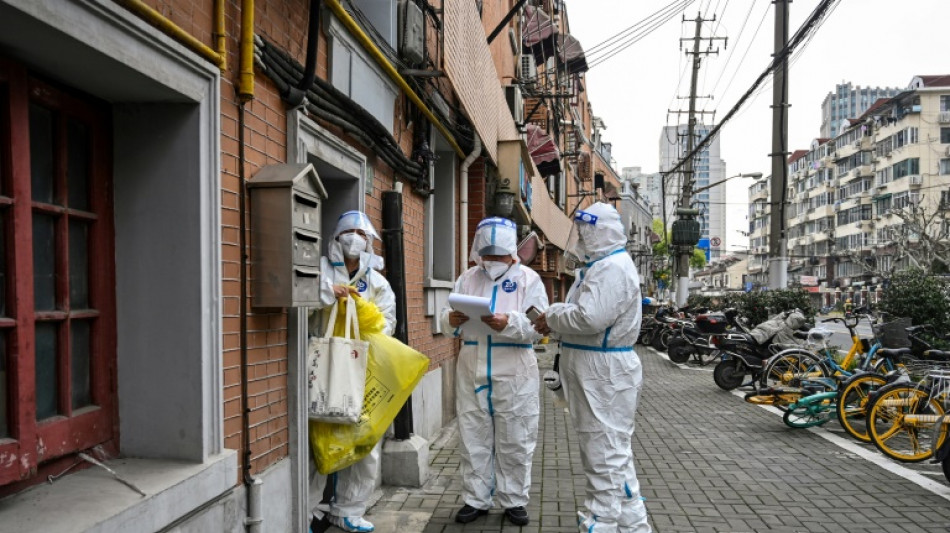
Shanghai to lock down in phases to rein in Covid-19 outbreak / Photo: ©

 Split loyalties for Indian football fans at Brazil friendly

 India-Pakistan blockbuster brings cricket fever to Japan baseball field

 Wong waiting on Rafa after winning Asian Games tennis gold

 With Russia next door and rising costs, Latvia goes to the polls

 Penalty hero rues empty seats as Games hosts Japan win football gold

 North Korea fires ballistic missile after Seoul's apology demand

 US regulator finds Boeing 737 MAX software bug 'not a safety concern'

 Ohtani 'managing' injuries as Dodgers launch MLB post-season

 Botched US execution leaves murderer unconscious on ventilator: lawyers
 Cornell rape case exposes sexual violence at US colleges

 France held by Italy in Zidane's homecoming after Olise stunner

 Ethiopian pro-government militia claims Tigray airport as regional tensions spike

 Ohtani shaking off injuries as Dodgers launch MLB post-season

 Sea levels to rise in California as coastal wave surges up west coast

 New rallies urged in France as protests disrupt over 730 schools

 Djokovic survives China Open scare, Sabalenka starts strong

 King Charles to evoke colonial 'darkest days' on Caribbean tour

 Tesla shares jump after global car sales top estimates

 DR Congo Ebola outbreak killed more than 4,000: official figures

 Djokovic survives China Open scare against wildcard world no. 104

 Lula, Bolsonaro trade blows in final scramble for votes in Brazil

 New clashes erupt as protests disrupt over 560 French schools

 NY governor vows to close loophole after alleged Cornell gang rape

 Ethiopia Tigray rebels pushed back as regional tensions spike

 Stocks rise, yields fall as US job numbers disappoint

Shanghai will launch a phased lockdown to curb an Omicron-fuelled Covid-19 outbreak that has hit China with its highest caseloads since the early days of the pandemic, the city government said Sunday.
China's biggest city will lock down its eastern half from Monday until Friday, officials said, followed by a similar lockdown of its western side beginning on April 1.
The metropolis of 25 million has in recent days become the leading hotspot in a nationwide outbreak that began to gain pace in early March.
Although recent case numbers remain insignificant in a global context, they are China's highest since the first weeks of the pandemic, which first emerged in the city of Wuhan in late 2019.
China's National Health Commission on Sunday reported more than 4,500 new domestically transmitted cases, down by more than 1,000 from the previous day but still far higher than the double-digit daily tallies usually seen over the past two years.
Millions of residents in affected areas across the country have been subjected to citywide lockdowns.
Shanghai, however, had thus far avoided a full lockdown, with officials saying it was imperative to keep the eastern Chinese port and financial hub running, for the good of both the national and global economies.
But with case counts climbing, the city government said in a public notice that the two-part lockdown was being implemented "to curb the spread of the epidemic, ensure the safety and health of the people" and root out cases of infection "as soon as possible".
The city's sprawling eastern half, known as Pudong, which includes the main international airport and financial district, would be locked down for testing beginning Monday morning and ending April 1.
On April 1, the city's western half, known as Puxi and featuring the historic Bund riverfront, will lock down until April 5, the government added.
Residents were told to stay indoors during the lockdowns, and all business employees and government personnel not involved in the supply of essential services were advised to work from home.
Those involved with providing vital services such as gas, electricity, transport, sanitation and the supply of food would be exempt from the stay-at-home order.
The announcement said buses, taxis and the city's extensive subway system would cease operations, but made no mention of activity at its massive port, or any impact on air travel or rail service in and out of Shanghai.
On Saturday, a member of the city's pandemic task force had vowed Shanghai would not shut down.
"If Shanghai, this city of ours, came to a complete halt, there would be many international cargo ships floating in the East China Sea," said Wu Fan, a medical expert on the task force, during a daily virus press briefing held by the city government.
"This would impact the entire national economy and the global economy."
China's government had previously kept the virus under control nationally through strict zero-tolerance measures including mass lockdowns of entire cities and provinces for even small numbers of cases.
But authorities have watched nervously as a deadly Hong Kong Omicron surge sparked panic buying and claimed a high toll of unvaccinated elderly in the southern Chinese city.
The variant's subsequent spread in mainland China has posed a dilemma for authorities wrestling with how forcefully to respond, with the zero-tolerance approach increasingly being questioned amid concerns over the economic impact and public "pandemic fatigue", especially considering Omicron's less severe symptoms.
Shanghai had sought to ease disruption with a targeted approach to the current outbreak marked by rolling 48-hour lockdowns of individual neighbourhoods combined with large-scale testing, but otherwise keeping the city running.
But the softer strategy has so far failed to dampen city case counts, and the localised lockdowns have provoked grumbling online and a run on groceries in some districts.
L.Janezki--BTB