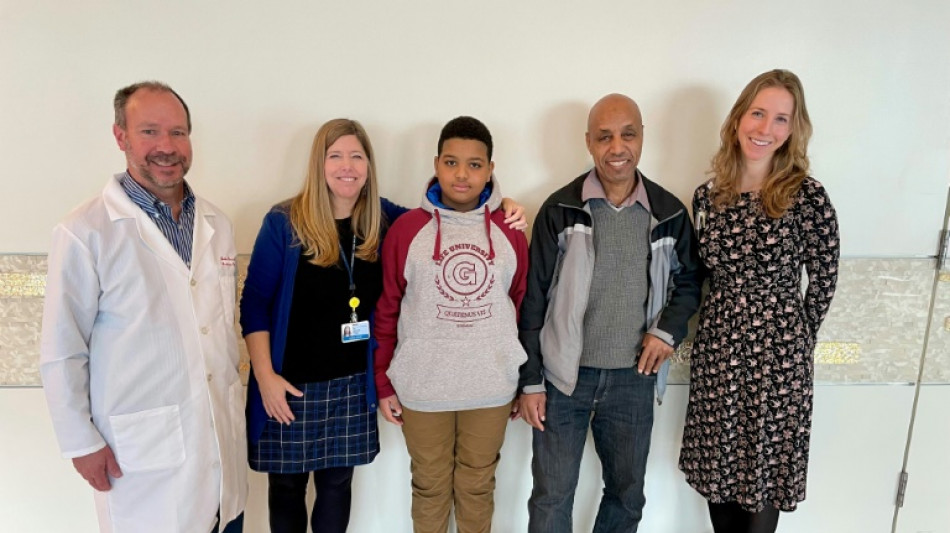
Deaf boy can now hear after breakthrough gene treatment / Photo: © Children's Hospital of Philadelphia/AFP

 Asian Games set to close after records, rancour and rain

 Cry for help as French-Swiss lake dries up

 Sabalenka swept out of China Open in third round

 US urges 'restraint' as Ethiopia's Tigray crisis rocks region

 Teens on target again as USA down Mexico 3-0

 World records prove Asian Games were a hit, says top official

 US prison chief who oversaw botched execution resigns

 'Chaotic' Asian Games threaten Japan hopes of hosting Olympics again

 Finnish town braces for change from Google data centres

 What is fuelling French school protests?

 Without lawyers, migrant children face deportation from the US

 Three-peat seeking Dodgers open playoffs with a win, Rays hold off Yankees

 Brazil votes in nail-biter polls closely watched by Trump

 'Just be you': Kim reveals Tiger text that inspired him to gold

 Myanmar migrants returned to war-torn nation from Malaysia

 ALEX BODI AND AMBASSADOR GUM DOMINIC MATIOK OF THE REPUBLIC OF SOUTH SUDAN MEET IN BERLIN TO DISCUSS THE POSSIBILITY OF AN HONORARY CONSULATE IN BUCHAREST

 Lula, Bolsonaro wrap up campaigns ahead of Brazil's knife-edge vote

 Toulouse edge Castres in Top 14 derby

 Murakami homer propels White Sox to MLB playoff win over Guardians

 Israel targets top Hamas leader in deadly Gaza strike on anniversary

 Houthis say struck oil facility near Riyadh, as Saudis hit Sanaa

 AI needs safety layers like nuclear plants: ex-OpenAI engineer

 MVP Judge will miss Yankees' MLB playoff series against Rays

 New lizard species discovered in Peru

 Fernandes hails Portugal's 'greatest symbol' Ronaldo, calls for unity

His father's voice, the sounds of passing cars and scissors clipping his hair: An 11-year-old boy is hearing for the first time in his life after receiving a breakthrough gene therapy.
The Children's Hospital of Philadelphia (CHOP) which carried out the treatment -- a first in the United States -- said in a statement Tuesday the milestone represents hope for patients around the world with hearing loss caused by genetic mutations.
Aissam Dam was born "profoundly deaf" because of a highly rare abnormality in a single gene.
"Gene therapy for hearing loss is something that we physicians and scientists in the world of hearing loss have been working toward for over 20 years, and it is finally here," said surgeon John Germiller, director of clinical research for CHOP's otolaryngology division.
"While the gene therapy we performed in our patient was to correct an abnormality in one, very rare gene, these studies may open the door for future use for some of the over 150 other genes that cause childhood hearing loss."
In patients like Aissam, a defective gene prevents the production of otoferlin, a protein necessary for the "hair cells" of the inner ear to be able to convert sound vibrations into chemical signals that are sent to the brain. Otoferlin gene defects are highly rare, accounting for 1 - 8 percent of hearing loss present from birth.
On October 4, 2023, he underwent a surgical procedure that involved partly lifting his eardrum and then injecting a harmless virus, which had been modified to transport working copies of the otoferlin gene, into the internal fluid of his cochlea. As a result, the hair cells began making the missing protein and functioning properly.
Almost four months since receiving the treatment in one ear, Aissam's hearing has improved to the point he only has mild-to-moderate hearing loss and he is "literally hearing sound for the first time in his life," said the statement.
The New York Times reported that despite being able to hear, Aissam, who was born in Morocco and later moved to Spain, may never learn to talk, as the brain's window for acquiring speech closes around the age of five. The US Food and Drug Administration, which greenlighted the study, wanted to start the research on older children first, for safety reasons.
The trial, sponsored by Akouos, Inc, a wholly owned subsidiary of Eli Lilly and Company, is one of several underway or about to start in the United States, Europe and China, where a handful of other children have already been reportedly cured.
"As more patients at different ages are treated with this gene therapy, researchers will learn more about the degree to which hearing is improved and whether that level of hearing can be sustained over many years," Germiller said.
O.Lorenz--BTB