'Game changer': Gene therapy offers hope for children born deaf / Photo: © Children's Hospital of Philadelphia/AFP/File

 Asian Games set to close after records, rancour and rain

 Cry for help as French-Swiss lake dries up

 Sabalenka swept out of China Open in third round

 US urges 'restraint' as Ethiopia's Tigray crisis rocks region

 Teens on target again as USA down Mexico 3-0

 World records prove Asian Games were a hit, says top official

 US prison chief who oversaw botched execution resigns

 'Chaotic' Asian Games threaten Japan hopes of hosting Olympics again

 Finnish town braces for change from Google data centres

 What is fuelling French school protests?

 Without lawyers, migrant children face deportation from the US

 Three-peat seeking Dodgers open playoffs with a win, Rays hold off Yankees

 Brazil votes in nail-biter polls closely watched by Trump

 'Just be you': Kim reveals Tiger text that inspired him to gold

 Myanmar migrants returned to war-torn nation from Malaysia

 ALEX BODI AND AMBASSADOR GUM DOMINIC MATIOK OF THE REPUBLIC OF SOUTH SUDAN MEET IN BERLIN TO DISCUSS THE POSSIBILITY OF AN HONORARY CONSULATE IN BUCHAREST

 Lula, Bolsonaro wrap up campaigns ahead of Brazil's knife-edge vote

 Toulouse edge Castres in Top 14 derby

 Murakami homer propels White Sox to MLB playoff win over Guardians

 Israel targets top Hamas leader in deadly Gaza strike on anniversary

 Houthis say struck oil facility near Riyadh, as Saudis hit Sanaa

 AI needs safety layers like nuclear plants: ex-OpenAI engineer

 MVP Judge will miss Yankees' MLB playoff series against Rays

 New lizard species discovered in Peru

 Fernandes hails Portugal's 'greatest symbol' Ronaldo, calls for unity

A gene therapy that has allowed several children born deaf to hear for the first time is being hailed as a "game changer" that raises hopes of the first new treatment for hereditary deafness in decades.
Several medical teams around the world are trialling the procedure, which focuses on a rare genetic mutation that affects only a small number of the 26 million people with congenital deafness globally.
But several success stories announced this week are already being seen as a turning point.
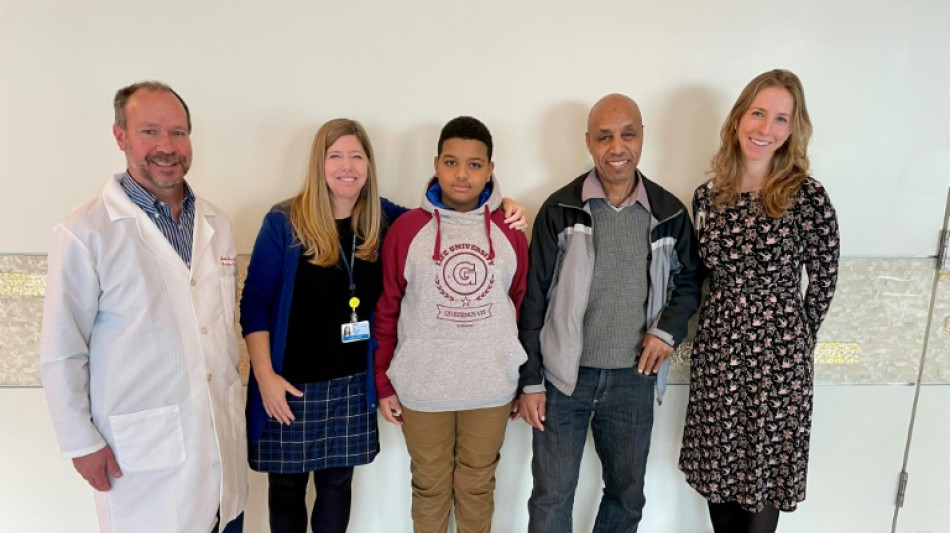
On Tuesday, the Children's Hospital of Philadelphia revealed that 11-year-old Aissam Dam, who was born deaf, was now "literally hearing sound for the first time in his life".
Aissam still has mild-to-moderate hearing loss, and may never learn to talk because the brain's window for acquiring speech closes around the age of five.
But a trial in China, the results of which were announced in The Lancet journal on Thursday, tested a similar treatment on six younger children.
Five gained the ability to hear, according to the findings of the trial that started in 2022, making it the first to have tested the gene therapy on humans.
Some of the children were already able to speak thanks to a cochlear implant -- which they now no longer need, study co-author Zheng-Yi Chen of the Massachusetts Eye and Ear hospital told AFP.
But one, a baby only a year old, had never been able to communicate verbally, Chen said.
Chen said that after the treatment, when the mother asked the baby "who am I?", the baby responded: "Mama."
When asked what a chicken sounds like, the baby responded: "Coo-coo."
"Everyone just cried with joy, it's really amazing," said Chen, adding that the baby was expected to grow up speaking normally.
Not since cochlear implants were invented 60 years has there been such an advance, Chen said, adding that the therapy "symbolises a new era in the fight against all types of hearing loss".
- How does it work? -
For now, the trials in China, the United States and another announced in France this week all use a similar technique to focus on people born with a mutation of the OTOF gene.
This defect means they can no longer produce the protein otoferlin, which is needed for hair cells in the inner ear to convert sound vibrations into electrical signals that can be sent to the brain.
The treatment involves injecting a harmless virus into the inner ear that smuggles in a working version of the OTOF gene, restoring hearing.
The French trial will focus on babies aged 12-31 months, in the hopes it can "enable the acquisition of language", said Nawal Ouzren, CEO of the firm Sensorion developing the treatment.
Natalie Loundon, a French doctor and hearing loss expert, called the technique "a game-changer, a technological advance that will revolutionise therapeutic care".
"The idea is to be able to offer this treatment to children rather than an implant, which is not always received well," she told AFP.
For the China-based trial, the researchers will continue to study the participants to find out if their improved hearing lasts.
Chen estimated that the treatment tested in that trial could be ready to apply for regulatory approval within three to five years.
- Targeting the other genes -
But this particular treatment will only help a fraction of those born deaf.
Around one in every 1,000 children are born deaf due to gene defects, but a lack of otoferlin is the cause of only around three percent of those cases.
More than 150 other genes have been discovered that trigger genetic hearing loss.
But Chen had some good news.
So far, the otoferlin treatment seems to work just as well in humans as it did in during trials on mice -- which is not always the case for such research.
Trials on mice targeting other gene defects that cause hearing loss have also been successful, Chen said.
Researchers therefore hope this first treatment opens the door to others.
France's Pasteur Institute, which pioneered the research on otoferlin, and Sensorion are already working on another therapy that focuses on a gene whose mutations are responsible for the most common forms of hereditary deafness.
O.Lorenz--BTB