The suffering of those who cannot feel pain / Photo: ©

 'Glad it's over': Kim powers to Games gold and military exemption

 After 11 World Cups, football finally comes home for one Indian fan
 Marc Marquez wins sprint at Japan MotoGP, Martin grabs pole

 Alcaraz fends off Arnaldi to reach Japan Open quarters

 Antonelli tops times in final practice at Bahrain GP

 Gauff digs deep to beat Osorio in China Open second round

 Fresh protests to hit Spain after housing measures defeated

 'He's here with me': Japan cycle queen dedicates gold to late brother

 Japan Olympic chief says 'lot more' athletes at Games than expected

 Asian carmakers besting US rivals at home, China poised to strike

 Widgets & Web Offers All-Inclusive Investor Relations Websites for Public Companies, IPOs and SPACs

 Adams named new US captain to 2030 World Cup

 China a better influence in Latin America than US: poll

 Judge pauses construction of border project in Texas national park

 Belgium's De Bruyne fires double to sink Turkey, France held by Italy
 US jobs data boosts stocks as oil prices dip

 US Supreme Court to hear high-stakes climate case

 Trump expected to name intel chief Clayton as AI czar: reports

 Argentina unveils passports-for-investment scheme

 Brazil election debate chaos sparks censorship row

 England's Carse charged by cricket body over nightclub incident

 Amazon vows $1 bn for data center towns, decries 'myths'
 Oil prices drop on G7 fuel release, US jobs data boosts stocks

 G7 agrees deal to ease global energy supply concerns

 Spain's government dealt blow as lawmakers reject housing bills

Patrice Abela first knew something was wrong when his eldest daughter was learning to walk and her feet left trails of blood behind her, yet she showed no sign of distress.
She was soon diagnosed with congenital insensitivity to pain, an extremely rare and dangerous genetic disorder that dooms sufferers to a lifetime of hurting themselves in ways they cannot feel.
Abela, a 55-year-old software developer in the southern French city of Toulouse, then watched in horror as his youngest daughter was revealed to have the same condition.
Now aged 12 and 13, the two girls spend around three months of every year in hospital.
"When they take a shower, they perceive hot and cold, but if it burns they don't feel anything," the father of four told AFP.
"Due to repeated infections, my eldest daughter lost the first joint of each of her fingers. She also had to have a toe amputated."
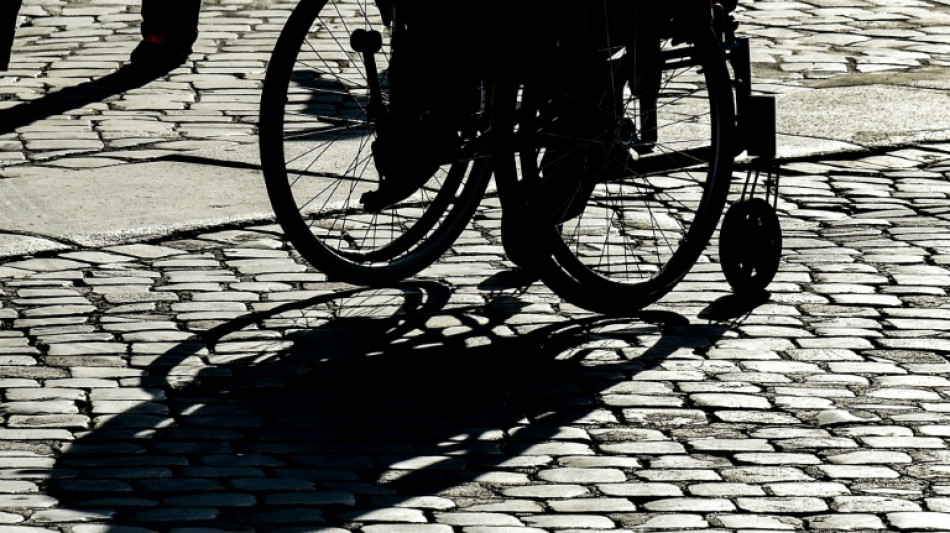
Repeated knee injuries have left both girls only able to move around using crutches or a wheelchair.
Abela said they may not feel physical pain but lamented their intense "psychological pain".
Aiming to raise awareness about the disease and "challenge the scientific community", Abela plans to run the equivalent of 90 marathons in fewer than four months. He plans to start on April 12, following the route of this year's Tour de France from Copenhagen to Paris.
- Danger everywhere -
A life without pain might sound like a dream come true but the reality is more like a nightmare.
There are only a few thousand known cases of the condition worldwide. The low number is believed to be partly due to sufferers often not living into adulthood.
"Pain plays a major physiological role in protecting us from the dangers of our environment," said Didier Bouhassira, a doctor at the centre for pain evaluation and treatment at Ambroise-Pare hospital in Paris.
In the most extreme cases, babies will "mutilate their tongue or fingers while teething", he told AFP.
Then comes "a lot of accidents, burns, walking on fractured limbs which heal badly", he added.
"They have to be taught what is innate in others: to protect themselves."
But when there are no warning signs, danger lurks everywhere.
Appendicitis, which announces itself in others via symptoms like pain and fever, can fester into a devastating general infection of the abdomen.
"Blindness can also occur because the eye must always be kept moist and the nervous system controls these processes via the so-called blink reflex," said Ingo Kurth of Germany's Institute of Human Genetics.
- New painkiller hopes -
Congenital insensitivity to pain (CIP) was first recognised in the 1930s, and numerous studies have since identified a genetic mutation that blocks a person's ability feel pain.
"We have learned that there are now more than 20 genetic causes of congenital or progressive insensitivity to pain," Kurth told AFP.
There is no cure and "no real drug breakthroughs have been made so far", Kurth said.
"But our understanding of the molecular causes of CIP continues to reveal new targets, and based on this, hopefully new therapies will be developed in the coming years."
There are also hopes that studying how CIP works could lead to the development of a new kind of painkiller, prompting huge interest from pharmaceutical giants seeking a fresh product in the billion-dollar industry of pain relief.
In this way, the unlucky few with CIP could contribute to the creation of a treatment that would help everyone in the world -- except themselves.
L.Dubois--BTB