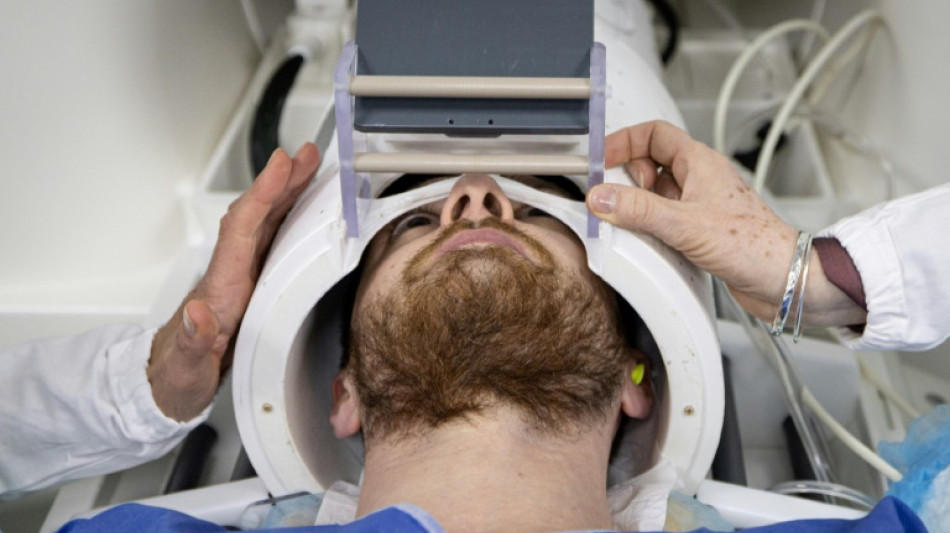
Low-cost MRI paired with AI produces high-quality results / Photo: © AFP/File

 Latvian partial election results suggest pro-European choice

 In Egypt's Sinai, Gazan builds school for children displaced by war

 Trump tariffs a mixed bag for US auto industry

 Yemen government forces say struck Houthi targets

 Music links past, present for Pedro Pascal's cellist in 'Behemoth!'

 ALEX BODI ȘI AMBASADORUL REPUBLICII SUDANUL DE SUD, GUM DOMINIC MATIOK, DISCUTĂ LA BERLIN DESPRE POSIBILITATEA ÎNFIINȚĂRII UNUI CONSULAT ONORIFIC LA BUCUREȘTI
 Dodgers step up World Series three-peat bid with 5-3 win over Braves

 Spain break down Czechs as England outclass Croatia in Nations League

 Yamal on target as Spain hold off Czech Republic

 Latvian exit polls suggest pro-European choice

 Lula, Bolsonaro wrap up campaigns ahead of knife-edge election

 Tuchel hails 'complete' England after Croatia demolition

 Fury to invite Trump to lead ring walk before Joshua showdown

 Fashion industry in 'precarious moment', says Vivienne Westwood supremo

 Seventh heaven for England in Nations League rout of Croatia

 Storms, flooding cause chaos on Greek holiday island of Crete

 #IAmJaneDoe: online support campaign in US university rape case

 Brazil shine on Selecao's first visit to India

 Zverev sets up Djokovic quarter-final at China Open, Rybakina out

 Happier at home, Bordeaux hammer Lyon in Top 14

 Lula, Bolsonaro in final push for votes ahead of knife-edge election

 Boisterous fashion week barnstorms 'sleepy' Nigerian capital

 UAE investigators say flydubai co-pilot was planning 'terrorist act'

 Rahul smacks century in India v Windies ODI

 Daryz seeks to join exclusive club of dual Arc winners

A magnetic resonance imaging device built with off-the-shelf parts and paired with AI matched the performance of high-end MRI machines, according to a study published Thursday that could pave the way for greater access to the life-saving tools.
First introduced five decades ago, MRI scanners are now a cornerstone of modern medicine, vital for diagnosing a wide range of conditions -- including strokes, tumors, and spinal conditions -- while avoiding exposing patients to radiation.
But they remain hard to come by in developing countries: Africa has less than one MRI machine per million people, while the figures in the United States and Japan are 40 and 55 per million, respectively.
To tackle the problem, Yujiao Zhao and colleagues at the University of Hong Kong built a simplified, low-powered MRI machine using store-bought hardware that cost around $22,000, and published their findings in the prestigious journal Science.
MRI uses a strong magnetic field and radio waves to align and manipulate the body's hydrogen atoms, producing detailed images of internal structures and organs.
The strength of magnets is measured in units called teslas (T), with conventional MRIs requiring powerful electromagnets that have wires bathed in supercooled liquid helium to generate magnetic fields of 1.5T to 7T.
These machines demand high electricity inputs, far exceeding what standard wall outlets can provide, and must be housed in radio frequency-shielded rooms to prevent equipment interference. Current clinical use MRIs cost upwards of million dollars.
By contrast, the Hong Kong research team's full body MRI machine used a helium-free 0.05T magnet and required just 1800 watts -- comparable to a hair dryer, meaning it could use a standard socket. What's more, it did not require radio shielding.
To compensate for the reduced image detail and higher levels of radio interference, the researchers integrated their system with a deep learning algorithm trained on a vast dataset of high-resolution images of human anatomical structures.
They then tested their machine on 30 healthy adult volunteers, performing scans over their bodies from their brains down to their knees.
The results from their so-called "ultra low field" MRI were found to be on par with conventional MRI scanners 60 times more powerful.
"These advances pave the way for affordable, patient centric, and deep learning–powered ULF MRI scanners, addressing unmet clinical needs in diverse healthcare settings worldwide," Zhao and colleagues wrote.
In an accompanying comment piece, researchers Udunna Anazodo and Stefan du Plessis wrote the approach was "promising" but added several challenges needed to be addressed before it can be widely applied.
"Concerted effort must be taken to develop the skills needed to ensure local production and maintenance of these devices and their proper use," in countries with low resources, they said. Radiologists would also need to be retrained to appropriately interpret the images.
B.Shevchenko--BTB