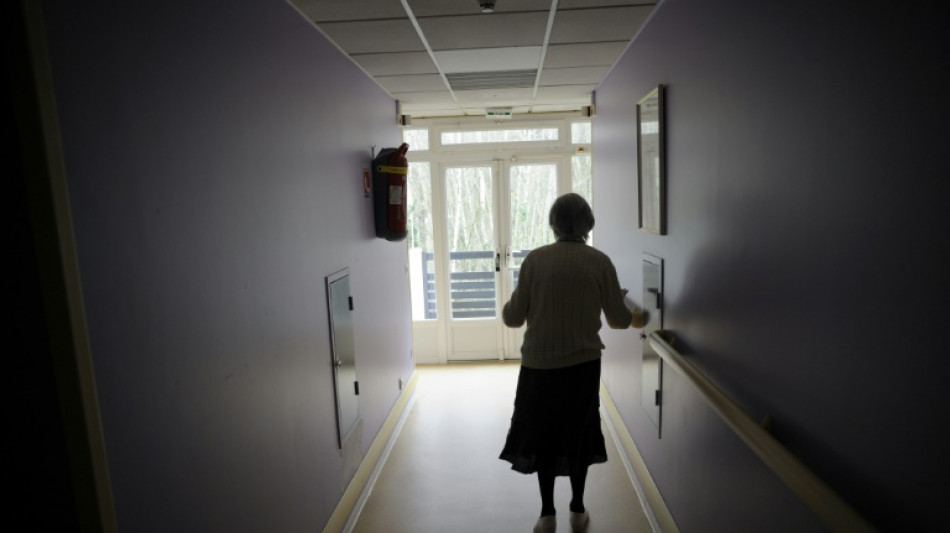
Many dementia cases could be prevented, but far from all: study / Photo: © AFP/File

 ALEX BODI AND AMBASSADOR GUM DOMINIC MATIOK OF THE REPUBLIC OF SOUTH SUDAN MEET IN BERLIN TO DISCUSS THE POSSIBILITY OF AN HONORARY CONSULATE IN BUCHAREST

 Lula, Bolsonaro wrap up campaigns ahead of Brazil's knife-edge vote

 Toulouse edge Castres in Top 14 derby

 Murakami homer propels White Sox to MLB playoff win over Guardians

 Israel targets top Hamas leader in deadly Gaza strike on anniversary

 Houthis say struck oil facility near Riyadh, as Saudis hit Sanaa

 AI needs safety layers like nuclear plants: ex-OpenAI engineer

 MVP Judge will miss Yankees' MLB playoff series against Rays

 New lizard species discovered in Peru

 Fernandes hails Portugal's 'greatest symbol' Ronaldo, calls for unity

 Grandidier-Nkanang double takes Pau to Top 14 summit despite Vannes fightback
 Trainer Scott gets perfect Arc boost with top notch double

 Ex-PM says Putin cannot admit 'mistake' over Ukraine

 Houthis say Saudi Arabia launches dozens of strikes on Yemen capital

 Qatar and Abu Dhabi F1 Grand Prix to go ahead - F1 boss

 South Korea lift gloom with smash-and-grab Games football gold

 Ireland news conference before Israel game cut short amid tensions

 Protests over housing flare in Spain after relief measures rejected

 Zverev thrashes Shang to set up Djokovic quarter-final at China Open

 Turkey football ref chief jailed pending trial for graft

 North Korea says test of intermediate-range strategic missile included use of AI

 Rampant Sayers leads Hong Kong to third men's rugby gold in a row

 Ethiopia's Tigray rebels abandon regional capital as govt advances

 Bulgaria's Tsar Samuel returns 'home' after 1,000 years

 'Glad it's over': Kim powers to Games gold and military exemption

Millions of cases of dementia could be prevented or delayed by reducing a range of risk factors such as smoking or air pollution, according to a major new study, though outside experts warn that such measures can only go so far.
The debilitating condition, which progressively robs people of their memories, cognitive abilities, language and independence, currently affects more than 55 million people across the world.
Dementia is caused by a range of diseases, the most common of which is Alzheimer's.
A huge review of the available evidence published in The Lancet journal on Wednesday said that the "potential for prevention is high" in the fight against dementia.
The study follows a previous report in 2020 that also emphasised the importance of prevention.
At the time, the international team of researchers estimated that 40 percent of dementia cases were linked to 12 risk factors.
The factors included people having a lower level of education, hearing problems, high blood pressure, smoking, obesity, depression, physical inactivity, diabetes, excessive drinking, traumatic brain injury, air pollution and social isolation.
The latest update adds two more risk factors: vision loss and high cholesterol.
"Nearly half of dementias could theoretically be prevented by eliminating these 14 risk factors," the study said.
- EU turns down new drug -
Decades of research and billions of dollars have failed to produce a cure or truly effective drug for dementia.
But since the start of last year, two Alzheimer's treatments have been approved in the United States: Biogen's lecanemab and Eli Lilly's donanemab.
They work by targeting the build-up of two proteins -- tau and amyloid beta -- considered to be one of the main ways the disease progresses.
However, the benefits of the drugs remain modest, they have severe side effects, and they are often very expensive.
In contrast to the US, the European Union's medicine watchdog last week refused to approve lecanemab, and it is still considering donanemab.
Some researchers hope the fact that the new drugs work at all means they will pave the way for more effective treatments in the future.
Others prefer to focus on ways to prevent dementia in the first place.
Masud Husain, a neurologist at the UK's University of Oxford, said that focusing on risk factors "would be far more cost effective than developing high-tech treatments which so far have been disappointing in their impacts on people with established dementia".
- 'How much more could we do?' -
The Lancet study was welcomed by experts in the field, among whom the importance of prevention is hardly debatable.
However, some said the idea that nearly half of all dementia cases could be prevented should be put in perspective.
It has not been proven that the risk factors directly cause dementia, as the authors of the study acknowledged.
For example, could it be dementia that is causing depression, rather than the other way around?
It is also difficult to separate the risk factors from each other, though the researchers tried.
Some could be intrinsically linked, such as depression and isolation, or smoking and high blood pressure.
Above all, many of the risk factors are societal scourges that have long proven near impossible to fully address.
The study lays out different recommendations ranging from the personal -- such as wearing a helmet while cycling -- to governmental, such as improving access to education.
"It is not clear whether we could ever completely eliminate any of these risk factors," Charles Marshall, a neurologist at Queen Mary University of London, told AFP.
"We already have public health programmes to reduce smoking and hypertension (high blood pressure), so how much more could we do?"
Tara Spires-Jones, a neuroscientist at the University of Edinburgh, said it was important that "we do not blame people living with dementia for their brain disease".
That is because "it is clear that a large portion of dementias could not be prevented due to genes and things beyond people's control, like opportunities for education as children", she added.
G.Schulte--BTB