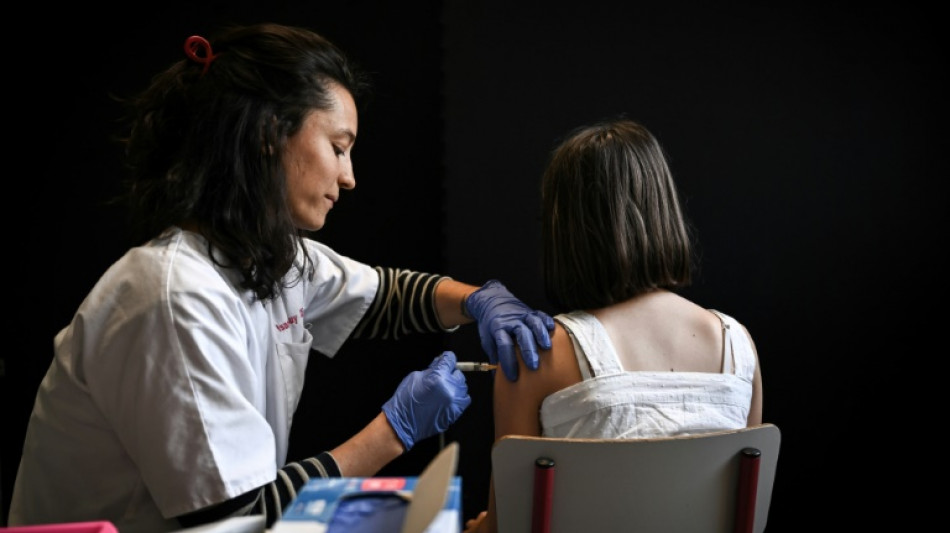
US study highlights success story of HPV vaccination / Photo: © AFP/File

 #IAmJaneDoe: online support campaign in US university rape case

 Brazil shine on Selecao's first visit to India

 Zverev sets up Djokovic quarter-final at China Open, Rybakina out

 Happier at home, Bordeaux hammer Lyon in Top 14

 Lula, Bolsonaro in final push for votes ahead of knife-edge election

 Boisterous fashion week barnstorms 'sleepy' Nigerian capital

 UAE investigators say flydubai co-pilot was planning 'terrorist act'

 Rahul smacks century in India v Windies ODI

 Daryz seeks to join exclusive club of dual Arc winners

 Russia warns diplomats to leave Kyiv over new strikes threat
 Olympic champ Zheng rebukes rowdy home crowd at China Open

 World No.1 Sinner pulls out of Shanghai Masters to delay return

 Red Bull's Verstappen grabs pole position for Bahrain GP

 India beat Pakistan in blockbuster as golfer Kim wins 'crazy' gold

 India beat arch-rivals Pakistan to win Asian Games cricket gold

 Ethiopia's Tigray rebels abandon regional capital as govt advances: journalist

 Tom Kim powers to Games gold and exemption from military service

 Split loyalties for Indian football fans at Brazil friendly

 India-Pakistan blockbuster brings cricket fever to Japan baseball field

 Wong waiting on Rafa after winning Asian Games tennis gold

 With Russia next door and rising costs, Latvia goes to the polls

 Penalty hero rues empty seats as Games hosts Japan win football gold

 North Korea fires ballistic missile after Seoul's apology demand

 US regulator finds Boeing 737 MAX software bug 'not a safety concern'

 Ohtani 'managing' injuries as Dodgers launch MLB post-season

A new study published Thursday by researchers at the US Centers for Disease Control and Prevention (CDC) highlights the powerful impact of the human papillomavirus (HPV) vaccine, first approved in 2006, in preventing precancerous lesions detected through cervical screening.
HPV is the most common sexually transmitted infection, and certain strains can lead to cervical, vulvar, vaginal, and other cancers later in life. Each year, around 14 million Americans contract HPV, and the virus is responsible for approximately 10,800 cases of cervical cancer annually.
Since 2008, the CDC's Human Papillomavirus Vaccine Impact Monitoring Project has tracked trends in precancerous cervical lesions to evaluate the vaccine's effectiveness.
The findings are striking. Among women aged 20–24 screened for cervical cancer between 2008 and 2022, rates of moderate-to-high-risk precancerous lesions dropped by about 80 percent.
For women aged 25–29, the decline was 37 percent -- a smaller reduction the researchers attributed to many in this age group receiving the vaccine later in life as part of a "catch-up" vaccination effort, which is less effective.
In the US, the HPV vaccine was first approved in 2006 for girls and women, with boys and men added to the recommendations in 2011. Today, the CDC recommends routine HPV vaccination for boys and girls ages 11–12 to prevent infections that can lead to cancer later in life.
HPV includes over 200 different strains, some of which cause genital warts. Two particular strains -- 16 and 18 -- are classified as high-risk for cancer.
While cervical cancer is treatable if caught early, it is still responsible for around 4,400 US deaths per year.
The US Preventive Services Task Force recommends women ages 21 to 65 receive a Pap smear test once every three years and that women over 30 get high-risk HPV test every five years.
"The data are consistent with a considerable impact from the US HPV vaccination program on cervical precancers, with the largest decreases in the youngest age group for which benefit of vaccination would first be observed," wrote the authors in the CDC's Morbidity and Mortality Weekly Report.
They added that as vaccinated women age, further declines in cervical precancers are expected in older groups.
One limitation of the study was that individual vaccination status was not recorded, meaning the study could not directly confirm causality. However, the authors noted that "no other plausible explanations" have been identified for the sharp decline in precancers.
The study's positive findings come as outspoken anti-vaccine advocate Robert F. Kennedy Jr. begins his tenure as US health secretary.
Under his leadership, the Food and Drug Administration abruptly canceled a scheduled meeting with experts on Wednesday to discuss the development of next year's flu vaccines.
J.Horn--BTB