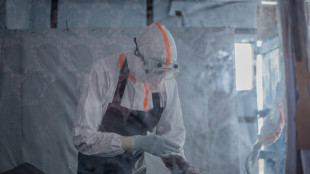
Ebola-infected monkeys cured with a pill, raising hopes for humans: study / Photo: © AFP/File

 #IAmJaneDoe: online support campaign in US university rape case

 Brazil shine on Selecao's first visit to India

 Zverev sets up Djokovic quarter-final at China Open, Rybakina out
 Happier at home, Bordeaux hammer Lyon in Top 14

 Lula, Bolsonaro in final push for votes ahead of knife-edge election

 Boisterous fashion week barnstorms 'sleepy' Nigerian capital

 UAE investigators say flydubai co-pilot was planning 'terrorist act'

 Rahul smacks century in India v Windies ODI

 Daryz seeks to join exclusive club of dual Arc winners
 Russia warns diplomats to leave Kyiv over new strikes threat

 Olympic champ Zheng rebukes rowdy home crowd at China Open

 World No.1 Sinner pulls out of Shanghai Masters to delay return

 Red Bull's Verstappen grabs pole position for Bahrain GP

 India beat Pakistan in blockbuster as golfer Kim wins 'crazy' gold

 India beat arch-rivals Pakistan to win Asian Games cricket gold

 Ethiopia's Tigray rebels abandon regional capital as govt advances: journalist

 Tom Kim powers to Games gold and exemption from military service

 Split loyalties for Indian football fans at Brazil friendly

 India-Pakistan blockbuster brings cricket fever to Japan baseball field

 Wong waiting on Rafa after winning Asian Games tennis gold

 With Russia next door and rising costs, Latvia goes to the polls

 Penalty hero rues empty seats as Games hosts Japan win football gold

 North Korea fires ballistic missile after Seoul's apology demand

 US regulator finds Boeing 737 MAX software bug 'not a safety concern'

 Ohtani 'managing' injuries as Dodgers launch MLB post-season

Monkeys infected with Ebola can be cured with a pill, according to a new study out Friday that could pave the way for more practical, affordable treatments in humans.
First identified in 1976 and thought to have crossed over from bats, Ebola is a deadly viral disease spread through direct contact with bodily fluids, causing severe bleeding and organ failure.
Because outbreaks primarily affect sub-Saharan Africa, pharmaceutical companies have lacked financial incentives to develop treatments, and the sporadic nature of outbreaks has made clinical trials difficult.
A vaccine was only widely approved in 2019, and while two intravenous antibody treatments improve outcomes, they require costly cold storage and are difficult to administer in some of the world's poorest regions.
"We're really trying to come up with something that was more practical, easier to use, that could be used to help prevent, control, and contain outbreaks," Thomas Geisbert, a virologist at The University of Texas Medical Branch at Galveston, who led the new study published in Science Advances, told AFP.
For their experiment, Geisbert and colleagues tested the antiviral Obeldesivir, the oral form of intravenous Remdesivir, originally developed for Covid-19.
Obeldesivir is a "polymerase inhibitor," meaning it blocks an enzyme crucial for viral replication.
The team infected rhesus and cynomolgus macaques with a high dose of the Makona variant of the Ebola virus.
A day after exposure, ten monkeys then received an Obeldesivir pill daily for ten days, while three control monkeys received no treatment and died.
Obeldesivir protected 80 percent of the cynomolgus macaques and 100 percent of the rhesus macaques, which are biologically closer to humans.
The drug not only cleared the virus from the treated monkeys' blood but also triggered an immune response, helping them develop antibodies while avoiding organ damage.
Geisbert explained that while the number of monkeys was relatively small, the study was statistically powerful because they were exposed to an extraordinarily high dose of the virus -- roughly 30,000 times the lethal dose for humans. This reduced the need for additional control monkeys, limiting unnecessary animal deaths.
The researcher, who has worked on Ebola since the 1980s and is credited with discovering the Reston strain, said one of the most exciting aspects of Obeldesivir is its "broad-spectrum" protection, compared to the approved antibody treatments that only work against the Zaire species of Ebola.
"That's a huge advantage," Geisbert said.
Pharmaceutical maker Gilead is currently advancing Obeldesivir to Phase 2 clinical trials for Marburg virus, a close relative of Ebola.
Geisbert also emphasized the importance of funding from the US National Institutes of Health, amid reports that dozens of grants have been canceled under President Donald Trump's administration.
"All these drugs and vaccines that were developed against Ebola and a lot of these exotic viruses and pathogens -- 90 percent of the money comes from the US government," he said, adding, "I think the general public would agree we need treatments for Ebola."
K.Brown--BTB