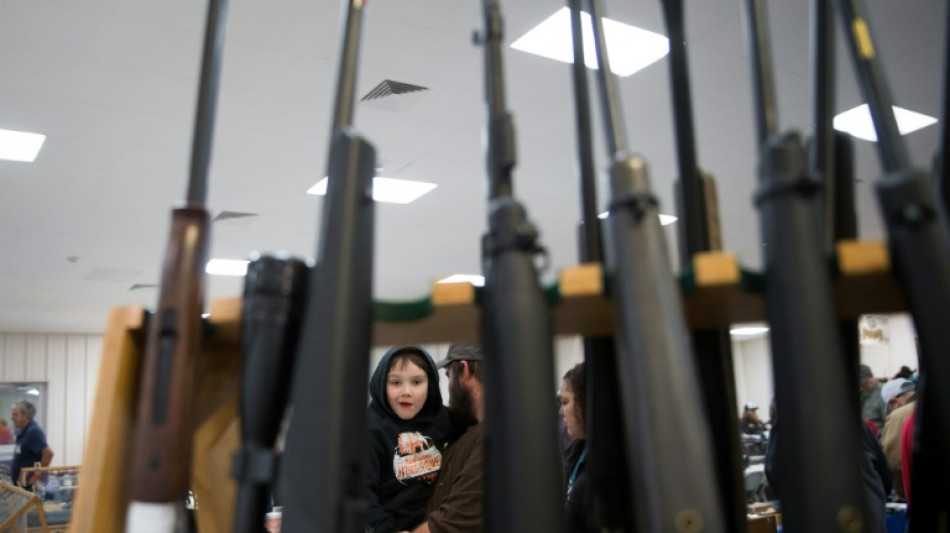
Looser gun laws tied to thousands more US child shooting deaths / Photo: © AFP/File

 Zverev thrashes Shang to set up Djokovic quarter-final at China Open

 Turkey football ref chief jailed pending trial for graft

 North Korea says test of intermediate-range strategic missile included use of AI

 Rampant Sayers leads Hong Kong to third men's rugby gold in a row

 Ethiopia's Tigray rebels abandon regional capital as govt advances

 Bulgaria's Tsar Samuel returns 'home' after 1,000 years

 'Glad it's over': Kim powers to Games gold and military exemption

 After 11 World Cups, football finally comes home for one Indian fan

 Marc Marquez wins sprint at Japan MotoGP, Martin grabs pole

 Alcaraz fends off Arnaldi to reach Japan Open quarters

 Antonelli tops times in final practice at Bahrain GP

 Gauff digs deep to beat Osorio in China Open second round

 Fresh protests to hit Spain after housing measures defeated

 'He's here with me': Japan cycle queen dedicates gold to late brother

 Japan Olympic chief says 'lot more' athletes at Games than expected
 Asian carmakers besting US rivals at home, China poised to strike

 Widgets & Web Offers All-Inclusive Investor Relations Websites for Public Companies, IPOs and SPACs

 Adams named new US captain to 2030 World Cup
 China a better influence in Latin America than US: poll

 Judge pauses construction of border project in Texas national park

 Belgium's De Bruyne fires double to sink Turkey, France held by Italy

 US jobs data boosts stocks as oil prices dip

 US Supreme Court to hear high-stakes climate case

 Trump expected to name intel chief Clayton as AI czar: reports

 Argentina unveils passports-for-investment scheme

US states that loosened their gun laws following a landmark court ruling saw thousands more childhood firearm deaths than they otherwise would have -- the vast majority homicides and suicides -- according to a study published Monday.
Jeremy Faust, an emergency physician at Brigham and Women's Hospital in Boston and lead author of the paper in JAMA Pediatrics, told AFP he was drawn to the topic as a father wondering whether today's world is safer for children than when he was growing up.
"Mortality from car accidents has fallen dramatically, but at the same time, firearm mortality rose and replaced car accidents as the leading cause of death in children over the age of one," he said -- a trend unique among peer nations.
To probe this shift, Faust and his colleagues analyzed state-level data before and after McDonald v Chicago, the 2010 Supreme Court decision that extended the Second Amendment to state and local governments.
The ruling sparked a wave of legislation, some tightening gun laws but much of it loosening them.
The team grouped states into three categories -- most permissive, permissive, and strict -- and used Centers for Disease Control data on firearm deaths among children aged 0–17.
They ran an "excess mortality analysis," comparing actual deaths from 2011 to 2023 against projections based on prior trends from 1999 to 2010 and population growth.
The results were stark: more than 7,400 excess pediatric firearm deaths in states that loosened gun laws -- including over 6,000 in the most permissive group of states.
By contrast, the eight strictest states overall saw no excess deaths. The model predicted 4,267 fatalities, while 4,212 were recorded -- a near-match that bolstered confidence in the analysis.
"The biggest thing people always want to know is, what's the intent behind these?" said Faust.
"And I think what surprises most people is that accidents are a very small number of these deaths -- it's mostly homicide and suicide."
While the study showed strong associations, it cannot prove causation -- a key limitation.
But in a test of whether broader increases in violence might explain the trend, rather than changes to the law, the team analyzed non-firearm homicides and suicides and found no similar rise, a result that makes the findings "pretty compelling," said Faust.
Black children saw the steepest increases. While the reasons are unclear, the authors speculated that disparities in safe firearm storage could play a role.
There were some exceptions. Deaths rose in Illinois and Connecticut despite tighter laws -- though in the latter case, the spike was entirely attributable to the 2012 Sandy Hook mass shooting at an elementary school.
"Big picture, we have a major problem in this country," said Faust.
"But we also have a handful of states that are resisting these increases and, in fact, turning the other direction."
M.Ouellet--BTB