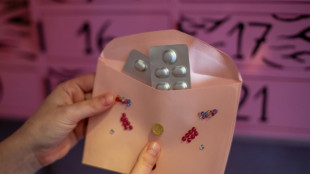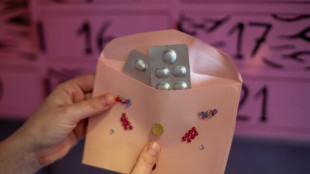
Shock study: Mild electric stimulation boosts math ability / Photo: © AFP/File

 Zverev thrashes Shang to set up Djokovic quarter-final at China Open

 Turkey football ref chief jailed pending trial for graft

 North Korea says test of intermediate-range strategic missile included use of AI

 Rampant Sayers leads Hong Kong to third men's rugby gold in a row

 Ethiopia's Tigray rebels abandon regional capital as govt advances

 Bulgaria's Tsar Samuel returns 'home' after 1,000 years

 'Glad it's over': Kim powers to Games gold and military exemption

 After 11 World Cups, football finally comes home for one Indian fan

 Marc Marquez wins sprint at Japan MotoGP, Martin grabs pole

 Alcaraz fends off Arnaldi to reach Japan Open quarters

 Antonelli tops times in final practice at Bahrain GP

 Gauff digs deep to beat Osorio in China Open second round

 Fresh protests to hit Spain after housing measures defeated

 'He's here with me': Japan cycle queen dedicates gold to late brother

 Japan Olympic chief says 'lot more' athletes at Games than expected

 Asian carmakers besting US rivals at home, China poised to strike

 Widgets & Web Offers All-Inclusive Investor Relations Websites for Public Companies, IPOs and SPACs

 Adams named new US captain to 2030 World Cup

 China a better influence in Latin America than US: poll

 Judge pauses construction of border project in Texas national park

 Belgium's De Bruyne fires double to sink Turkey, France held by Italy

 US jobs data boosts stocks as oil prices dip

 US Supreme Court to hear high-stakes climate case

 Trump expected to name intel chief Clayton as AI czar: reports

 Argentina unveils passports-for-investment scheme

Struggle with math? A gentle jolt to the brain might help.
A new study published Tuesday in PLOS Biology suggests that mild electrical stimulation can boost arithmetic performance -- and offers fresh insight into the brain mechanisms behind mathematical ability, along with a potential way to optimize learning.
The findings could eventually help narrow cognitive gaps and help build a more intellectually equitable society, the authors argue.
"Different people have different brains, and their brains control a lot in their life," said Roi Cohen Kadosh, a neuroscientist at the University of Surrey who led the research.
"We think about the environment -- if you go to the right school, if you have the right teacher -- but it's also our biology."
Cohen Kadosh and colleagues recruited 72 University of Oxford students, scanning their brains to measure connectivity between three key regions.
Participants then tackled math problems that required either calculating answers or recalling memorized solutions.
They found that stronger connections between the dorsolateral prefrontal cortex, which governs executive function, and the posterior parietal cortex, involved in memory, predicted better calculation performance.
When the researchers applied a painless form of brain stimulation using electrode-fitted caps -- a technique known as transcranial random noise stimulation -- the low performers saw their scores jump by 25–29 percent.
The team believes the stimulation works by enhancing the excitability of neurons and interacting with GABA, a brain chemical that inhibits excessive activity -- effectively compensating for weak neural connectivity in some participants.
In fact, the stimulation helped underperformers reach or even surpass the scores of peers with naturally stronger brain wiring. But those who already performed well saw no benefit.
"Some people struggle with things, and if we can help their brain to fulfill their potential, we open them a lot of opportunities that otherwise would be closed," said Cohen Kadosh, calling it an "exciting time" for the field of brain stimulation research.
Still, he flagged a key ethical concern: the risk that such technologies could become more available to those with financial means, widening -- rather than closing -- access gaps.
He also urged the public not to try this at home. "Some people struggle with learning, and if our research proves successful beyond the lab, we could help them fulfil their ambitions and unlock opportunities that might otherwise remain out of reach."
C.Meier--BTB