New push to reach plastic pollution pact / Photo: © AFP

 World No.1 Sinner pulls out of Shanghai Masters to delay return
 Red Bull's Verstappen grabs pole position for Bahrain GP

 India beat Pakistan in blockbuster as golfer Kim wins 'crazy' gold
 India beat arch-rivals Pakistan to win Asian Games cricket gold
 Ethiopia's Tigray rebels abandon regional capital as govt advances: journalist

 Tom Kim powers to Games gold and exemption from military service

 Split loyalties for Indian football fans at Brazil friendly

 India-Pakistan blockbuster brings cricket fever to Japan baseball field
 Wong waiting on Rafa after winning Asian Games tennis gold

 With Russia next door and rising costs, Latvia goes to the polls

 Penalty hero rues empty seats as Games hosts Japan win football gold

 North Korea fires ballistic missile after Seoul's apology demand

 US regulator finds Boeing 737 MAX software bug 'not a safety concern'

 Ohtani 'managing' injuries as Dodgers launch MLB post-season

 Botched US execution leaves murderer unconscious on ventilator: lawyers
 Cornell rape case exposes sexual violence at US colleges
 France held by Italy in Zidane's homecoming after Olise stunner

 Ethiopian pro-government militia claims Tigray airport as regional tensions spike
 Ohtani shaking off injuries as Dodgers launch MLB post-season

 Sea levels to rise in California as coastal wave surges up west coast
 New rallies urged in France as protests disrupt over 730 schools
 Djokovic survives China Open scare, Sabalenka starts strong
 King Charles to evoke colonial 'darkest days' on Caribbean tour

 Tesla shares jump after global car sales top estimates

 DR Congo Ebola outbreak killed more than 4,000: official figures
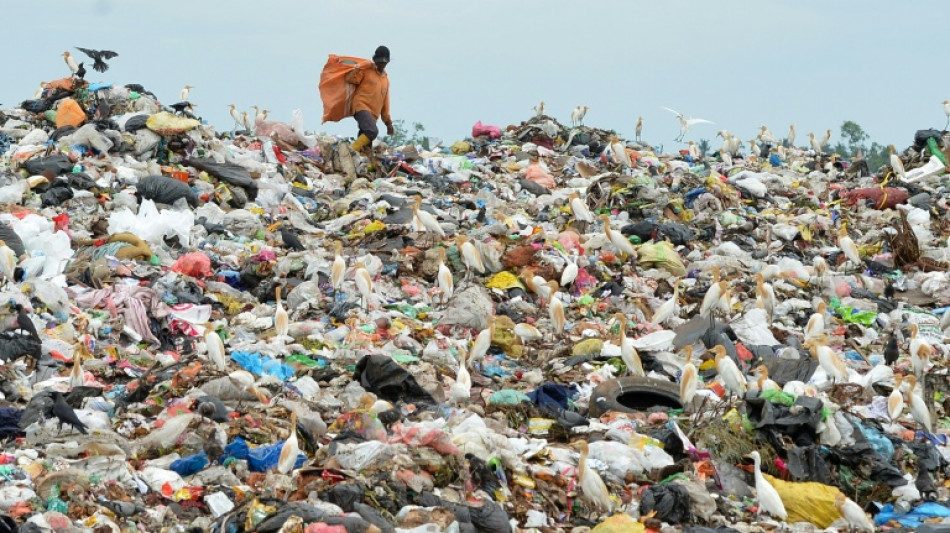
Negotiators will take another stab at reaching a global pact on plastic pollution at talks opening Tuesday in Geneva but they face deep divisions over how to tackle the health and ecological hazard.
The coming 10 days of talks involving delegates from nearly 180 nations follows a failure to reach a deal last December on how to stop millions of tonnes of plastic waste entering the environment each year.
Plastic pollution is so ubiquitous that microplastics have been found on the highest mountain peak, in the deepest ocean trench and scattered throughout almost every part of the human body.
In 2022, countries agreed they would find a way to address the crisis by the end of 2024, but the talks in Busan, South Korea failed to overcome fundamental differences.
One group of countries sought an ambitious globally binding agreement to limit production and phase out harmful chemicals.
However, a group of mostly oil-producing nations rejected production limits and wanted to focus on treating waste.
The stakes are high. If nothing is done, global plastic consumption could triple by 2060, according to OECD projections.
Meanwhile, plastic waste in soils and waterways is expected to surge 50 percent by 2040, according to the United Nations Environment Programme (UNEP), which is acting as the secretariat for the talks.
Some 460 million tonnes of plastic are produced globally each year, half of which is single-use. And less than 10 percent of plastic waste is recycled.
Plastics break down into bits so small that not only do they find their way throughout the ecosystem but into human blood and organs, recent studies show, with largely unknown consequences on the health of current and future generations.
- 'Forever chemicals' -
Despite the complexity of trying to reconcile the diverging interests the environment, human health, and industry "it's very possible to leave Geneva with a treaty," UNEP Executive Director Inger Andersen told the press in the runup to the talks.
The text published after the failed talks in South Korea contained 300 points that still needed to be resolved.
"You have over 300 brackets in the text, which means you have over 300 disagreements," said Bjorn Beeler, executive director and international coordinator at IPEN, a global network aimed at limiting toxic chemicals. "So 300 disagreements have to be addressed."
The most divisive issue is whether to restrict production of new plastic, with petroleum-producing nations like Saudi Arabia, Iran and Russia opposing limits.
Another contentious point: establishing a list of chemicals considered dangerous, such as per- and polyfluoroalkyl substances (PFAS), a family of synthetic chemicals often called forever chemicals as they take an extremely long time to break down.
Bjorn Beeler, head of the IPEN network of activist groups working to eliminate pollutants said that no one wants the talks to go to a third round and the diplomats need to show progress.
The "context is difficult," a diplomatic source acknowledged on condition of anonymity, saying they could not ignore the changed US attitude towards multilateral initiatives under Donald Trump's administration.
- Lobbyists at work -
Meanwhile, developing nations are keenly interested in talks "either because they are plastic producers with a risk of a strong impact on their economies or because they suffer from plastic pollution and demand accountability," said the same source.
In Nice in June, at the UN Oceans Conference, 96 countries, ranging from tiny island states to Zimbabwe, including the 27 members of the European Union, Mexico and Senegal, called for an ambitious treaty, including a target to reduce the production and consumption of plastics.
Ilane Seid, chair of the Alliance of Small Island states (AOSIS), said "the treaty should cover the full life cycle of plastics and this includes production. It should not be a waste management treaty."
"Governments must act in the interest of people, not polluters," said Graham Forbes, the head of Greenpeace's delegation at the talks, who denounced the presence of industry lobbyists.
IPEN's Beeler said negotiators want to avoid another round of talks, but that does not assure an all-encompassing deal will be reached.
"The escape hatch is most likely a skeleton that's going to be called a treaty, that needs to have finance, guts, and a soul to be actually something effective," he said.
L.Dubois--BTB