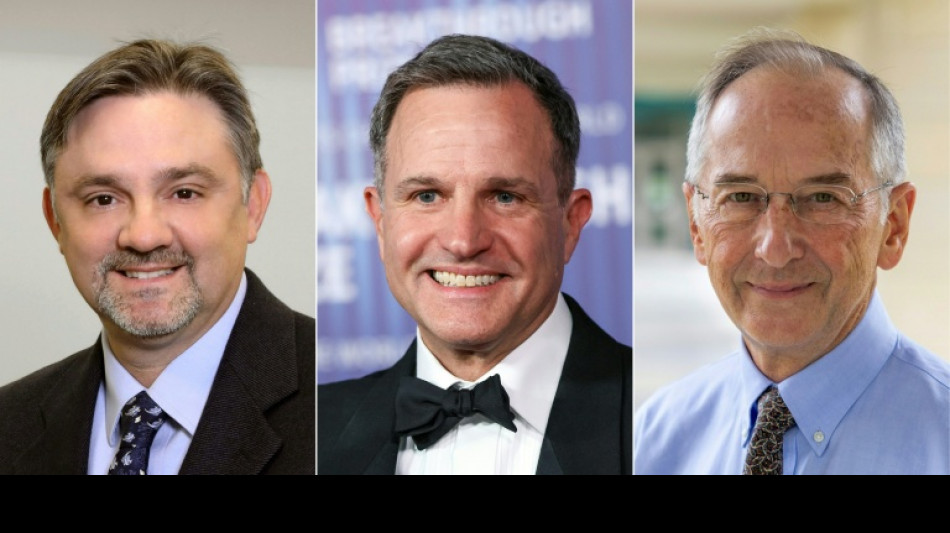
Scientists behind breakthrough cystic fibrosis treatment awarded top US prize / Photo: © Courtesy of Jesus Tito Gonzalez/AFP/File

 'Glad it's over': Kim powers to Games gold and military exemption

 After 11 World Cups, football finally comes home for one Indian fan
 Marc Marquez wins sprint at Japan MotoGP, Martin grabs pole

 Alcaraz fends off Arnaldi to reach Japan Open quarters

 Antonelli tops times in final practice at Bahrain GP

 Gauff digs deep to beat Osorio in China Open second round
 Fresh protests to hit Spain after housing measures defeated

 'He's here with me': Japan cycle queen dedicates gold to late brother

 Japan Olympic chief says 'lot more' athletes at Games than expected
 Asian carmakers besting US rivals at home, China poised to strike

 Widgets & Web Offers All-Inclusive Investor Relations Websites for Public Companies, IPOs and SPACs
 Adams named new US captain to 2030 World Cup
 China a better influence in Latin America than US: poll

 Judge pauses construction of border project in Texas national park

 Belgium's De Bruyne fires double to sink Turkey, France held by Italy
 US jobs data boosts stocks as oil prices dip
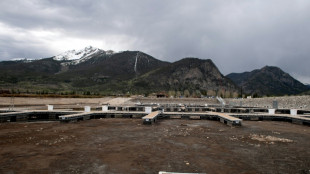 US Supreme Court to hear high-stakes climate case

 Trump expected to name intel chief Clayton as AI czar: reports

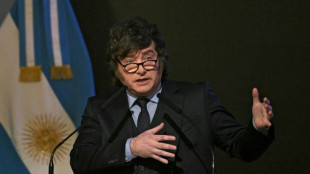 Argentina unveils passports-for-investment scheme

 Brazil election debate chaos sparks censorship row
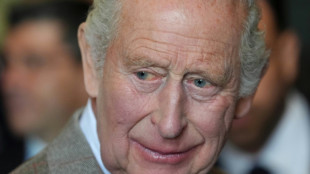
 England's Carse charged by cricket body over nightclub incident

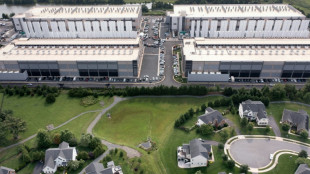 Amazon vows $1 bn for data center towns, decries 'myths'

 Oil prices drop on G7 fuel release, US jobs data boosts stocks

 G7 agrees deal to ease global energy supply concerns

 Spain's government dealt blow as lawmakers reject housing bills

Cystic fibrosis was once a dire, likely deadly diagnosis, destroying a patient's ability to breathe and digest food -- but a revolutionary new treatment offers reason for hope.
And on Thursday the three scientists who developed the clinical advance were awarded America's most prestigious scientific award, taking home the Lasker prize.
The top honor is frequently cited as a pre-cursor for a potential Nobel, and this year it recognized the pulmonologist Michael Welsh along with researchers Jesus Gonzalez and Paul Negulescu from the US laboratory Vertex.
Their research has shed light on the causes of the disease and given rise to a new class of innovative drugs, including the flagship treatment Kaftrio -- known as Trikafta in the United States -- which are capable of stabilizing the otherwise debilitating condition.
"It's unbelievable. It's better than I ever hoped," Welsh told AFP. "You see these kids and they look healthy and they're not coughing. They're running around and playing."
"I almost can't believe it. Then they go, and they're getting married and they're having kids, and they're getting on with their lives."
That reality stands in sharp contrast to Welsh's memories from the early days of his career, when a cystic fibrosis diagnosis was a likely death sentence in childhood or adolescence.
The new award-winning treatment has been hailed as "revolutionary" by patient advocacy organizations.
It works by addressing the underlying causes of the inherited disease -- which wreaks havoc on the lungs and digestive system -- rather than its symptoms.
- 'Not totally broken' -
Some 100,000 people worldwide are estimated to suffer from cystic fibrosis, in which sticky mucus builds up in the lungs, digestive tract and other parts of the body.
After the 1989 discovery of the CFTR gene -- whose mutation was identified as the cause of the disease -- Welsh began dissecting the problem with fellow researchers.
"We thought, if we understand how CFTR works, we have a chance of fixing it," he said.
Gaining a better understanding of how the protein that the gene codes for led the pulmonologist down a path seeking how genetic mutations impaired its function.
Welsh identified two major anomalies caused by the most common mutation: a trapping of sorts of the protein within the cell, and its reduced performance.
The medical breakthrough resulted from experiments, notably some that showed how lowering temperature could help release the trapped protein.
"That meant it was not totally broken," Welsh remembered enthusiastically.
Armed with these discoveries, the American Cystic Fibrosis Foundation then approached researchers Gonzalez and Negulescu, who began studying the possibility of chemically reversing the identified malfunctions.
- 'Panning for gold' -
The notion of gene therapy -- which would aim to directly reverse the gene mutations -- had seemed on paper to be the simplest route.
But when it didn't work as hoped, patient organizations began to explore other options.
Gonzalez developed an innovative research technique using dyes that allowed for testing thousands of chemical compounds in record times.
"Without the screening, we would never have found these molecules," he said.
It was process akin to "panning for gold," recalled Negulescu.
But ultimately their dogged work paid off; they identified a handful of molecules that led to the birth of a new class of treatments.
Those molecules proved capable of restoring mobility to the stuck protein, and improving its function.
Kaftrio/Trikafta -- approved stateside in 2019 and classified by the World Health Organization as an essential treatment in 2025 -- is among them.
But their significant cost poses an obstacle for some patients, especially as the treatment is lifelong, and the therapy is ineffective in a small minority of patients including those with different mutations.
"The work is not done," said Negulescu.
P.Anderson--BTB


