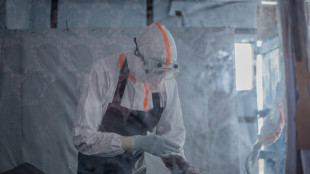
Parliamentary hearings worldwide used to spread anti-vaccine conspiracies / Photo: © AFP/File

 AI needs safety layers like nuclear plants: ex-OpenAI engineer

 MVP Judge will miss Yankees' MLB playoff series against Rays
 New lizard species discovered in Peru

 Fernandes hails Portugal's 'greatest symbol' Ronaldo, calls for unity

 Grandidier-Nkanang double takes Pau to Top 14 summit despite Vannes fightback

 Trainer Scott gets perfect Arc boost with top notch double

 Ex-PM says Putin cannot admit 'mistake' over Ukraine

 Houthis say Saudi Arabia launches dozens of strikes on Yemen capital

 Qatar and Abu Dhabi F1 Grand Prix to go ahead - F1 boss
 South Korea lift gloom with smash-and-grab Games football gold
 Ireland news conference before Israel game cut short amid tensions

 Protests over housing flare in Spain after relief measures rejected

 Zverev thrashes Shang to set up Djokovic quarter-final at China Open

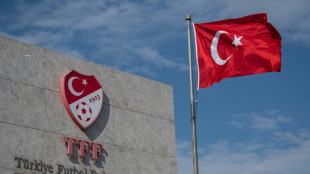 Turkey football ref chief jailed pending trial for graft
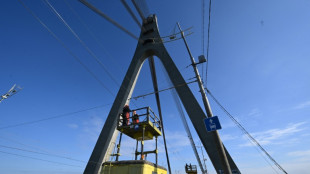
 North Korea says test of intermediate-range strategic missile included use of AI

 Rampant Sayers leads Hong Kong to third men's rugby gold in a row

 Ethiopia's Tigray rebels abandon regional capital as govt advances

 Bulgaria's Tsar Samuel returns 'home' after 1,000 years

 'Glad it's over': Kim powers to Games gold and military exemption

 After 11 World Cups, football finally comes home for one Indian fan

 Marc Marquez wins sprint at Japan MotoGP, Martin grabs pole

 Alcaraz fends off Arnaldi to reach Japan Open quarters

 Antonelli tops times in final practice at Bahrain GP

 Gauff digs deep to beat Osorio in China Open second round

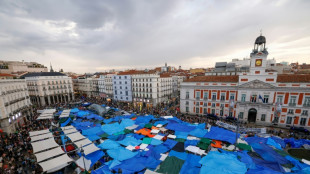 Fresh protests to hit Spain after housing measures defeated
Standing on the podium of the Ohio Statehouse in the United States last year, a nurse pressed a key against her neck aiming to prove that Covid vaccines make people magnetic.
The key -- like the theory -- didn't stick, instead tumbling down her neck and leading to the video of her testimony going viral.
While the nurse's failure mainly prompted derision, it was just one example of how parliamentary hearings worldwide have been weaponised to spread vaccine misinformation since the start of the pandemic.
Parliaments have hosted known conspiracy theorists, who quickly post edited videos of their testimony on social media where the prestigious platform gives them the veneer of legitimacy, experts warn.
The nurse at the Ohio Statehouse was following the lead of anti-vaxxer Sherri Tenpenny, who had earlier testified at the invitation of Republican lawmakers, and has promoted the thoroughly debunked theory that coronavirus vaccines make people magnetic.
Known spreaders of Covid-19 misinformation have addressed hearings across the United States, such as Peter McCullough, who has testified to a Texas Senate committee as well as the US Senate in Washington DC.
Such parliamentary hearings "are part of an arsenal of disinformation," said Sebastian Dieguez, a neuroscientist specialising in conspiracy theories at Switzerland's University of Fribourg.
These figures paradoxically "need the seal of legitimacy imparted by the 'system'," such as mainstream politicians and media, that they spend so much time and rejecting, he told AFP.
- 'A trap' -
"I do think having the opportunity to participate in hearings gives those perspectives a legitimate platform," Molly Reynolds of the US think tank Brookings Institution told AFP.
She said she suspected that in some cases Republicans invited anti-vaccine witnesses to hearings to support their own views.
Dieguez said one argument was that, in a democratic legislative process, all voices have a right to be heard.
But this can be "a bit of a trap", he warned, "if it means giving a false sense of balance by offering a platform to positions that are not only in the minority but also often quite outrageous".
France's Parliamentary Office for the Evaluation of Scientific and Technological Choices has been accused of doing just that.
Earlier this year, it heard from speakers who gave misleading statistics about the adverse effects of Covid-19 vaccines.
Alain Fischer, who coordinates France's pandemic vaccine strategy, criticised the office after himself giving testimony at the Senate hearing in May.
It was "regrettable... that a public hearing was held where specialists who rely on scientific data and pseudo-experts who promote opinion not based on facts were placed on the same level," he told L'Express newspaper.
"This amounts to granting them a form legitimacy."
- Time to change the rules? -
Mathematician and politician Cedric Villani, the then president of the office, rejected the criticism, saying the panel "does not claim to offer more or less legitimacy to one person or another".
Senator Sonia de La Provote, the office's rapporteur, said the office was "proud" to hear from everyone.
"Only giving the floor to those we consider have the right speak seems to me to be particularly detrimental to our democratic functioning," she told AFP.
In the tiny neighbouring country of Luxembourg, several known anti-vaccine figures including French scientist Luc Montagnier spoke in parliament in January.
They were brought along by a group whose petition about compulsory Covid vaccines gained enough signatures to trigger a parliamentary debate.
The president of Luxembourg's Chamber of Deputies Fernand Etgen told AFP in January that it was "obvious" that "most of their assertions were untrue, false or misleading".
The parliament is looking at changing the rules about how much notification it gets about the identity of those who testify.
In January, it only found out who would be speaking the day before the event, making it "impossible for members of parliament to prepare," Etgen said.
T.Bondarenko--BTB