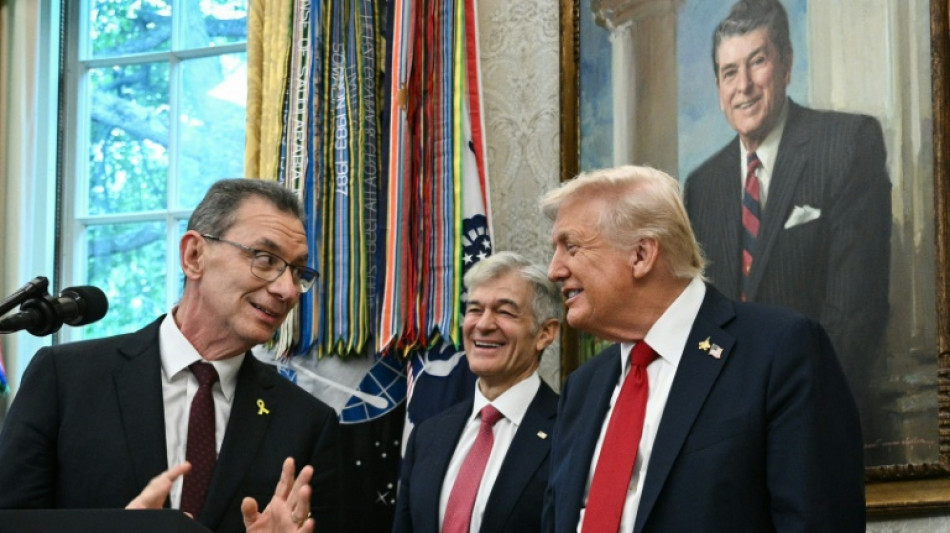
Trump announces Pfizer deal he says will lower certain drug prices / Photo: © AFP

 Prague’s Concert for the Future Kicks Off on Wenceslas Square

 Prince William and Princess of Wales to Announce Earthshot Prize Winners in Mumbai

 Indonesia Forest Fires: Health Crisis, Diplomatic Strains and the Search for Solutions

 BYD Dolphin G Leasing Deal: Plug-in Hybrid Supermini Available from £174 a Month

 JUEL Group Expands from Real Estate to Hospitality with Hyatt Centric Malta Opening

 French Economy Shrinks 0.1% as Consumer Confidence Slumps

 Wall Street Ends Turbulent Week Higher Despite Inflation and AI Jitters
The Trump administration on Tuesday announced a deal granting Pfizer a three-year reprieve on planned tariffs as the pharmaceutical giant vowed to voluntarily lower the prices of unspecified drugs for US purchase.
President Donald Trump, flanked by top health officials, was scant on details regarding what or how many drugs were included in the agreement, the announcement of which came as Washington faced a looming government shutdown.
Under the deal Pfizer is to charge "Most Favored Nation" pricing -- matching the lowest price offered in other wealthy nations -- to Medicaid, the US health insurance program for low-income Americans.
The White House also said it would unveil a website -- called TrumpRx -- that would allow consumers to directly purchase some medications from manufacturers at discounted rates.
Like Trump, Pfizer CEO Albert Bourla heralded the deal as a great achievement, although a statement from the company was equally vague on specifics.
The company did say a "large majority" of "primary care treatments and some select specialty brands" could be offered at savings from 50 percent to 85 percent.
"We now have the certainty and stability we need on two critical fronts, tariffs and pricing, that have suppressed the industry's valuations to historic lows," said Bourla.
Part of the deal included Pfizer agreeing to "invest $70 billion to reshore domestic manufacturing facilities" to the United States.
- Wider impact unclear -
Trump's initiative revives drug-pricing efforts from his first term. The president has taken steps since returning to the White House to pressure pharmaceutical companies into voluntarily lowering their prices.
In July the US leader sent letters to leading pharmaceutical companies demanding they lower drug prices.
Democrats have long indicated that they, too, would like to lower drug prices.
In a report released Monday, independent Senator Bernie Sanders said that Trump's efforts on the issue had "made headlines" but had done "little beyond that."
The member of the Senate's health committee said in his report that since Trump sent the letters over the summer, the prices of 87 drugs actually increased.
Drug costs for consumers in the United States can depend on several variables, notably insurance coverage.
Many people receive insurance through an employer, the health insurance market or government programs including Medicare, which is for seniors, and the safety net Medicaid.
It is not clear how Tuesday's deal will impact drug pricing in the commercial insurance market.
The announcement comes as drugmakers gird for a 100-percent tariff Trump said he would impose on branded pharmaceutical products entering the country from October 1 -- unless companies were building manufacturing plants in the United States.
But details surrounding the rollout remain unclear.
Since returning to the presidency in January, Trump has imposed sector-specific tariffs on imports like steel, aluminum and autos, while launching investigations into other areas like pharmaceuticals that could lead to new levies.
Asked Tuesday about the timeline for fresh tariffs, Commerce Secretary Howard Lutnick said the Trump administration plans to allow negotiations with companies to play out.
T.Bondarenko--BTB



