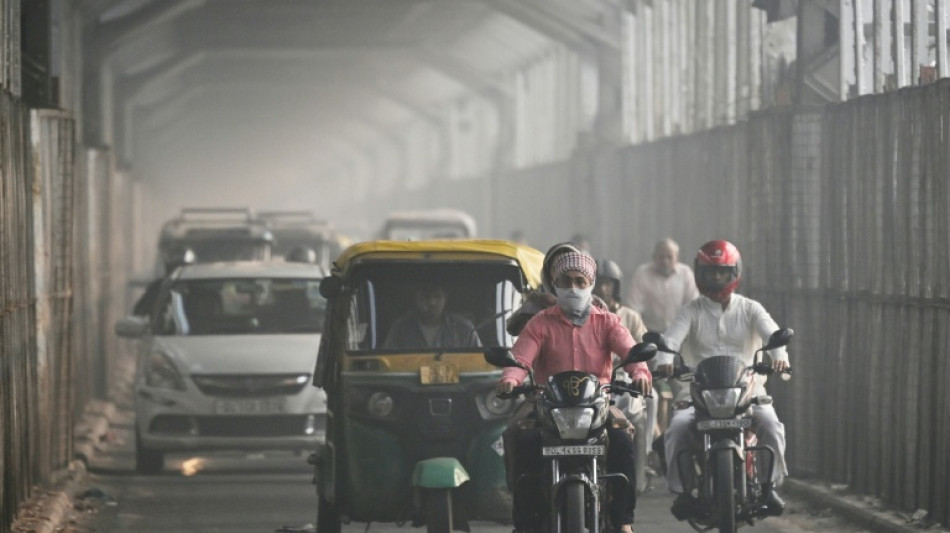
Indian capital chokes after Diwali firework frenzy / Photo: © AFP

 Prague’s Concert for the Future Kicks Off on Wenceslas Square

 Prince William and Princess of Wales to Announce Earthshot Prize Winners in Mumbai

 Indonesia Forest Fires: Health Crisis, Diplomatic Strains and the Search for Solutions

 BYD Dolphin G Leasing Deal: Plug-in Hybrid Supermini Available from £174 a Month

 JUEL Group Expands from Real Estate to Hospitality with Hyatt Centric Malta Opening

 French Economy Shrinks 0.1% as Consumer Confidence Slumps

 Wall Street Ends Turbulent Week Higher Despite Inflation and AI Jitters
Toxic air in India's capital hit more than 56 times the UN health limit early Tuesday, after fireworks for the Hindu festival of Diwali worsened air pollution.
This month, the Supreme Court relaxed a ban on fireworks during the festival of lights, allowing the use of less-polluting "green firecrackers" -- designed to emit fewer particulates.
The ban was widely ignored in past years, however, and environmental groups have expressed doubts about the efficacy of the supposedly greener explosives.
In the early hours of Tuesday morning, just after the peak of the bursting fireworks, levels of cancer-causing PM 2.5 microparticles hit 846 micrograms per cubic metre in parts of New Delhi, according to monitoring organisation IQAir.
That is more than 56 times the World Health Organization's recommended daily maximum.
By Tuesday morning, PM2.5 concentrations had eased to around 320 micrograms per cubic metre — roughly 23 times WHO limits, but relatively typical for New Delhi in winter.
The city regularly ranks as among the most polluted capitals.
A study in The Lancet Planetary Health last year estimated that 3.8 million deaths in India between 2009 and 2019 were linked to air pollution.
The UN children's agency warns that polluted air puts children at heightened risk of acute respiratory infections.
O.Bulka--BTB



