In India's mining belt, women spark hope with solar lamps / Photo: © AFP

 Split loyalties for Indian football fans at Brazil friendly

 India-Pakistan blockbuster brings cricket fever to Japan baseball field

 Wong waiting on Rafa after winning Asian Games tennis gold
 With Russia next door and rising costs, Latvia goes to the polls

 Penalty hero rues empty seats as Games hosts Japan win football gold

 North Korea fires ballistic missile after Seoul's apology demand

 US regulator finds Boeing 737 MAX software bug 'not a safety concern'

 Ohtani 'managing' injuries as Dodgers launch MLB post-season

 Botched US execution leaves murderer unconscious on ventilator: lawyers

 Cornell rape case exposes sexual violence at US colleges
 France held by Italy in Zidane's homecoming after Olise stunner

 Ethiopian pro-government militia claims Tigray airport as regional tensions spike
 Ohtani shaking off injuries as Dodgers launch MLB post-season
 Sea levels to rise in California as coastal wave surges up west coast

 New rallies urged in France as protests disrupt over 730 schools

 Djokovic survives China Open scare, Sabalenka starts strong
 King Charles to evoke colonial 'darkest days' on Caribbean tour

 Tesla shares jump after global car sales top estimates
 DR Congo Ebola outbreak killed more than 4,000: official figures
 Djokovic survives China Open scare against wildcard world no. 104

 Lula, Bolsonaro trade blows in final scramble for votes in Brazil
 New clashes erupt as protests disrupt over 560 French schools
 NY governor vows to close loophole after alleged Cornell gang rape

 Ethiopia Tigray rebels pushed back as regional tensions spike
 Stocks rise, yields fall as US job numbers disappoint
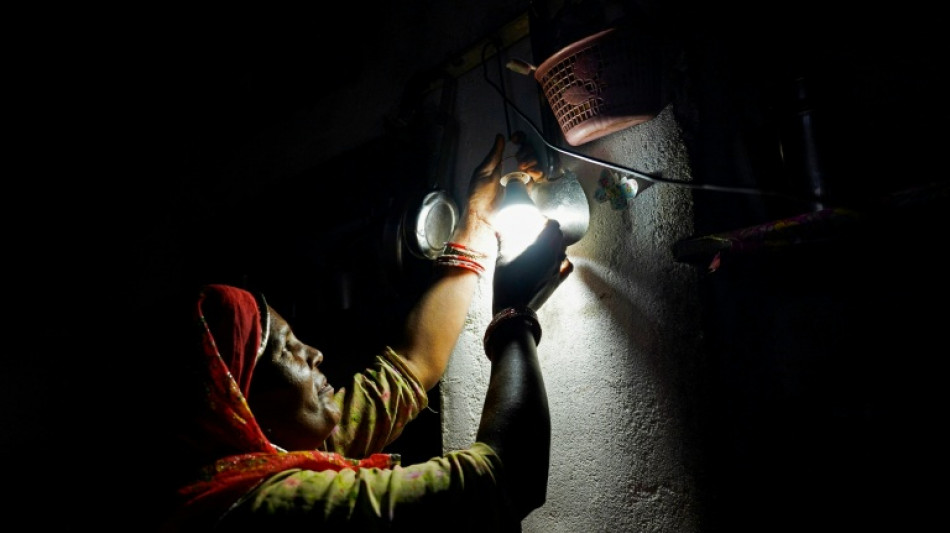
Santosh Devi is proud to have brought light -- and hope -- to her hamlet in western India, taking up solar engineering through a programme for women like her whose husbands suffer chronic disease from mining work.
Her husband is bedridden with silicosis, a respiratory illness caused by inhaling fine silica dust which is common across some 33,000 mines in Rajasthan state, where the couple and their four children live.
Santosh, 36, has joined seven other women for a three-month course at Barefoot College in Tilonia, a two-hour drive from her village in the desert state's Beawar district.
There, the group learned the basics of solar engineering -- installing panels, wiring them, and assembling and repairing lamps -- to help light up homes and provide electricity for anything from charging phones to powering fans.
With their sick husbands out of work, the training has allowed these women to make a living and support their families.
Barefoot College has trained more than 3,000 women from 96 countries since it was set up in 1972, according to Kamlesh Bisht, the technical manager of the institute.
The college offers rural women new skills with the aim of making them independent in an environment where jobs are scarce and healthcare generally inaccessible.
Santosh, who is illiterate, said she wants to "offer a good education and a better future" to her children, aged five to 20.
She now earns a small income by installing solar panels, and hopes to eventually make the equivalent of $170 a month.
The time away from her family was tough, but Santosh said it was worth it.
"At first, I was very scared," she recalled. "But this training gave me confidence and courage."
She showed with enthusiasm the three houses where she had installed a photovoltaic panel powering lamps, fans and chargers.
- Slow killer -
Her husband used to cut sandstone for pavers exported around the world.
But now he can barely walk, needs costly medication and relies on a meagre state allowance of $16 a month.
Wiping away tears with the edge of her bright red scarf, Santosh said she has had to borrow money from relatives, sell her jewellery and mortgage her precious mangalsutra, the traditional Hindu wedding necklace, to make ends meet.
The family share a similar fate with many others in Rajasthan state's mining belt, where tens of thousands of people suffer from silicosis.
According to pulmonologist Lokesh Kumar Gupta, there are between 5,000 and 6,000 cases in just a single district, Ajmer.
In Santosh's village of 400 households, 70 people have been diagnosed with silicosis, a condition that kills slowly and, in many cases, has no cure.
An estimated 2.5 million people work in mines across Rajasthan, extracting sandstone, marble or granite for less than $6 a day.
Those using jackhammers earn double but face even higher exposure to toxic dust.
Vinod Ram, whose wife has also graduated from the Barefoot College course, has been suffering from silicosis for six years and struggles to breathe.
"The medication only calms my cough for a few minutes," said Vinod, 34, who now weighs just 45 kilos (99 pounds).
He started mining at age 15, working for years without a mask or any other protective gear.
- No choice but to work -
His wife Champa Devi, 30, did not even know how to write her name when she arrived at Barefoot College in June.
Now back home, at a village not far from Santosh's, she is proud of her newfound expertise.
But her life remains overshadowed by illness and poverty.
Champa, who has dark circles under her eyes, has installed solar panels in four nearby homes but has not yet been paid.
For now, she earns about 300 rupees ($3.35) a day working at construction sites -- hardly enough to cover her husband's medical bills, which come up to some $80 a month.
The couple live in a single dark room with thin blankets covering the floor, and the near-contact sound of detonations from nearby mines.
"There is no treatment for silicosis," said pulmonologist Gupta.
Early treatment can help, but most patients come only after five to seven years, he said.
Under state aid schemes, patients receive $2,310 upon diagnosis, and their families get another $3,465 in the case of death.
Ill miners, who are physically capable, sometimes continue to cut sandstone for a pittance to support their families, despite the dire health risks.
Sohan Lal, a 55-year-old mine worker who suffers from shortness of breath and severe cough, sees no other option but to keep working.
"If I were diagnosed, what difference would it make?" he said.
W.Lapointe--BTB