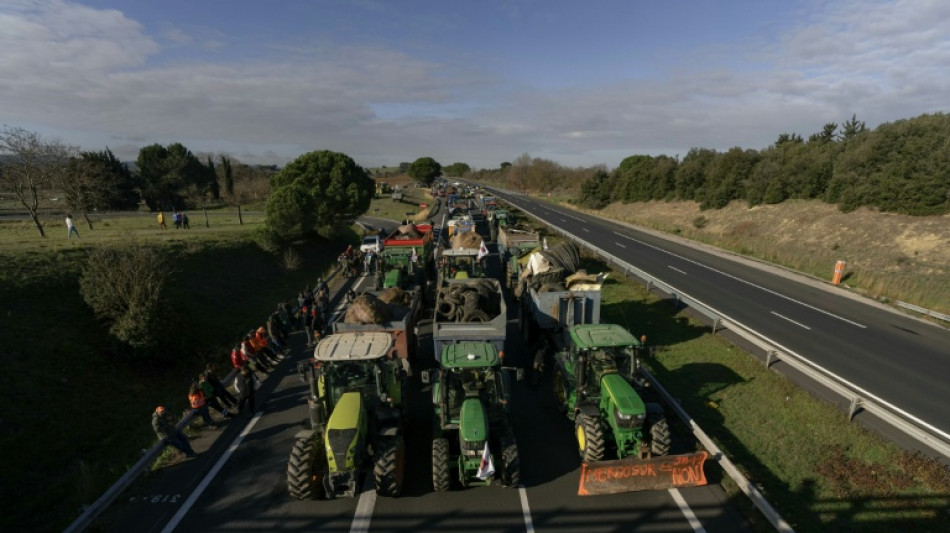
Balkan nations offer lessons on handling cow virus sowing turmoil / Photo: © AFP

 Split loyalties for Indian football fans at Brazil friendly

 India-Pakistan blockbuster brings cricket fever to Japan baseball field

 Wong waiting on Rafa after winning Asian Games tennis gold

 With Russia next door and rising costs, Latvia goes to the polls

 Penalty hero rues empty seats as Games hosts Japan win football gold

 North Korea fires ballistic missile after Seoul's apology demand

 US regulator finds Boeing 737 MAX software bug 'not a safety concern'

 Ohtani 'managing' injuries as Dodgers launch MLB post-season

 Botched US execution leaves murderer unconscious on ventilator: lawyers

 Cornell rape case exposes sexual violence at US colleges

 France held by Italy in Zidane's homecoming after Olise stunner

 Ethiopian pro-government militia claims Tigray airport as regional tensions spike

 Ohtani shaking off injuries as Dodgers launch MLB post-season

 Sea levels to rise in California as coastal wave surges up west coast

 New rallies urged in France as protests disrupt over 730 schools

 Djokovic survives China Open scare, Sabalenka starts strong

 King Charles to evoke colonial 'darkest days' on Caribbean tour

 Tesla shares jump after global car sales top estimates

 DR Congo Ebola outbreak killed more than 4,000: official figures

 Djokovic survives China Open scare against wildcard world no. 104

 Lula, Bolsonaro trade blows in final scramble for votes in Brazil

 New clashes erupt as protests disrupt over 560 French schools
 NY governor vows to close loophole after alleged Cornell gang rape

 Ethiopia Tigray rebels pushed back as regional tensions spike

 Stocks rise, yields fall as US job numbers disappoint

An outbreak of a highly contagious cattle disease has left France, the world's top exporter of live animals, struggling since June to prevent devastating impacts on its industry, amid growing protests by farmers.
But in 2016 several Balkan nations curtailed major epidemics of the same disease through swift action, mass vaccination and culls in about three months.
With no cases reported since 2018, Tamas Petrovic, head of virology at the Scientific Veterinary Institute in the Serbian city of Novi Sad, said the Balkans' response could offer lessons for this new outbreak.
- Early alert -
When lumpy skin disease (LSD), or nodular dermatitis, was detected in nearby Greece and Bulgaria, Serbia was placed on alert and formed a task force to monitor its spread, said Petrovic, who was involved in the response.
Although the viral disease poses no risk to humans, it severely affects milk production and fertility and can be fatal in cattle.
As the prolonged incubation of the disease made it difficult to track and contain, officials quickly turned to vaccination, the researcher said.
But with no registered vaccine in Europe at the time, imports were ordered from South Africa.
Within a week of its arrival in Serbia, the vaccine was tested, and the first cattle vaccinations began.
- Mass vaccination -
Mass vaccination was carried out in phases, with one million doses eventually administered across the country.
By first targeting large swaths of livestock in infected districts and then broadening out in three phases, the outbreak was quickly controlled, he said.
"We stopped the disease within two to three months after it entered the country," Petrovic said.
By 2018 the European Food Safety Authority (EFSA) said that more than 70 per cent of the Balkan region's cattle were vaccinated.
- Culls -
But vaccination alone did not stop the disease -- several culls were needed across the region.
"If the disease appears, the euthanasia of the entire herd is mandatory," Petrovic said.
But rapid action meant fewer than 1,000 cattle were slaughtered in Serbia, out of a total herd of close to 900,000, Petrovic said.
Insect controls across the entire region also helped prevent the spread of diseases through mosquitoes, ticks and flies.
- 'A good example' -
Petrovic said the Balkans proved to be "more than a good example" in controlling the disease.
Croatia's preventive vaccination, after EU approval, meant LSD was never reported in the country, despite outbreaks nearby in Serbia and Montenegro.
Its vaccination programme effectively stopped the disease from entering the bloc at the time, he said.
Bosnia and Herzegovina also carried out vaccination and booster campaigns between 2016 and 2018.
As of 2019, the EFSA said that the disease had not been detected in the region, and preventive vaccination programmes continued in high-risk areas.
The main lesson from that crisis was that experts must take the lead, Petrovic said.
"The state and politicians acted in line with the experts and followed what needed to be done -- and they did it," he insisted.
K.Brown--BTB


