'Help me, I'm dying': inside Ecuador's TB-ridden gang-plagued prisons / Photo: © AFP

 Split loyalties for Indian football fans at Brazil friendly

 India-Pakistan blockbuster brings cricket fever to Japan baseball field

 Wong waiting on Rafa after winning Asian Games tennis gold
 With Russia next door and rising costs, Latvia goes to the polls

 Penalty hero rues empty seats as Games hosts Japan win football gold

 North Korea fires ballistic missile after Seoul's apology demand

 US regulator finds Boeing 737 MAX software bug 'not a safety concern'

 Ohtani 'managing' injuries as Dodgers launch MLB post-season

 Botched US execution leaves murderer unconscious on ventilator: lawyers

 Cornell rape case exposes sexual violence at US colleges
 France held by Italy in Zidane's homecoming after Olise stunner

 Ethiopian pro-government militia claims Tigray airport as regional tensions spike

 Ohtani shaking off injuries as Dodgers launch MLB post-season
 Sea levels to rise in California as coastal wave surges up west coast
 New rallies urged in France as protests disrupt over 730 schools

 Djokovic survives China Open scare, Sabalenka starts strong

 King Charles to evoke colonial 'darkest days' on Caribbean tour

 Tesla shares jump after global car sales top estimates

 DR Congo Ebola outbreak killed more than 4,000: official figures

 Djokovic survives China Open scare against wildcard world no. 104

 Lula, Bolsonaro trade blows in final scramble for votes in Brazil

 New clashes erupt as protests disrupt over 560 French schools
 NY governor vows to close loophole after alleged Cornell gang rape

 Ethiopia Tigray rebels pushed back as regional tensions spike
 Stocks rise, yields fall as US job numbers disappoint

In gang-plagued Ecuador, being sent to prison is increasingly a death sentence, whatever the crime.
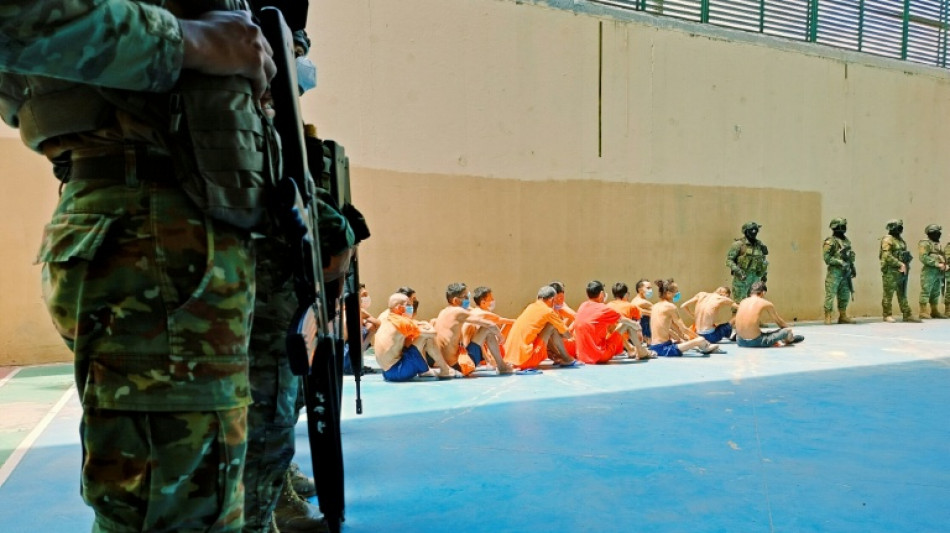
In a bid to free the country from the clutches of drug traffickers -- some of them operating from their jail cells -- President Daniel Noboa sent the military into 19 prisons in January 2024 to restore order.
The takeover not only failed to stop gruesome gang massacres in the country's overcrowded penitentiaries, but it also worsened humanitarian conditions, prisoners' families and rights groups say.
"A crime against humanity is being committed against the prisoners," said Billy Navarrete of Ecuador's Permanent Committee for Human Rights (CDH).
Inmate deaths in the South American country rose 137 percent between 2024 and 2025, according to Human Rights Watch's Americas director Juanita Goebertus, who denounced a "failed system" in a post on X last month.
At Ecuador's biggest prison -- Litoral Penitentiary in the port city of Guayaquil -- some 600 inmates have died so far this year due to a lack of medical attention for injuries or illnesses such as HIV/AIDS and tuberculosis (TB), according to the CDH. The facility, filled far beyond capacity, has nearly 7,100 inmates.
With prisoner visiting rights suspended for over a year in the name of keeping drugs and weapons out, and no cellphones allowed, loved ones on the outside are kept in the dark.
Santiago Hidalgo, 29, who was arrested in 2024 on suspicion of drug trafficking, died of TB in July at the Litoral Penitentiary.
“When I arrived at the morgue, I found my son on top of more than five other corpses. He was so thin, just skin and bones," his mother Benigna Dominguez, 57, told AFP at her home in an impoverished neighborhood of Guayaquil.
Dominguez, who was never allowed to see her son during his seven months in prison, said his body was covered in bruises.
At least 663 inmates have died in violent incidents in prisons in Ecuador since 2020, according to the Inter-American Commission on Human Rights (IACHR).
- Highest murder rate -
The last call Ana Maria Pin had with her son in Guayaquil's infamous prison was unnerving.
"Mommy, help me, I'm dying... get me out of here, this is hell," she said he told her. Pin clutched a photo of her son sitting, clearly ill, on the floor of his cell.
Ten prisoners died from TB at Litoral in November alone.
AFP contacted prison authorities about the spiraling death rate but received no response.
Noboa, re-elected in April on the back of his iron-fisted anti-gang policies, built a maximum-security prison for Ecuador's most dangerous offenders. It was modelled on El Salvador's brutal Terrorism Confinement Center (CECOT).
On his X account last month, the 38-year-old president posted pictures of inmates at the facility, reminiscent of those of Venezuelan migrants held at CECOT earlier this year: shorn heads, shackles, orange jumpsuits.
"Welcome to your new home," Noboa quipped.
Ecuador has gone from one of South America's safest countries to a major cocaine trafficking hub, plagued by gangs with ties to Mexican and Colombian cartels.
Soldiers have been withdrawn from eight of the 19 prisons to which the military was deployed last year, but remain in those considered most dangerous, including Litoral.
Desperate for news of their loved ones, relatives pay imprisoned gang leaders as much as $20 a pop to contact family via WhatsApp.
Prisoners at Litoral describe TB raging out of control. Those infected are kept in beds outdoors to try and prevent spreading disease, while corpses pile up in the prison yard, according to accounts relayed by their families.
Sanitary conditions are also dire and drains overflow with sewage.
"They want them to die," the sister of a TB-infected prisoner told AFP bitterly.
Another woman, who gave her name only as Elizabeth, was waiting to recover the body of her brother who died of tuberculosis.
"He's been lying like a dog in a cellblock since yesterday, and they won't let him out," she said.
Human rights organizations question the effectiveness of Noboa's crackdown.
Ecuador ends the year with the worst homicide rate in Latin America: 52 per 100,000 inhabitants, according to Ecuador's Organized Crime Observatory.
J.Horn--BTB