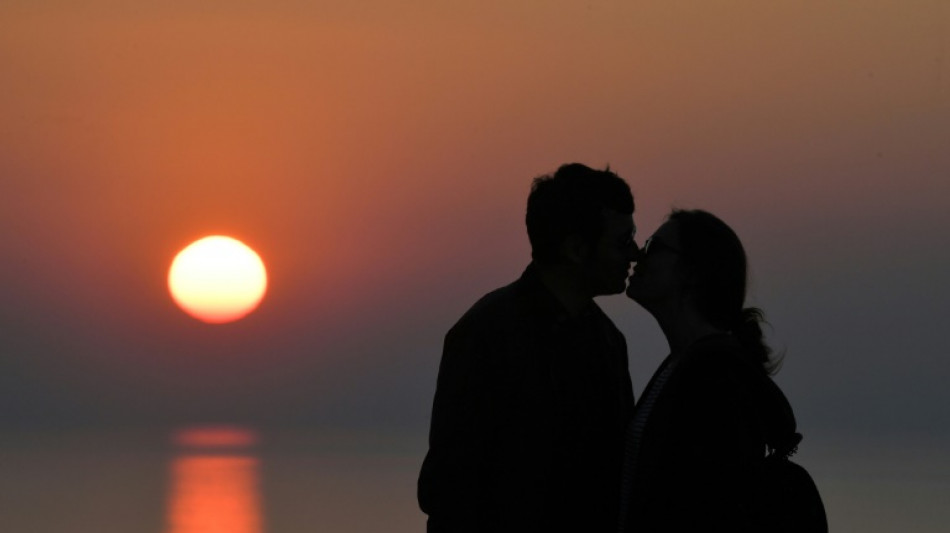
First kisses may have helped spread cold sore virus / Photo: © AFP/File

 AI needs safety layers like nuclear plants: ex-OpenAI engineer

 MVP Judge will miss Yankees' MLB playoff series against Rays

 New lizard species discovered in Peru

 Fernandes hails Portugal's 'greatest symbol' Ronaldo, calls for unity

 Grandidier-Nkanang double takes Pau to Top 14 summit despite Vannes fightback

 Trainer Scott gets perfect Arc boost with top notch double

 Ex-PM says Putin cannot admit 'mistake' over Ukraine

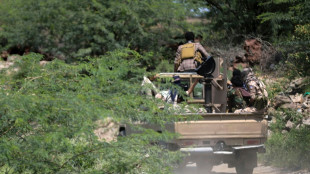 Houthis say Saudi Arabia launches dozens of strikes on Yemen capital

 Qatar and Abu Dhabi F1 Grand Prix to go ahead - F1 boss

 South Korea lift gloom with smash-and-grab Games football gold
 Ireland news conference before Israel game cut short amid tensions

 Protests over housing flare in Spain after relief measures rejected

 Zverev thrashes Shang to set up Djokovic quarter-final at China Open

 Turkey football ref chief jailed pending trial for graft

 North Korea says test of intermediate-range strategic missile included use of AI

 Rampant Sayers leads Hong Kong to third men's rugby gold in a row

 Ethiopia's Tigray rebels abandon regional capital as govt advances

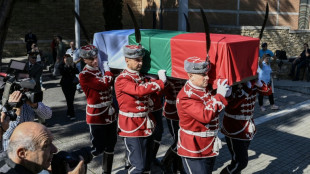 Bulgaria's Tsar Samuel returns 'home' after 1,000 years

 'Glad it's over': Kim powers to Games gold and military exemption

 After 11 World Cups, football finally comes home for one Indian fan

 Marc Marquez wins sprint at Japan MotoGP, Martin grabs pole

 Alcaraz fends off Arnaldi to reach Japan Open quarters

 Antonelli tops times in final practice at Bahrain GP

 Gauff digs deep to beat Osorio in China Open second round

 Fresh protests to hit Spain after housing measures defeated

The modern strain of the virus that causes cold sores has been traced back to around 5,000 years ago, with researchers suggesting its spread could have been propelled by the emergence of kissing.
Around 3.7 billion people -- the majority of the world's population -- have a life-long infection of the HSV-1 virus behind facial herpes, according to the World Health Organization.
But despite its ubiquity, relatively little has been known about the history of this virus, or how it spread throughout the world.
So an international team of researchers screened the DNA of teeth in hundreds of people from ancient archaeological finds.
They found four people who had the virus when they died, then sequenced their genomes for research published in the journal Science Advances on Wednesday.
"Using these reconstructed genomes, we were able to determine that the variations of modern strains all trace back to some time in the late Neolithic, early Bronze Age," said the study's co-senior author Christiana Scheib of Cambridge University.
"This was a bit surprising because it has been assumed that herpes is something that has co-evolved with humans for a very long time," she told AFP.
- Never been kissed -
She said that was still true: all primate species have a form of herpes and humans likely had a strain when they first left Africa.
But the research indicated that those earlier strains were replaced by the modern form around 5,000 years ago.
So what brought about that change? The researchers suggested two theories.
Around 5,000 years ago was a time of great migration from Eurasia into Europe, and that spread could have affected the virus.
The other theory? That was around the time when people starting romantically kissing each other.
"That is definitely one way to change the transferability of a herpes virus," Scheib said.
The virus is normally passed by a parent to their child, but kissing would have given it a whole new way to jump between hosts, she said.
"There is some textual evidence starting to show in the Bronze Age of kissing between romantic partners," Scheib said.
- 'Far grander' -
The researchers said the earliest known record of kissing was a manuscript from South Asia during the Bronze Age, suggesting the custom may have also migrated from Eurasia into Europe.
Kissing "is not a universal human trait," Scheib pointed out, emphasising that it is difficult to trace exactly when it began -- or if it is definitively linked to the spread of HSV-1.
Around 2,000 years ago, the Roman Emperor Tiberius was believed to have attempted to ban kissing at official functions to prevent the spread of herpes.
Co-senior study author Charlotte Houldcroft, also from Cambridge, said that a virus like herpes evolves on a "far grander timescale" than Covid-19, which the world has watched mutate in a matter of months.
"Facial herpes hides in its host for life and only transmits through oral contact, so mutations occur slowly over centuries and millennia," she said.
"Previously, genetic data for herpes only went back to 1925," she added, calling for more "deep time investigations" of viruses.
"Only genetic samples that are hundreds or even thousands of years old will allow us to understand how DNA viruses such as herpes and monkeypox, as well as our own immune systems, are adapting in response to each other."
O.Lorenz--BTB