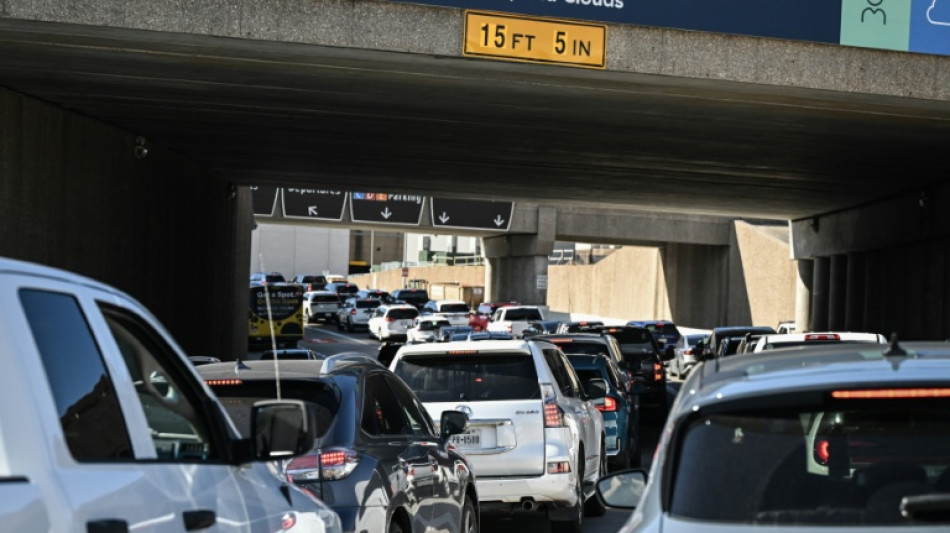
Environmental groups sue Trump administration over scrapped climate rule / Photo: © AFP/File

 Prague’s Concert for the Future Kicks Off on Wenceslas Square

 Prince William and Princess of Wales to Announce Earthshot Prize Winners in Mumbai

 Indonesia Forest Fires: Health Crisis, Diplomatic Strains and the Search for Solutions

 BYD Dolphin G Leasing Deal: Plug-in Hybrid Supermini Available from £174 a Month

 JUEL Group Expands from Real Estate to Hospitality with Hyatt Centric Malta Opening

 French Economy Shrinks 0.1% as Consumer Confidence Slumps

 Wall Street Ends Turbulent Week Higher Despite Inflation and AI Jitters

 Kansas City Fed Chief Says Inflation Is Still Running Too Hot

A coalition of environmental and health groups filed suit Wednesday against the Trump administration's repeal of a key scientific finding that underpinned federal climate regulations.
The action taken in a Washington appeals court argues that Republican President Donald Trump's move -- which eliminated greenhouse gas standards on automobiles and placed a host of additional rules in jeopardy -- was illegal.
Trump's Environmental Protection Agency (EPA) on Wednesday rejected the accusation, insisting in a statement to AFP that it had "carefully considered and reevaluated the legal foundation" of the finding.
The federal body said it concluded it did not have statutory authority to set automobile emissions standards "for the purpose of addressing global climate change concerns."
"Unlike our predecessors, the Trump EPA is committed to following the law exactly as it is written and as Congress intended -- not as others might wish it to be," the agency said in the statement.
The 2009 "endangerment finding," which said greenhouse gases harm public health, was core to years of federal climate policy.
Its rollback was broadly condemned by environmental groups and many Democrats, and legal action was expected.
According to the coalition, the Trump administration's justifications for the repeal do not hold water and have already been litigated.
The Supreme Court has reaffirmed the endangerment finding multiple times -- most recently in 2022, when the court's composition was much the same as today. It's likely the issue eventually will land there once again.
The case was brought by a broad group of organizations including the American Lung Association, the Clean Air Council, the Union of Concerned Scientists, the Sierra Club and the Center for Biological Diversity.
"We're suing to stop Trump from torching our kids' future in favor of a monster handout to oil companies," said David Pettit, an attorney at the Center for Biological Diversity, in a statement.
"Nobody but Big Oil profits from Trump trashing climate science and making cars and trucks guzzle and pollute more," Pettit said. "The EPA's rollbacks are based on political poppycock, not science or law, and the courts should see it that way."
- 'Shortsighted' -
Trump, 79, has dismissed concerns that the repeal could cost lives by worsening climate change, reiterating his belief that human-caused global warming is a hoax.
The administration has framed the measure as a cost-saving move, claiming it would generate more than $1 trillion in regulatory savings and bring down new car costs by thousands of dollars.
The endangerment finding was a determination based on overwhelming scientific consensus that six greenhouse gases threaten public health and welfare by fueling climate change.
It came about as a result of a prolonged legal battle ending in a 2007 Supreme Court decision, Massachusetts v. EPA, which ruled that greenhouse gases qualify as pollutants under the Clean Air Act and directed the EPA to determine whether they pose a danger to public health and welfare.
While it initially applied only to vehicle emissions, it later became the legal foundation for a broader suite of climate regulations, which are now vulnerable.
Joanne Spalding of the Sierra Club said in a statement Wednesday that the Trump administration's move would have "disastrous consequences for the American people, our health, and our shared future."
"This shortsighted rollback is blatantly unlawful and their efforts to force this upon the American people will fail."
P.Anderson--BTB



