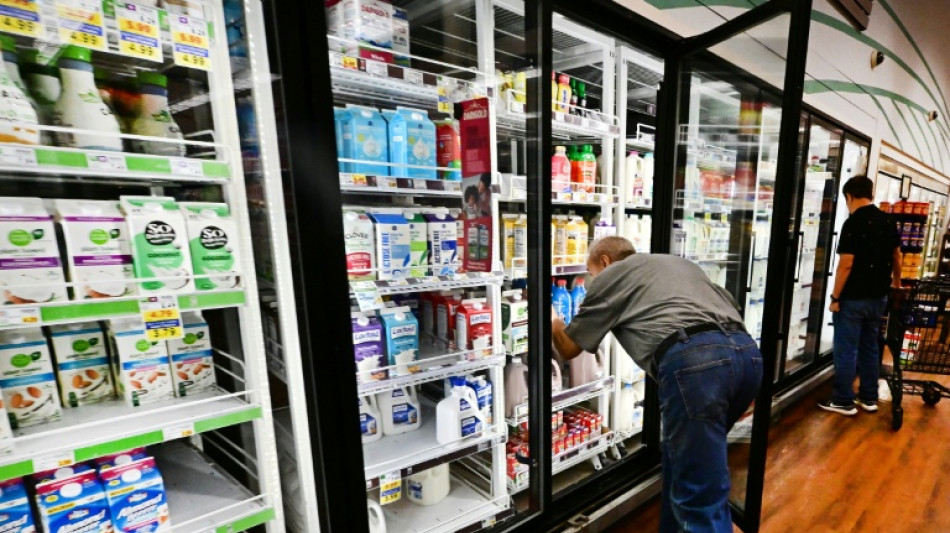
In the online 'maxxing' era, what's the deal with fiber and protein? / Photo: © AFP/File

 'He's here with me': Japan cycle queen dedicates gold to late brother

 Japan Olympic chief says 'lot more' athletes at Games than expected

 Asian carmakers besting US rivals at home, China poised to strike

 Widgets & Web Offers All-Inclusive Investor Relations Websites for Public Companies, IPOs and SPACs

 Adams named new US captain to 2030 World Cup

 China a better influence in Latin America than US: poll

 Judge pauses construction of border project in Texas national park

 Belgium's De Bruyne fires double to sink Turkey, France held by Italy

 US jobs data boosts stocks as oil prices dip

 US Supreme Court to hear high-stakes climate case

 Trump expected to name intel chief Clayton as AI czar: reports

 Argentina unveils passports-for-investment scheme

 Brazil election debate chaos sparks censorship row

 England's Carse charged by cricket body over nightclub incident

 Amazon vows $1 bn for data center towns, decries 'myths'

 Oil prices drop on G7 fuel release, US jobs data boosts stocks

 G7 agrees deal to ease global energy supply concerns

 Spain's government dealt blow as lawmakers reject housing bills

 Food, medicine shortages deepen in Russian-occupied Oleshky

 Man City whistleblower Rui Pinto facing 'dire consequences' - lawyers

 Russia 'tearing Kyiv apart', mayor says, as strikes paralyse traffic

 Taiwan boxer Lin wins Games gold as Japan edge North Korea on penalties

 Japan tame North Korea to win Games gold after shootout drama

 US posts weak job growth data in September

 Ethiopia's conflict: the regional dimension

First it was protein, now it's fiber: the "maxxing" mindset has permeated social media, as wellness influencers insist that loading up on certain nutrients is the key to vitality and a life-changing gut glow-up.
These viral diet trends rooted in extreme optimization are impacting how people eat and what companies sell -- but are they actually healthy?
The concept of "proteinmaxxing" insists that more is better when it comes to the macronutrient found in foods like meat, dairy and nuts, which is essential to a vast array of bodily functions such as repairing tissue or enhancing immune function.
Meanwhile dietary fiber is on track to be 2026's online trend of choice: ingest as much as possible and you'll be less hungry and more regular, say online advocates who wave bowls of chia seeds and oats at the camera.
Brands have taken note: if you can buy it, there's probably a protein-boosted version of it -- even the sugariest cereals are touting their high protein content.
And blue chip companies like PepsiCo and Nestle along with newer firms like Olipop are jumping on the bandwagon, highlighting the fiber content in prebiotic sodas or chips.
"I think fiber will be the next protein," said PepsiCo CEO Ramon Laguarta in an earnings call late last year.
A survey from the consulting firm Bain & Company showed nearly half of US consumers are trying to eat more protein.
Across the United States, Europe and Asia, it's Gen Z and Millennial consumers primarily driving the fad, according to the survey.
The same goes for fiber: according to London's GlobalData, 40 percent of Gen Z and 45 percent of Millennials reported they're trying to improve their gut health.
- More not always best -
Nutritionists say there are grains of truth to the fiber craze.
Andrea Glenn, an assistant professor of nutrition at New York University, called the movement surrounding fiber a "pretty tame wellness trend compared to the other things out there."
Samantha Snashall, a registered dietitian at Ohio State University's medical center, said protein has been "the special child" in recent years -- and fiber has been "pretty undervalued."
"I'm glad it's having some light shed on it."
But those experts along with Arch Mainous -- a professor of community health and family medicine at the University of Florida, who has researched the use of social media in health communication -- said more isn't always best, especially when it comes to protein.
Mainous said eating according to the recommended daily values is one thing -- but "if you say one's good, five's better? I'm not really for that."
He voiced concern that people are putting too much stock in the one-size-fits-all health advice of influencers.
It's part of a broader trend that has resulted in a "lack of trust in health experts," he said -- a "I'll do my own research" mentality that has also been fueled by the likes of US Health Secretary Robert F. Kennedy Jr, who has spread anti-vaccine misinformation for years.
Few influencers are trained scientists, Mainous said, and many have brand deals or agendas of their own, including products to sell.
- No 'silver bullet' -
So what's an eater to do?
First, talk to your physician, Mainous said.
As a general guideline, the American Heart Association says that for many people, a day that includes a combination of foods like a glass of milk, a cup of yogurt, a cup of cooked lentils, and a piece of cooked lean meat or fish approximately the size of a deck of cards will be in the ballpark of the average daily protein target.
Fiber-wise, Glenn said 25-38 grams depending on age and sex is a good goal.
High-fiber foods -- such as beans, fruits, vegetables, nuts and whole grains like oats or quinoa -- are linked to lower rates of certain cancers, and can help keep cholesterol and blood sugar in check.
Generally, Glenn said, people can eat some whole grains or fruit at breakfast, and then should try to fill half their plates with vegetables at lunch and dinner.
With that visualization, "you'll easily hit that target without needing to meticulously count how much fiber you're consuming," she told AFP.
But if you're not currently eating much fiber -- most people aren't -- "maxxing" is not a good course, Snashall warned.
Shake things up overnight and "your GI system is going to have a strong reaction," she said. "Slow and steady wins the race."
And Glenn noted that powders and supplements can't serve as a replacement for whole, real foods.
Perhaps most importantly, no nutrient is a cure-all -- those "fiber-rich" chips probably won't change your life.
"I think it's important to never view these things as a silver bullet to all your problems," she said.
C.Meier--BTB