Climate deniers use past heat records to sow doubt online
/ Photo: © AFP/File

 AI needs safety layers like nuclear plants: ex-OpenAI engineer

 MVP Judge will miss Yankees' MLB playoff series against Rays

 New lizard species discovered in Peru

 Fernandes hails Portugal's 'greatest symbol' Ronaldo, calls for unity

 Grandidier-Nkanang double takes Pau to Top 14 summit despite Vannes fightback

 Trainer Scott gets perfect Arc boost with top notch double

 Ex-PM says Putin cannot admit 'mistake' over Ukraine

 Houthis say Saudi Arabia launches dozens of strikes on Yemen capital

 Qatar and Abu Dhabi F1 Grand Prix to go ahead - F1 boss

 South Korea lift gloom with smash-and-grab Games football gold

 Ireland news conference before Israel game cut short amid tensions

 Protests over housing flare in Spain after relief measures rejected

 Zverev thrashes Shang to set up Djokovic quarter-final at China Open

 Turkey football ref chief jailed pending trial for graft
 North Korea says test of intermediate-range strategic missile included use of AI

 Rampant Sayers leads Hong Kong to third men's rugby gold in a row

 Ethiopia's Tigray rebels abandon regional capital as govt advances

 Bulgaria's Tsar Samuel returns 'home' after 1,000 years

 'Glad it's over': Kim powers to Games gold and military exemption

 After 11 World Cups, football finally comes home for one Indian fan

 Marc Marquez wins sprint at Japan MotoGP, Martin grabs pole

 Alcaraz fends off Arnaldi to reach Japan Open quarters

 Antonelli tops times in final practice at Bahrain GP

 Gauff digs deep to beat Osorio in China Open second round

 Fresh protests to hit Spain after housing measures defeated

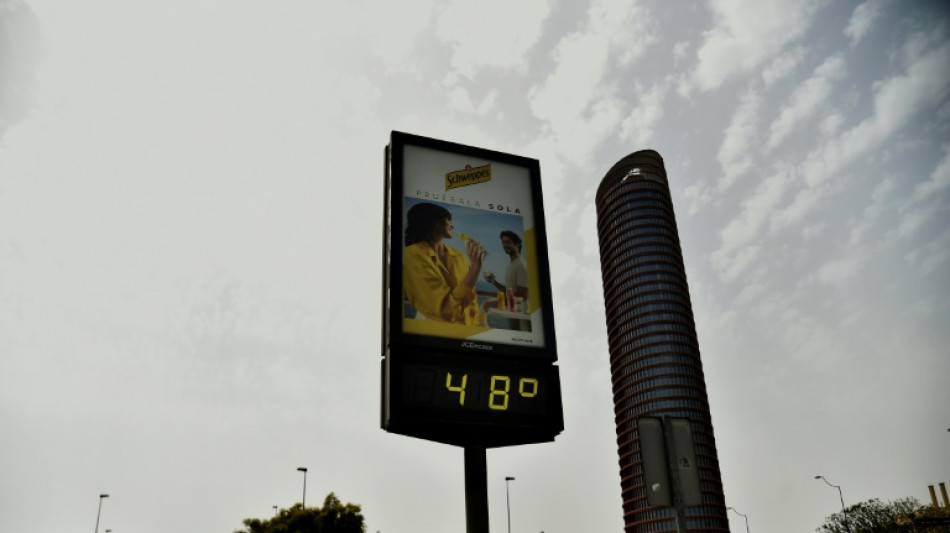
With Europe gripped by successive heatwaves, climate-change deniers are spreading scepticism by publishing data on social media on extreme temperatures allegedly recorded decades ago to imply scientists are exaggerating global warming.
But experts say the figures cited from the past are often incorrect or taken out of context -- and even if accurate do not change the fact that heatwaves are becoming more frequent and intense.
The posts typically include heat records from almanacs or newspaper reports from the past, arguing that they are similar to the record highs set during this year's heatwaves in Europe.
One post that has gone viral on Facebook includes a screen grab of a brief article published in the New York Times on June 23, 1935, which said the mercury had hit 127 degrees Fahrenheit (52.7 degrees Celsius) in Zaragoza, in northeastern Spain, the day before.
That temperature is much higher than the record for the highest temperature in Spain of 47.6 degrees Celsius recorded on August 14, 2021 by national weather office Aemet at the La Rambla meteorological station in the southern province of Cordoba.
Contacted by AFP Fact Check, Aemet spokesman Ruben del Campo said the highest temperature recorded in Zaragoza that day in 1935 was just 39 degrees Celsius.
"The figure of over 52 degrees in incorrect. It is not a figure that is in our climate database, and in fact, there is no log of a temperature above 50 degrees Celsius," he said.
And "even if the figure was correct, which I stress it is not, that is not proof that climate changes does not exist", he added.
- 'Warmer now' -
Spanish daily newspaper La Vanguardia in 1935 also reported that temperatures had hit the low 50s in Zaragoza but explained that the measurement was taken "in the sun".
Scientists recommend a series of strict criteria to ensure an accurate temperature reading.
"Sensors must be protected from the sun and the rain, and the temperature inside the weather station must be the same as what it is outside," said Aemet meteorologists Ricardo Torrijo.
Another post that has gone viral on Facebook, Telegram and Twitter since last June shows a front page of Spanish weekly magazine El Espanol from August 1957 with the headline: "The hottest summer of the century".
It referred to a reading of a temperature of 50 degrees Celsius in central Spain, which was also taken in the sun.
Isabel Cacho, a climate expert at the University of Barcelona, said that "in the hypothetical case" that the mercury soared above 50 degrees Celsius, "this would not be an argument to question that it is warmer now".
- 'Not change trend' -
Climate scientists overwhelmingly agree that carbon emissions from humans burning fossil fuels are heating the planet, raising the risk, length and severity of heatwaves and other extreme weather events.
"These figures of high temperatures (in the past) do not discredit the existence of climate change," said Jose Luis Garcia, a climate change expert at Greenpeace in Spain.
"They are unrelated. One thing is one-off temperature data and another very different thing is the tendency towards an increase in the average temperature."
Pedro Zorrilla, a Spanish expert in climate change, said the "anomaly" of a very high temperature recorded in 1935 would have a "very small effect" on average temperatures.
"It does not change the trend," he added.
Records show heatwaves are occurring with greater frequency in the Iberian Peninsula, said Mariano Barriendos, a geography and history professor at the University of Barcelona.
"It is relatively usual for a hot air mass to enter the peninsula from the Sahara Desert. What is worrying is that heatwaves are happening more often," he said.
J.Fankhauser--BTB