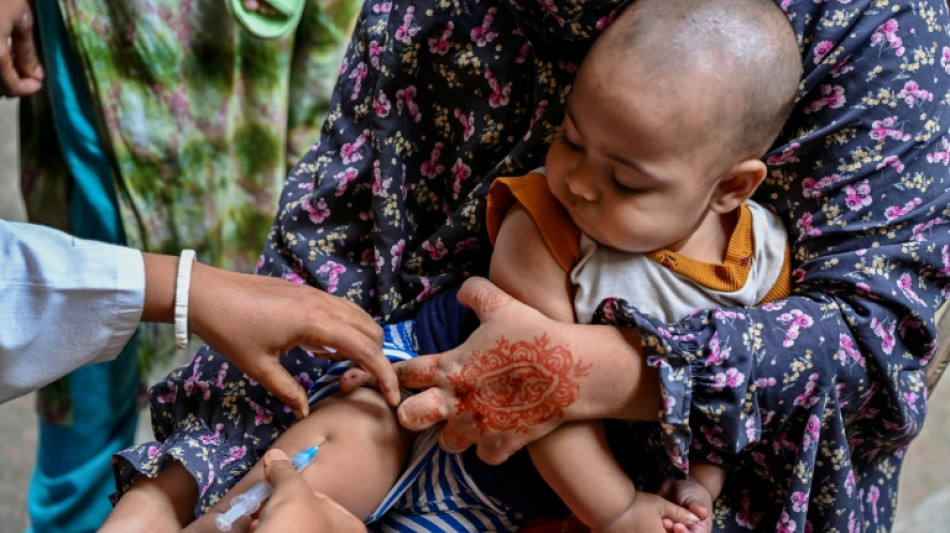
Bangladesh measles outbreak kills over 220 children since March / Photo: © AFP

 Prague’s Concert for the Future Kicks Off on Wenceslas Square

 Prince William and Princess of Wales to Announce Earthshot Prize Winners in Mumbai

 Indonesia Forest Fires: Health Crisis, Diplomatic Strains and the Search for Solutions

 BYD Dolphin G Leasing Deal: Plug-in Hybrid Supermini Available from £174 a Month

 JUEL Group Expands from Real Estate to Hospitality with Hyatt Centric Malta Opening

 French Economy Shrinks 0.1% as Consumer Confidence Slumps

 Wall Street Ends Turbulent Week Higher Despite Inflation and AI Jitters

 Kansas City Fed Chief Says Inflation Is Still Running Too Hot

Bangladesh has recorded 227 child deaths since March in one of its worst outbreaks of measles in decades, with the number of suspected cases reaching nearly 35,000, government data showed Wednesday.
One of the hardest hit areas is Kurukpata in the Chittagong Hill Tracts, home to Indigenous communities, which border war-torn Myanmar.
Children in these rural areas are often left out of vaccination coverage, and some families avoid vaccination programmes due to fear.
"The most affected area of Chittagong Hill tracts is Kurukpata, one of the remotest parts of Bangladesh," district health chief Sheikh Fazle Rabbi told AFP, saying more than 80 children had been treated for measles.
Local Kurukpata council head Kratpung Mro said the cases were unusually high.
"Communication from Kurukpata is difficult," he said. "People, mostly farmers, are among the poorest and cannot afford even boat or motorcycle fares to reach the hospital."
Kratpung Mro said the government should "launch awareness programmes and bring Indigenous communities under vaccination coverage".
Ngangoi Mro, 30, a farmer, brought his two-year-old son, Rengle Mro, who was suffering from high fever, cough and diarrhoea, to the clinic.
"We walked four kilometres (2.5 miles) and then took a vehicle to the hospital from our village, as my boy became very weak," he told AFP.
Measles is one of the world's most contagious diseases, according to the World Health Organization (WHO), and is spread through coughs and sneezes.
It can affect people of any age but is most common among children, and can cause complications that include brain swelling and severe respiratory problems.
Since March 15, the number of suspected cases nationwide has reached 34,980, mostly among children aged between six months and five years.
Bangladesh health officials, aid by the UN children's agency, WHO and the security forces are working to vaccinate children.
I.Meyer--BTB



