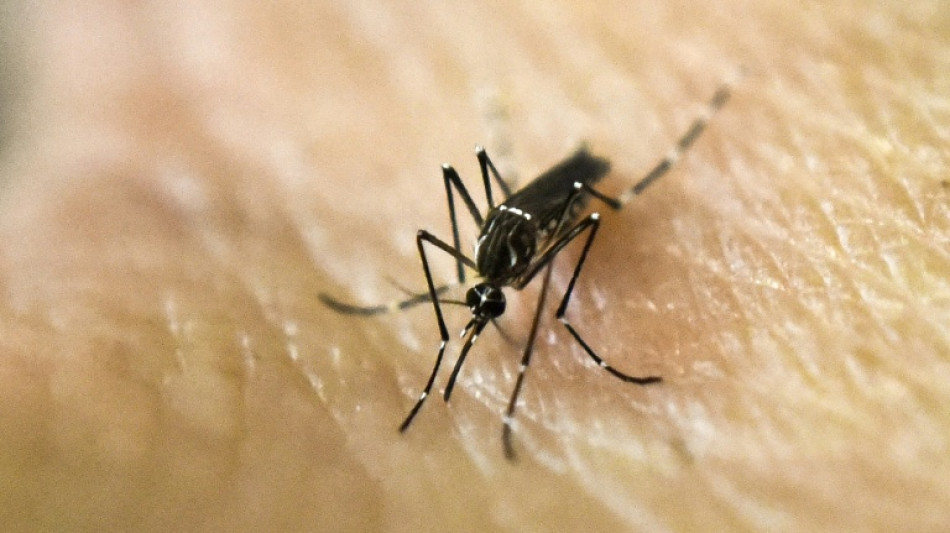
Why are some people mosquito magnets? Clues are emerging / Photo: © AFP/File

 Japan Olympic chief says 'lot more' athletes at Games than expected

 Asian carmakers besting US rivals at home, China poised to strike

 Widgets & Web Offers All-Inclusive Investor Relations Websites for Public Companies, IPOs and SPACs

 Adams named new US captain to 2030 World Cup

 China a better influence in Latin America than US: poll

 Judge pauses construction of border project in Texas national park

 Belgium's De Bruyne fires double to sink Turkey, France held by Italy

 US jobs data boosts stocks as oil prices dip

 US Supreme Court to hear high-stakes climate case

 Trump expected to name intel chief Clayton as AI czar: reports

 Argentina unveils passports-for-investment scheme

 Brazil election debate chaos sparks censorship row
 England's Carse charged by cricket body over nightclub incident

 Amazon vows $1 bn for data center towns, decries 'myths'
 Oil prices drop on G7 fuel release, US jobs data boosts stocks

 G7 agrees deal to ease global energy supply concerns

 Spain's government dealt blow as lawmakers reject housing bills

 Food, medicine shortages deepen in Russian-occupied Oleshky

 Man City whistleblower Rui Pinto facing 'dire consequences' - lawyers

 Russia 'tearing Kyiv apart', mayor says, as strikes paralyse traffic

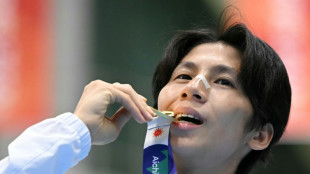 Taiwan boxer Lin wins Games gold as Japan edge North Korea on penalties

 Japan tame North Korea to win Games gold after shootout drama

 US posts weak job growth data in September

 Ethiopia's conflict: the regional dimension

 Life expectancy almost back to pre-Covid levels, says WHO

Ever felt like mosquitoes bite you while ignoring everyone else? Scientists are now making progress in deciphering the complex chemical cocktail that makes particular people more enticing to these disease-spreading bloodsuckers.
"It's not a misconception -- mosquitoes are attracted to some people more than others," Frederic Simard of France's Institute of Research for Development told AFP.
"But we are not all magnets all the time," the medical entomologist added.
A range of sensory cues can cause mosquitoes to pick one human over another -- mainly the smell and heat our bodies give off, and the carbon dioxide we exhale.
Female mosquitoes -- which are the only ones that bite -- detect these signals with finely-tuned receptors, then choose their target accordingly.
"We have known for over 100 years that mosquitoes are attracted by the carbon dioxide that we exhale -- this is the first signal that triggers their behaviour" when they are dozens of metres away, Swedish scientist Rickard Ignell told AFP.
Within around 10 metres, "mosquitoes will start detecting our odour, and in combination with carbon dioxide," this attracts them even more, said the senior author of a recent study on the subject.
As they get closer, body temperature and humidity make particular humans even more enticing.
- Blood type doesn't matter -
However some popular theories on this subject do not hold water.
The idea that mosquitoes prefer particular blood types "has no scientific basis," Simard said.
"There have been some studies, but only involving very few people," he said. "Nor is it related to skin, eye or hair colour," he added.
Odour, on the other hand, matters greatly.
"A soup of molecules produced by our microbiota is more -- or less -- appealing to mosquitoes," Simard explained.
Humans release between 300 and 1,000 different odorous compounds, research has shown, but scientists are only just beginning to understand which ones attract mosquitoes.
For Ignell's recent study, the researchers released Aedes aegypti mosquitoes -- known for spreading yellow fever and dengue -- on 42 women in a lab, to see which ones they preferred.
"We have shown that mosquitoes use a blend of odorous compounds (we identified 27 that the mosquitoes will detect, out of the possible 1,000) for their attraction to us," Ignell said.
The woman the mosquitoes most liked to bite -- which included pregnant women in their second trimester -- produced a large amount of a particular compound made by a breakdown of the skin oil sebum.
That even a small increase of this compound -- called "1-octen-3-ol", or mushroom alcohol -- made a difference came as a surprise, Ignell emphasised.
"Mosquitoes are fascinating creatures," he added.
- Beer makes you attractive -
Drinking beer has also been linked to attracting mosquitoes, because it raises body temperature, increases the amount of exhaled CO2 and changes skin odour, according to several studies.
For standardised research conducted in Burkina Faso, some brave volunteers drank beer, then several days later water, to see which mosquitoes preferred.
The Anopheles mosquito, which can spread malaria, was more enticed by the scent of the beer drinkers.
For a 2023 study in the Netherlands, 465 volunteers put their arms in cages filled with female Anopheles mosquitoes.
The volunteers who had drunk beer in the previous 24 hours were 1.35 times more attractive to the mosquitoes.
Discovering why mosquitoes prefer particular people has becoming a more pressing issue as climate change expands the range where they roam.
For example, the tiger mosquito, a vector for the chikungunya virus, is spreading into new areas. Last year, chikungunya reached as far north as France's Alsace region for the first time.
"This risk is affecting more and more people," Simard said.
So what can you do to avoid getting bitten?
Try loose-fitting clothing that covers your skin, mosquito nets and repellent, Simard advised.
"Try to eat light meals -- and go easy on the alcohol," he added.
B.Shevchenko--BTB