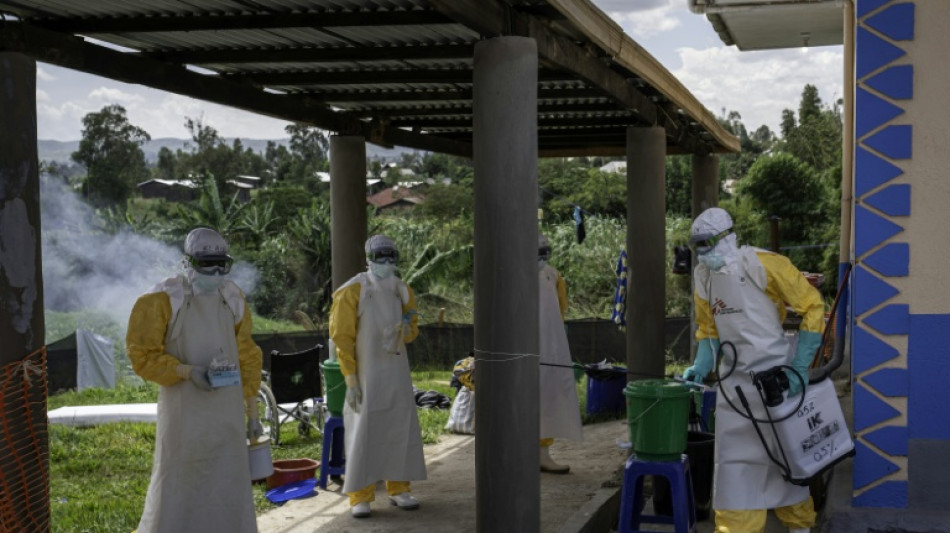
US warns Ebola outbreak on scale of largest 'is possible' / Photo: © AFP

 Prague’s Concert for the Future Kicks Off on Wenceslas Square

 Prince William and Princess of Wales to Announce Earthshot Prize Winners in Mumbai

 Indonesia Forest Fires: Health Crisis, Diplomatic Strains and the Search for Solutions

 BYD Dolphin G Leasing Deal: Plug-in Hybrid Supermini Available from £174 a Month

 JUEL Group Expands from Real Estate to Hospitality with Hyatt Centric Malta Opening

 French Economy Shrinks 0.1% as Consumer Confidence Slumps

 Wall Street Ends Turbulent Week Higher Despite Inflation and AI Jitters

 Kansas City Fed Chief Says Inflation Is Still Running Too Hot

The US CDC on Friday urged strong public health interventions against the current Ebola outbreak, citing their models that show it could otherwise rival the scale of the 2014 West Africa outbreak.
That eruption of the virus resulted in more than 28,000 cases and more than 11,000 deaths.
"That scale is possible," said Jason Asher, director of CDC's Center for Forecasting and Outbreak Analytics, during a press briefing.
The US projections from the Centers for Disease Control and Prevention were part of Morbidity and Mortality Weekly Report documents published Friday.
The worst outcomes could be avoided if "a larger proportion of patients were identified, isolated, and treated," the agency said in its reports.
But "the public health response to control this outbreak will likely need to be of similar magnitude to the response for the 2014-2016 West Africa Ebola outbreak."
Asher emphasized the models were "not a forecast" but "a planning tool."
"They're designed to support action, not to generate alarm."
They are based on four possible intervention scenarios ranging from poor (20 percent) to extremely high (95 percent) levels of isolation and treatment.
If isolation levels are what the CDC would consider poor, with no other interventions there is a 65 percent chance cases will top 20,000 within three months, according to the agency.
Satish Pillai, the CDC manager for the Ebola response, said "the total individuals that are infected and requiring isolation remains unclear."
But he said the situation on the ground would indicate levels of isolation are currently on the lower end.
Also on Friday the World Health Organization and the African Union's public health agency said $518 million was needed across the next six months to combat the deadly Ebola outbreak in the DR Congo and its neighbors.
The outbreak was declared on May 15 in northeastern DR Congo, but the rare Bundibugyo species of the Ebola virus is believed to have spread for some time beforehand.
According to the WHO's latest figures, there are 381 confirmed cases in the DRC, including 64 deaths.
The outbreak has hit three provinces, with the epicenter in Ituri, which the Africa CDC says accounts for 90 percent of confirmed cases and 76 percent of confirmed deaths.
Across the northeastern border in Uganda, there have been 16 confirmed cases, including one death.
Seven Ebola patients in the DRC and two in Uganda have recovered.
S.Keller--BTB



