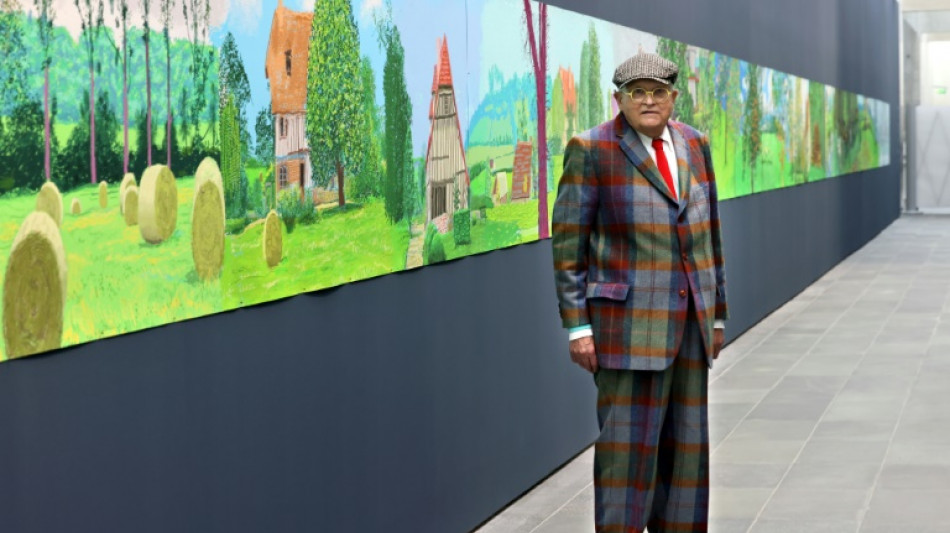
When Hockney told AFP about his lockdown 'blessing' in France / Photo: © AFP

 Prague’s Concert for the Future Kicks Off on Wenceslas Square

 Prince William and Princess of Wales to Announce Earthshot Prize Winners in Mumbai

 Indonesia Forest Fires: Health Crisis, Diplomatic Strains and the Search for Solutions

 BYD Dolphin G Leasing Deal: Plug-in Hybrid Supermini Available from £174 a Month

 JUEL Group Expands from Real Estate to Hospitality with Hyatt Centric Malta Opening

 French Economy Shrinks 0.1% as Consumer Confidence Slumps

 Wall Street Ends Turbulent Week Higher Despite Inflation and AI Jitters

 Kansas City Fed Chief Says Inflation Is Still Running Too Hot

British artist David Hockney, who has died at the age of 88, spoke to AFP in 2021 about spending the months of the Covid-19 pandemic lockdown in France.
They were, he said, a welcome opportunity to devote himself to observing nature.
"I really enjoy looking," he told AFP.
"If you look at the world, it's very beautiful. But you've got to have a clear head and there's lots of things that stop you looking."
Hockney met AFP at the Musee de L'Orangerie in Paris, which was displaying the fruits of that period in an exhibition, "A Year in Normandy".
It featured a 91-metre-long frieze made from some of the 220 pictures he created during the strange year of solitude in 2020.
It is a clear nod to the 19th-century masters of landscape, particularly Claude Monet, occupying some of the neighbouring rooms in the museum.
"When the lockdown came I didn't mind at all," said Hockney, resplendent in his trademark round-rimmed glasses and a checked suit.
"We were in an isolated place and I worked every day because there were no visitors. Visitors put me off, get in the way."
All of the drawings were made on an iPad, which had become his preferred way to make art -- much more than the photographs that used to be so central to his work.
He talked of how he loved drawing on the iPad, freeing him up from the paraphernalia of regular painting.
"It's a new technique," he said. " don't think there's many people doing it."
- 'Nature is the source' -
The dazzling colours of the Normandy countryside were a perfect fit for Hockney, who made his name with sun-soaked scenes from California in the 1960s.
Though known for his jet-set lifestyle, sartorial elegance and large retinue of friends, he was always an industrious worker.
And he was delighted to have time to devote himself to nature, which he said had become his principal muse.
"The first day we came to Normandy, we watched a marvellous sunset over the Seine estuary. We had the clarity of Van Gogh."
He dismissed the idea that landscapes were no longer an interesting subject for art.
"Nature is the source of everything," he said.
"When I went to Yorkshire 16 years ago, people said 'You can't paint landscape today'. I said 'That's just because of the paintings -- the landscape itself can't be boring'.
"The depictions of it have become boring, that's all. You've got to make them a bit different -- and that's what I've tried to do."
M.Furrer--BTB



