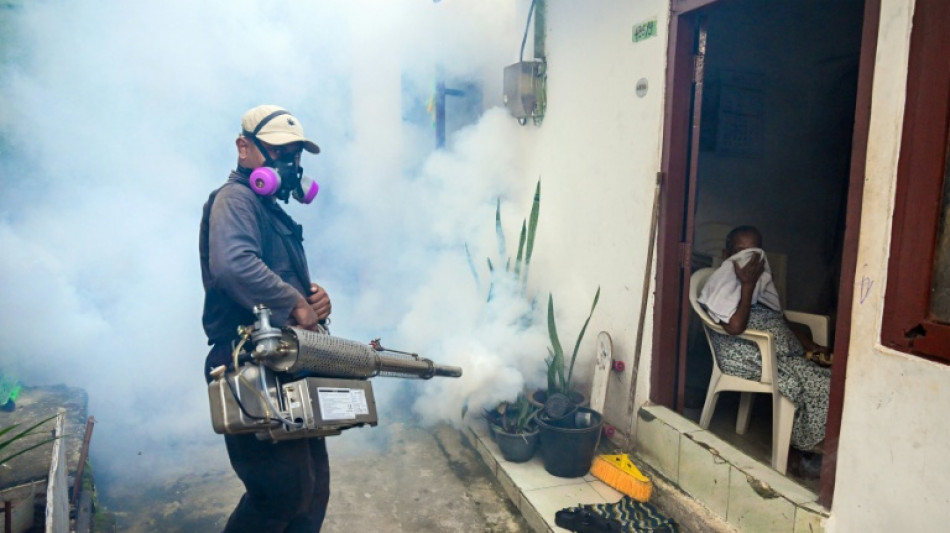
Sri Lanka expands anti-dengue drive as deaths mount / Photo: © AFP/File

 Prague’s Concert for the Future Kicks Off on Wenceslas Square

 Prince William and Princess of Wales to Announce Earthshot Prize Winners in Mumbai

 Indonesia Forest Fires: Health Crisis, Diplomatic Strains and the Search for Solutions

 BYD Dolphin G Leasing Deal: Plug-in Hybrid Supermini Available from £174 a Month

 JUEL Group Expands from Real Estate to Hospitality with Hyatt Centric Malta Opening

 French Economy Shrinks 0.1% as Consumer Confidence Slumps

 Wall Street Ends Turbulent Week Higher Despite Inflation and AI Jitters

 Kansas City Fed Chief Says Inflation Is Still Running Too Hot

Sri Lanka is intensifying a military-backed drive to contain the spread of mosquito-borne dengue fever, a senior official said Wednesday, as the death toll climbed to 49 since the start of the year.
The South Asian island nation deployed the military last month to to identify and destroy mosquito breeding sites.
Beginning Thursday, medical staff and security forces involved in the effort will be doubled, focusing on the capital Colombo and two neighbouring districts, which are the worst-affected areas, said Kapila Kannangara, head of the National Dengue Control Unit.
Dengue causes high fevers, headaches, nausea, vomiting, muscle pain and, in the most serious cases, bleeding that can lead to death.
"We are launching a new drive from tomorrow to expand into more areas with additional staff and security personnel," Kannangara told reporters in Colombo.
Official data shows that 61,057 people were infected in the first six months of this year -- more than double the 30,060 infections recorded during the same period in 2025.
More than 15,000 people have been infected this month alone.
This year's figures are still lower than in 2017, which saw a record 186,000 cases and 440 deaths.
Officials said they needed to control the spread of the virus without delay to prevent overcrowding in hospitals.
The Aedes mosquito that spreads dengue -- identifiable by its black-and-white striped legs -- breeds in stagnant pools.
The World Health Organization has warned that dengue and other mosquito-borne viruses are spreading more rapidly and widely due to climate change.
O.Lorenz--BTB



