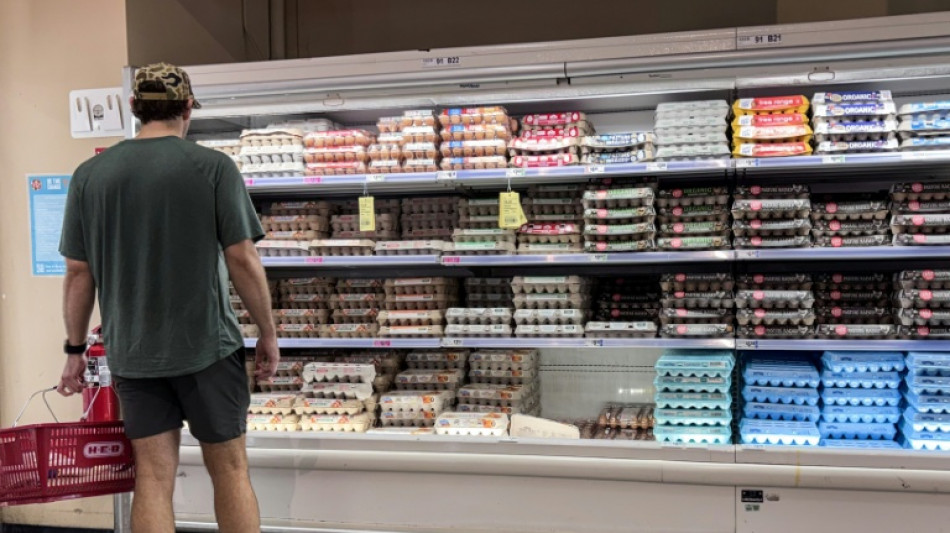
US says 19 million recalled eggs pose deadly risk / Photo: © AFP/File

 Prague’s Concert for the Future Kicks Off on Wenceslas Square

 Prince William and Princess of Wales to Announce Earthshot Prize Winners in Mumbai

 Indonesia Forest Fires: Health Crisis, Diplomatic Strains and the Search for Solutions

 BYD Dolphin G Leasing Deal: Plug-in Hybrid Supermini Available from £174 a Month

 JUEL Group Expands from Real Estate to Hospitality with Hyatt Centric Malta Opening

 French Economy Shrinks 0.1% as Consumer Confidence Slumps

 Wall Street Ends Turbulent Week Higher Despite Inflation and AI Jitters

 Kansas City Fed Chief Says Inflation Is Still Running Too Hot

The US Food and Drug Administration (FDA) has said some 19 million eggs that were voluntarily recalled pose a reasonable risk of serious health consequences, including death.
Midwest Poultry Services voluntarily recalled the eggs over potential contamination with Salmonella Enteritidis on July 22.
The bacteria is linked to sometimes fatal infections, especially in young children, the elderly and people with weakened immunity.
On Wednesday, the FDA designated the recall category as Class 1, meaning "a situation in which there is a reasonable probability that the use of or exposure to a violative product will cause serious adverse health consequences or death."
The eggs were produced in Texas between June 6 and July 3, 2026, with sell by or best by dates between July 20 and August 17, 2026. They were distributed to stores and retail consumers in Texas, Oklahoma, Arkansas, Louisiana, New Mexico, and Mississippi.
In all, 1,589,577 dozen eggs were covered by the recall, and included both white shell eggs and brown cage free shell eggs under a variety of brand names.
The company said it "identified the issue on two of its farm locations in Texas through proactive environmental monitoring practices and a robust internal investigation. The company also initiated its own testing protocols to identify potential sources of" salmonella.
"Do not consume the eggs. You should throw your eggs away or return them to your retailer for a full refund."
It added it was not aware of any specific illnesses linked to its products.
J.Fankhauser--BTB



