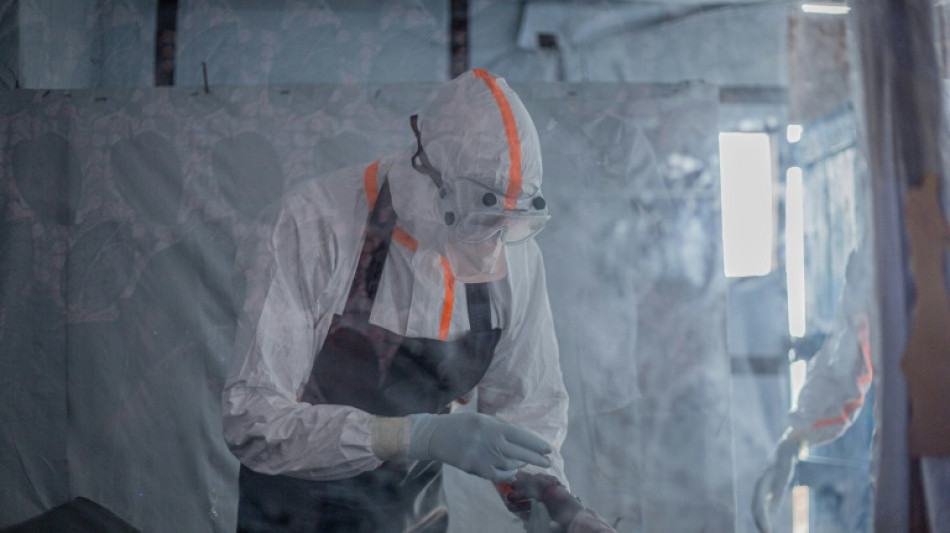
Ebola death toll passes 3,000 in DR Congo: official data / Photo: © AFP

 Prague’s Concert for the Future Kicks Off on Wenceslas Square

 Prince William and Princess of Wales to Announce Earthshot Prize Winners in Mumbai

 Indonesia Forest Fires: Health Crisis, Diplomatic Strains and the Search for Solutions

 BYD Dolphin G Leasing Deal: Plug-in Hybrid Supermini Available from £174 a Month

 JUEL Group Expands from Real Estate to Hospitality with Hyatt Centric Malta Opening

 French Economy Shrinks 0.1% as Consumer Confidence Slumps

 Wall Street Ends Turbulent Week Higher Despite Inflation and AI Jitters

 Kansas City Fed Chief Says Inflation Is Still Running Too Hot

The deadliest ever Ebola outbreak in the Democratic Republic of Congo has now claimed the lives of more than 3,000 people, according to the latest official toll released on Wednesday.
The epidemic, which has hit the conflict-hit east and northeast of the country, has caused 3,007 deaths and infected 6,186 people, the Congolese National Institute of Public Health said.
The fatality rate is 48.6 percent. A total of 1,409 people have been reported to have recovered, it added.
Ebola, which is transmitted through contact with bodily fluids and causes haemorrhagic fever, has killed more than 15,000 people in Africa in the last 50 years.
The worst outbreak previously recorded in DR Congo left nearly 2,300 people dead from 3,500 reported cases between 2018 and 2020.
The current outbreak originated in the remote northeastern province of Ituri and is caused by the Bundibugyo strain, for which there is currently no approved vaccine or treatment.
The virus has spread to six provinces and is ravaging areas where the presence of the Congolese state is weak and insecurity is widespread due to the presence of armed groups.
The health response lacks sufficient resources and has been overwhelmed by the surge in cases, while there has been widespread mistrust in parts of the community.
Several treatments and vaccines are being tested against the Bundibugyo strain. Approved vaccines are only effective against the Zaire strain, which is responsible for the largest-known Ebola outbreak to date.
The World Health Organization has in the meantime recommended the implementation of a phase three clinical trial using the Ervebo vaccine deployed against the Zaire strain.
WHO experts are still unclear as to whether Ervebo protects humans against Bundigbugyo but initial data suggests that it could offer a degree of protection.
A batch of 16,250 doses for use by frontline medical personnel arrived in DR Congo at the end of last month and vaccination began shortly afterwards in Kisangani, the capital of Tshopo province in the northeast.
J.Bergmann--BTB



