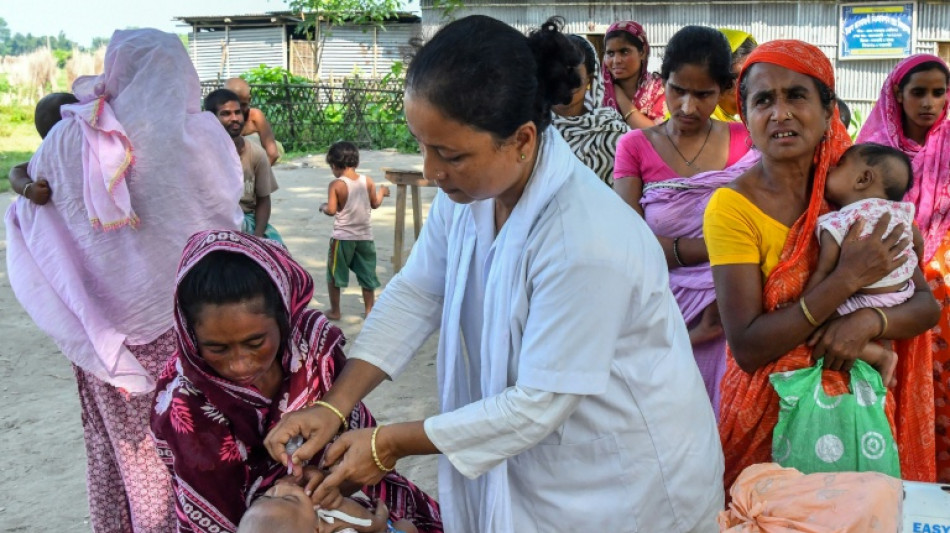
Mobile boat clinics bring healthcare to India's remote islands / Photo: © AFP

 Prague’s Concert for the Future Kicks Off on Wenceslas Square

 Prince William and Princess of Wales to Announce Earthshot Prize Winners in Mumbai

 Indonesia Forest Fires: Health Crisis, Diplomatic Strains and the Search for Solutions

 BYD Dolphin G Leasing Deal: Plug-in Hybrid Supermini Available from £174 a Month

 JUEL Group Expands from Real Estate to Hospitality with Hyatt Centric Malta Opening

 French Economy Shrinks 0.1% as Consumer Confidence Slumps

 Wall Street Ends Turbulent Week Higher Despite Inflation and AI Jitters

 Kansas City Fed Chief Says Inflation Is Still Running Too Hot

An infant lets out a feeble cry as a doctor administers a routine but vital injection aboard a mobile boat clinic, part of a network serving remote riverine communities in northeastern India.
Hundreds of thousands of people in Assam state, crisscrossed by the Brahmaputra river, live on "chars", or temporary river islands and sandbars where access to even basic healthcare can be a challenge.
More than 2,000 such islands dot the state where there are limited health facilities, most "with little or no manpower", according to the local government.
But the network of mobile boat clinics has brought doctors, medicines, vaccines and basic laboratory services to 13 districts across the state.
For thousands of villagers on these remote islands -- many prone to flooding and erosion -- the clinics provide a vital link to healthcare.
"We are totally dependent on the boat clinic," said Rekibul Amin, a resident of the Barballa river island in Nalbari district, which has no medical facilities at all.
"Whatever medicines people receive here, they get them through the boat clinic," Amin said, adding that women in particular had "benefited greatly".
An initiative of non-profit The Centre for North East Studies and Policy Research, the "Akha" -- Assamese for "hope" -- boat network was launched in 2005.
It has expanded to 15 boats, with support from authorities and UNICEF, now serving roughly 20,000 people a month, according to the UN agency.
Maternal and infant health are the main areas of focus, in a bid to help reduce mortality rates that exceed that national average.
Despite significant gains in recent years, infant and maternal mortality rates continue to languish in Assam, a state of more than 30 million people.
According to official figures, the state has an average of 29 infant deaths and 34 under-five deaths per 1,000 live births, compared with national rates of 24 and 28 deaths, respectively.
Maternal deaths in Assam stood at 125 per 100,000 live births as against 88 nationally.
"Mainly, we are targeting the pregnant women who need the antenatal care checkup and the newborn babies who need the routine immunisation," said Habibul Hoque, medical officer at a boat clinic serving Nalbari.
"We are very happy to serve the people of these 'char' areas," he said, where poverty and illiteracy are some of the barriers to healthcare access.
Y.Bouchard--BTB