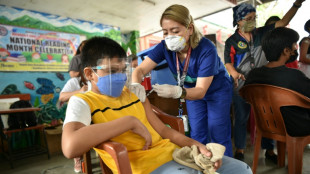
Study confirms AstraZeneca jab's higher risk of very rare clot / Photo: © AFP/File

 Lula, Bolsonaro wrap up campaigns ahead of Brazil's knife-edge vote

 Toulouse edge Castres in Top 14 derby

 Murakami homer propels White Sox to MLB playoff win over Guardians

 Israel targets top Hamas leader in deadly Gaza strike on anniversary

 Houthis say struck oil facility near Riyadh, as Saudis hit Sanaa

 AI needs safety layers like nuclear plants: ex-OpenAI engineer

 MVP Judge will miss Yankees' MLB playoff series against Rays

 New lizard species discovered in Peru

 Fernandes hails Portugal's 'greatest symbol' Ronaldo, calls for unity

 Grandidier-Nkanang double takes Pau to Top 14 summit despite Vannes fightback

 Trainer Scott gets perfect Arc boost with top notch double

 Ex-PM says Putin cannot admit 'mistake' over Ukraine

 Houthis say Saudi Arabia launches dozens of strikes on Yemen capital

 Qatar and Abu Dhabi F1 Grand Prix to go ahead - F1 boss

 South Korea lift gloom with smash-and-grab Games football gold

 Ireland news conference before Israel game cut short amid tensions

 Protests over housing flare in Spain after relief measures rejected

 Zverev thrashes Shang to set up Djokovic quarter-final at China Open

 Turkey football ref chief jailed pending trial for graft
 North Korea says test of intermediate-range strategic missile included use of AI

 Rampant Sayers leads Hong Kong to third men's rugby gold in a row

 Ethiopia's Tigray rebels abandon regional capital as govt advances

 Bulgaria's Tsar Samuel returns 'home' after 1,000 years

 'Glad it's over': Kim powers to Games gold and military exemption

 After 11 World Cups, football finally comes home for one Indian fan

AstraZeneca's Covid vaccine has been linked to a 30-percent higher risk of getting a very rare blood clotting condition compared to the Pfizer jab, a large international study said Thursday.
Several countries have already altered their advice after previous research indicated that -- in a tiny number of cases -- thrombosis with thrombocytopenia syndrome (TTS) can be a possible side effect of Covid vaccines that use an adenovirus vector, or "engineered" virus, such as those from AstraZeneca and Johnson & Johnson.
Thrombocytopenia produces potentially life-threatening blood clots with low levels of blood platelets -- the small cell fragments in our blood that prevent bleeding.
The new study, published in the journal BMJ, was the first to compare thrombocytopenia rates between adenovirus and mRNA vaccines -- such as Pfizer -- across multiple countries.
The international research team analysed health data from more than 10 million adults in France, Germany, the Netherlands, Spain, the United Kingdom and the United States who received at least one vaccine dose between December 2020 and mid-2021.
In Germany and the UK, they matched the data of 1.3 million people who had a first dose of AstraZeneca to 2.1 million who took Pfizer.
There were a total of 862 "thrombocytopenia events" recorded in the 28 days after a first dose of AstraZeneca, compared to 520 for Pfizer, the study said.
That meant AstraZeneca's vaccine had a 30-percent higher risk of thrombocytopenia than Pfizer.
However when it came to a second dose, there was no additional risk between any of the vaccines.
The study was observational, meaning it could not show cause and effect. But the researchers said that additional analysis found the results to be consistent.
While very rare, these risks "should be considered when planning further immunisation campaigns and future vaccine development," the study said.
- 'Safe and effective' -
Sarah Pitt, a microbiologist at the UK's Brighton University who was not involved in the research, said the "well-designed" study "adds to the data showing that all vaccines are safe and effective".
The "extremely rare" cases of thrombocytopenia occurred after just 0.04 percent of vaccine doses in Germany and the UK, she told AFP.
Most countries had already been avoiding using adenovirus Covid vaccines for the older and young age groups who are more at risk, she added.
European countries have largely pivoted towards mRNA vaccines. AstraZeneca's jab was never authorised in the US, which limited the use of the Janssen (Johnson & Johnson) COVID-19 jab to certain individuals earlier this year
However both AstraZeneca and Johnson & Johnson's vaccines play a pivotal role in Covax global vaccine distribution scheme, which provides doses to lower-income countries.
C.Kovalenko--BTB