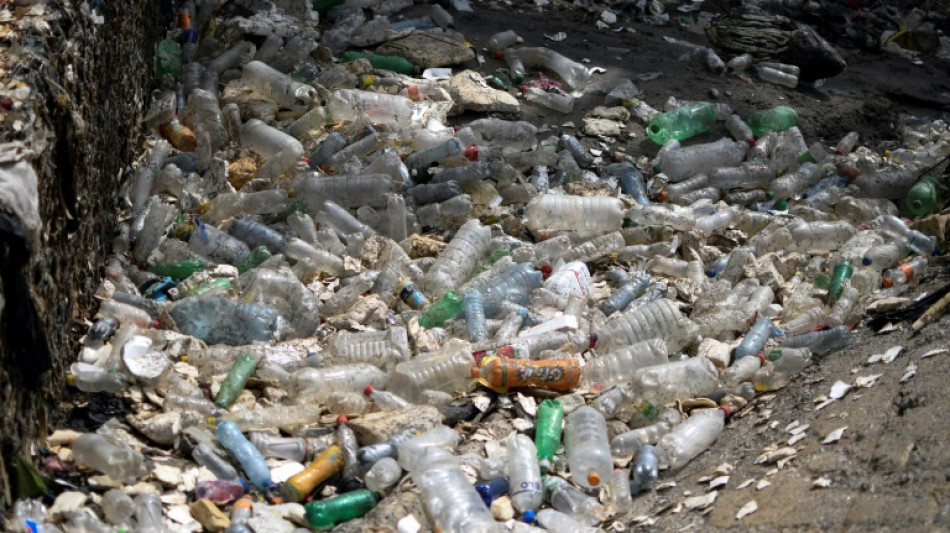
Talks kick off on global plastic trash treaty / Photo: © AFP/File

 Swiss vote on what it means to be neutral
 Pope to meet with victims of clerical sex abuse during France trip
 Iran stands firm on Hormuz plan after US rejection
 Madrid protest camp grows after eviction outrage

 Italy winemakers hail bumper harvest but cut output

 Kyiv shoppers feel the pinch from Russian strikes
 Japanese anime actor fights TikTok over AI voice cloning
 Curtain falls on the romance of India's single-screen cinemas

 Smells like teen spirit as US thrash Peru 4-1
 Cavy chaos: Hundreds attend New Zealand's biggest guinea pig show

 Venezuela releases more political prisoners after opposition talks

 England's best 'for a long time' despite Spain defeat, says Kane

 Powerful storm pummels northeast US with rain, high winds

 Filmmaker Mike Leigh wins top prize at Spain festival with 'last film'

 Spain beat England in Nations League to extend unbeaten run

 Ireland squad vote to play Israel tie despite Gaza unease

 Gutsy Vollering wins cycling road race world title
 Vollering wins cycling road race world title
 Man City's meteoric rise clouded by dark shadow

 Mbappe out for two weeks or more with knee injury say Real
 Lyon collapse away to Stade and suffer first Top 14 loss
 Russia accuses Europe of seeking to thwart Ukraine talks

 Man City chairman defiant over reported Premier League charges
 Germany ready to 'walk through fire' for Klopp, says Tah
 At least 16 killed in Russian and Ukrainian strikes

Despite decades of effort, plastic pollution is only getting worse -- a gloomy fact that representatives of almost 200 nations meeting in Uruguay Monday are determined to change.
Delegates in the seaside city of Punta Del Este began charting a path to the first global treaty to combat plastic pollution.
"We know that the world has a significant addiction to plastic," said Inger Andersen, Executive Director of the Nairobi-based United Nations Environment Programme, at the start of the talks.
"A plastic crisis is also a climate crisis. Plastic has a heavy carbon footprint and a heavy chemical footprint," she said.
The Uruguay meeting comes after the parties at the UN Environment Assembly in Nairobi in March agreed to create an intergovernmental committee to negotiate and finalize a legally binding plastics treaty by 2024.
The decision was seen as the biggest environmental advance since the Paris Agreement to curb global warming was signed in 2015.
By some estimates, a garbage truck's worth of plastic is dumped into the sea every minute. The amount of plastic entering the oceans is forecast to triple by 2040.
At the same time, microplastics have been found in human blood, lung, spleen, and kidney tissue, and even in fetal tissue.
Experts believe it is only an international, legally binding agreement that could truly begin to halt one of the worst environmental scourges on the planet -- if there is enough political will.
The meeting in Uruguay will last for five days, and is only a first step in the negotiations process. Another four global meetings are planned to carry the process forward.
Technical matters, such as how to structure the two years of talks, or even what should be included in the treaty, are up for discussion.
"It is ambitious to end plastic pollution, but it is entirely doable," said Andersen.
She said the delegates would work together to "transform the entire life cycle of plastic," from the production of polymers, to the way brands and retailers use plastic, to the waste that emerges.
"That means working with the private sector, that means working with environmentalists, that means working with communities, that means strong political leadership," said Andersen.
According to the World Wide Fund for Nature (WWF) the total plastic in the ocean has increased 50 percent in the past five years. This is despite a 60 percent increase in policies to fight plastic pollution on the country level.
"The unique potential of a global treaty is to hold all signatories to a high common standard of action," the WWF said in a report on the treaty published this month.
R.Adler--BTB


