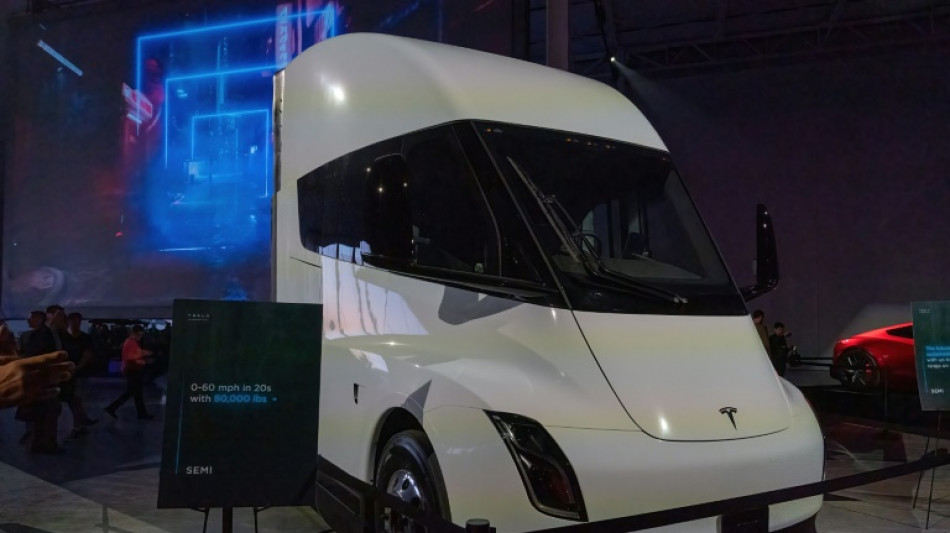
Tesla hoping electric 'Semi' will shake up heavy duty market / Photo: © AFP/File

 How young is too young as child prodigies win big at Asian Games

 UK Labour party meets buoyed by Burnham but eager for concrete plans

 Thousands protest ahead of Mexican president's report on missing students
 Bangkok floods force thousands into shelters

 AI startup urges optimism from Europe despite safety fears

 'Godlike, invincible': Japan hails 11-year-old Games history-maker

 Nepal's hydropower ambitions face climate reality check

 Power cuts, rubble: millions come home to find Sudan's capital unlivable

 Internationals keep Presidents Cup lead with late fightbacks

 Tuchel to 'keep pushing' England to reach Spain's level

 Alcaraz saves match points to keep Europe ahead in Laver Cup

 Spain success driven by hunger to improve, says De La Fuente

 Lyon collapse at Stade Francais to suffer first Top 14 loss

 Oyarzabal and Spain sink England again as Modric shines for Croatia

 Housing protesters camp in central Madrid after mass demonstration

 Louise Trotter expands her palette at Bottega Veneta

 Pope prays at Lourdes after huge Paris mass

 USA trims International lead after Presidents Cup four-balls

 Russia accuses Europe of blocking Ukraine talks, as strikes drag on

 'He said hello': Families pray with pope on Paris avenue

 Pope celebrates giant Paris mass, flies to Lourdes

 Thousands march in Madrid over eviction of 87-year-old woman

 England women back to winning ways with last-gasp defeat of New Zealand

 Trump rejects Iran proposal for deal to reopen Hormuz

 England's Cox says injured Buttler leaves 'big shoes to fill'

After years of delays, US automaker Tesla is expected on Thursday to deliver its first battery-powered semi truck, with which it hopes to get a jump start on the nascent electric heavy duty vehicle market by offering longer ranges without recharging.
The Elon Musk-led company is scheduled to hand over the keys to its first electric truck -- dubbed "Semi" -- at its Nevada manufacturing plant to multinational food company PepsiCo.
With its sleek design, the Tesla electric semi has been highly anticipated since Musk unveiled a prototype in 2017, but the launch of full-scale production has been delayed well past the initial 2019 expectation.
Other manufacturers have meanwhile entered the market, from traditional truck makers such as Daimler, Volvo and China's BYD, to startups like US company Nikola.
The competition has also begun to roll out their deliveries, and have many orders of their own waiting to fill.
However, the truck that "the market has been waiting for... is the one from Tesla," says Dave Mullaney, a transportation specialist with sustainability think tank RMI.
Legacy manufacturers have primarily converted their diesel-designed trucks to electric.
"The Tesla, on the other hand, was designed to be electric from the very first design," says Mullaney, who also underlined the company's 15 years of experience in electric vehicles.
If the Tesla vehicle lives up to expectations, "it's going to be a huge difference," Mullaney says.
In a tweet on Saturday, Musk said that one Semi had driven 500 miles (800 kilometers) with a total weight of 81,000 pounds (nearly 37 tons).
The electric vehicles currently on offer only have a range of 250 to 300 miles.
- Physical limitations? -
To carry heavy loads over such long distances, the battery "needs to be very large -- that makes it very heavy, takes up a lot of space and is very costly," says Mike Roeth, director of the North American Council for Freight Efficiency (NACFE).
"The industry has kind of been wondering whether you can physically package that much battery" and keep the truck's weight low enough to be able to do the job, Roeth adds.
With the ability to travel up to 500 miles without recharging, long-distance trips in electric trucks would be much more feasible, allowing drivers to return to warehouses in the same day.
Even longer trips could be taken over several days if drivers can find charging stations at truck rest stops.
The use of electric light duty vehicles for short-haul deliveries has been steadily growing for some time, but new regulations are pushing manufacturers and transporters to speed up the transition and build out long-haul capabilities.
The most populous US state, California, has passed a law phasing out combustion engine trucks, which has since been followed by other states.
The European Union is also expected to debate new standards in the coming months.
Companies are also facing pressure to have more environmentally conscious reputations.
They "want to be on the right side of history," says Marie Cheron of the Europe-based association Transport & Environment.
Those who do not commit to a decarbonization strategy, some of whom say they are waiting for technologies to improve, "are falling behind," she says.
Another motivation to transition, Roeth says, is that drivers who have been able to test them, "love the electric trucks a lot."
"They're very quiet, they don't have the smells of the exhaust, and they are comfortable to drive."
- Cost considerations -
For the adoption of electric trucks to accelerate, their range must truly live up to promises and batteries ideally would shrink, several analysts told AFP.
The charging infrastructure must also be built out.
That means adding more charging stations, but also building an electric distribution system strong enough to allow, for example, ten trucks to plug in at the same time in one parking lot.
The biggest factor will certainly be price.
An electric truck costs about 70 percent more to buy than a diesel truck at the moment, but in terms of energy and maintenance, it's cheaper, Mullaney says.
"Battery electric vehicles will be competitive with diesel... it's only a matter of time," a spokeswoman for the American manufacturer Navistar, a subsidiary of Traton, told AFP.
Wedbush Securities analyst Dan Ives says that Tesla must now "prove they can produce at scale, they need to execute."
In late October, Musk said that Tesla is aiming to build 50,000 Semis by 2024.
In 2018, when production of Tesla's Model 3 sedan struggled to ramp up, Musk showed that he was capable of getting his teams to speed up.
Ives says Musk's attention is unfortunately focused on his newest acquisition, Twitter.
"The circus show there takes away a monumental moment in Tesla history," he adds.
J.Fankhauser--BTB


