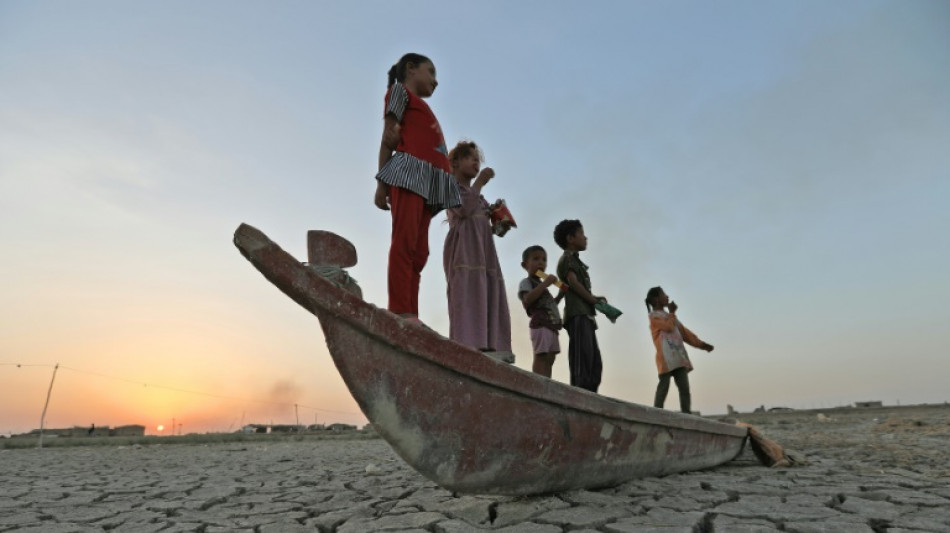
After year of climate disasters, world off-track to curb warming / Photo: © AFP/File

 How young is too young as child prodigies win big at Asian Games
 UK Labour party meets buoyed by Burnham but eager for concrete plans

 Thousands protest ahead of Mexican president's report on missing students
 Bangkok floods force thousands into shelters

 AI startup urges optimism from Europe despite safety fears

 'Godlike, invincible': Japan hails 11-year-old Games history-maker

 Nepal's hydropower ambitions face climate reality check

 Power cuts, rubble: millions come home to find Sudan's capital unlivable

 Internationals keep Presidents Cup lead with late fightbacks

 Tuchel to 'keep pushing' England to reach Spain's level

 Alcaraz saves match points to keep Europe ahead in Laver Cup
 Spain success driven by hunger to improve, says De La Fuente

 Lyon collapse at Stade Francais to suffer first Top 14 loss
 Oyarzabal and Spain sink England again as Modric shines for Croatia

 Housing protesters camp in central Madrid after mass demonstration

 Louise Trotter expands her palette at Bottega Veneta

 Pope prays at Lourdes after huge Paris mass

 USA trims International lead after Presidents Cup four-balls

 Russia accuses Europe of blocking Ukraine talks, as strikes drag on

 'He said hello': Families pray with pope on Paris avenue

 Pope celebrates giant Paris mass, flies to Lourdes

 Thousands march in Madrid over eviction of 87-year-old woman
 England women back to winning ways with last-gasp defeat of New Zealand
 Trump rejects Iran proposal for deal to reopen Hormuz
 England's Cox says injured Buttler leaves 'big shoes to fill'
Catastrophic floods, crop-wilting droughts and record heatwaves this year have shown that climate change warnings are increasingly becoming reality and this is "just the beginning", experts say, as international efforts to cut planet-heating emissions founder.
The year did see some important climate progress, with major new legislation particularly in the United States and Europe as well as a deal at the UN climate talks to help vulnerable countries cope with an increasing onslaught of devastating climate impacts.
But the goal of keeping warming within a safer limit of 1.5 degrees Celsius since the pre-industrial era appears increasingly in peril, with carbon dioxide emissions from fossil fuels -- the main driver of global heating -- on track to reach an all-time high in 2022.
United Nations chief Antonio Guterres warned world leaders at a climate summit in Egypt in November that humanity faces a stark choice between working together in the battle against global warming or "collective suicide".
They opted to put off the most important decisions for another time, observers say.
This year UN climate science experts issued their strongest warning yet of the dangers facing people and planet, with a landmark report on climate impacts in February dubbed an "atlas of human suffering".
Since then a series of extreme events has illustrated the accelerating dangers of climate change, at barely 1.2C of warming.
Record heatwaves damaged crops from China to Europe, while drought has brought millions to the point of starvation in the Horn of Africa.
Floods super-charged by climate change engulfed Pakistan, affecting 33 million people and causing some $30 billion in damage and economic losses.
"The year 2022 will be one of the hottest years on earth, with all the phenomena that go with higher temperatures," said climate scientist Robert Vautard, head of France's Pierre-Simon Laplace Institute.
"Unfortunately, this is just the beginning."
This year is on track to be the fifth or sixth warmest ever recorded despite the impact, since 2020, of La Nina -- a periodic and naturally occurring phenomenon in the Pacific that cools the atmosphere.
When this phenomenon reverses, potentially within months, the world will likely climb to a "new level" in warming, said Vautard.
- Still polluting -
Economy-battering climate extremes, which amplified the energy price surges for many countries as a result of Russia's invasion of Ukraine, provided the backdrop to last month's high-stakes UN climate talks in Egypt.
The negotiations did make history, with wealthy polluters agreeing to a fund to pay for climate damage increasingly unleashed on poorer countries.
Pakistani climate minister Sherry Rehman called the move a "down payment on the longer investment in our joint futures".
But vulnerable nations and campaigners said the Egypt conference failed to deliver on the emissions reductions needed to curb climate losses and damages in the future.
"COP27 tackled the consequences of climate change, but not the cause -- fossil fuels," said Harjeet Singh of Climate Action Network.
To keep the 1.5C limit in play, planet-heating emissions need to be slashed 45 percent by 2030, and be cut to net zero by mid-century.
At 2021 UN talks in Glasgow, nations were urged to ramp up their emissions reduction commitments.
But only around 30 countries have heeded that call, leaving the world on track to hot up by about 2.5C.
- 'Emergency room' -
Guterres decried the failure of the climate talks to address the drastic emissions cuts needed, adding: "Our planet is still in the emergency room."
He has also urged nations to urgently address the other main existential crisis facing humanity and the planet -- the loss of biodiversity -- which is the subject of a crunch meeting in Montreal from December 7 to 19.
Nature has been gravely damaged by human activity and the UN talks are tasked with outlining a roadmap for protecting the land and ocean ecosystems that provide Earth's life support.
A series of potentially crucial climate milestones will then stretch through next year.
These will include spring meetings of the International Monetary Fund and World Bank, following "a formal request to look at the international financial system and to review the role of international financial institutions" from the Egypt climate talks, said Laurence Tubiana, who leads the European Climate Foundation.
The next UN climate meeting in November 2023 -- held in fossil fuel exporter the United Arab Emirates -- will see the publication of a "global stocktake" of progress on the 2015 Paris Agreement goal to limit warming to well below 2C, and preferably 1.5C.
Tubiana, a key architect of the Paris deal, said the talks in Dubai will likely be dominated by discussion of the oil and gas industry and its financial contribution.
The issue is likely to create "great tension", she predicted.
R.Adler--BTB


