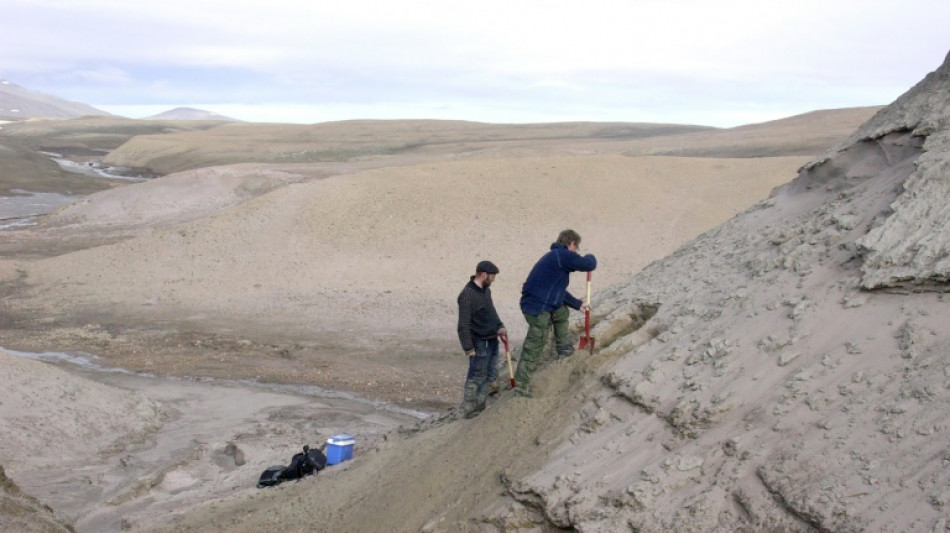
Scientists find 2-million year-old DNA in Greenland / Photo: © SVEND FUNDER/AFP

 How young is too young as child prodigies win big at Asian Games

 UK Labour party meets buoyed by Burnham but eager for concrete plans

 Thousands protest ahead of Mexican president's report on missing students

 Bangkok floods force thousands into shelters

 AI startup urges optimism from Europe despite safety fears

 'Godlike, invincible': Japan hails 11-year-old Games history-maker

 Nepal's hydropower ambitions face climate reality check

 Power cuts, rubble: millions come home to find Sudan's capital unlivable

 Internationals keep Presidents Cup lead with late fightbacks

 Tuchel to 'keep pushing' England to reach Spain's level

 Alcaraz saves match points to keep Europe ahead in Laver Cup

 Spain success driven by hunger to improve, says De La Fuente

 Lyon collapse at Stade Francais to suffer first Top 14 loss

 Oyarzabal and Spain sink England again as Modric shines for Croatia

 Housing protesters camp in central Madrid after mass demonstration

 Louise Trotter expands her palette at Bottega Veneta

 Pope prays at Lourdes after huge Paris mass

 USA trims International lead after Presidents Cup four-balls

 Russia accuses Europe of blocking Ukraine talks, as strikes drag on

 'He said hello': Families pray with pope on Paris avenue

 Pope celebrates giant Paris mass, flies to Lourdes

 Thousands march in Madrid over eviction of 87-year-old woman

 England women back to winning ways with last-gasp defeat of New Zealand

 Trump rejects Iran proposal for deal to reopen Hormuz

 England's Cox says injured Buttler leaves 'big shoes to fill'

Scientists in Greenland announced Wednesday they had found DNA dating back two million years -- the oldest ever extracted -- in sediment from the Ice Age, opening a new chapter in paleogenetics.
"We are breaking the barrier of what we thought we could reach in terms of genetic studies," said Mikkel Winther Pedersen, co-author of a new study published in science journal Nature.
"It was long thought that one million years was the boundary of DNA survival, but now we are twice as old" as that, told AFP.
They found the DNA fragments in sediment from the northernmost part of Greenland known as Kap Copenhagen, said the University of Copenhagen lecturer.
The fragments "come from an environment that we do not see anywhere on Earth today," he added. Frozen in a remote unpopulated area, the DNA had been very well preserved.
New technology enabled the scientists to determine that the 41 fragments were more than a million years older than the oldest known DNA, from a Siberian mammoth.
They had to first determine whether there was DNA hidden in the clay and quartz, then see whether it could be removed from the sediment to examine it.
The method used "provides a fundamental understanding of why minerals, or sediments, can preserve DNA", said Karina Sand, who heads the geobiology team at the University of Copenhagen and who took part in the study.
"It's a Pandora's box we're just about to open up", she added.
- Species adaptability -
The "rivers running through the environment transported minerals and organic material into the marine environment and this was where these terrestrial sediments were deposited", said Winther Pedersen.
Then, at some point around two million years ago, "this land mass beneath the water was raised up and became a part of North Greenland", he explained.
Today, Kap Copenhagen is an Arctic desert, where different types of deposits, including plant and insect fossils preserved in excellent condition, have already been discovered.
But scientists hadn't tried to establish the fossils' DNA, and very little was known about the presence of animals at the time.
The research team, which began its work in 2006, has now made it possible to paint a picture of what the region looked like two million years ago.
"We had this forested environment with mastodons and reindeer and hares running around in the landscape together with a lot of different plant species", he said, they had found 102 different kinds of plant.
The presence of mastodons was particularly noteworthy, he added, never having been found so far north before. The discovery has also given researchers more information about the adaptability of species.
Two million years ago, Greenland had temperatures 11 to 17 degrees warmer than today, but at its latitude, the sun doesn't set in summer nor rise in winter.
"We don't see this environment anywhere, this mix of species anywhere on Earth today", said Winther Pedersen.
"The plasticity in species, how species are actually able to adapt to different types of climate, might be different than what we previously thought.
"And obviously, it makes us look for newer and older sites.
"There are several different sites across the world that actually have geological deposits that go this far back. And even further back," ha added.
B.Shevchenko--BTB


