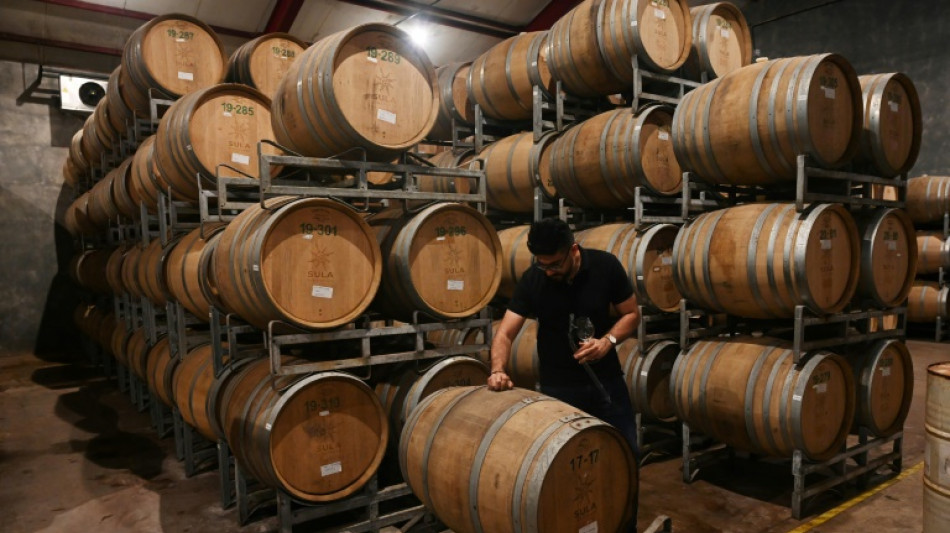
Grape expectations: India's biggest winemaker seeks millions / Photo: © AFP

 How young is too young as child prodigies win big at Asian Games

 UK Labour party meets buoyed by Burnham but eager for concrete plans

 Thousands protest ahead of Mexican president's report on missing students

 Bangkok floods force thousands into shelters

 AI startup urges optimism from Europe despite safety fears

 'Godlike, invincible': Japan hails 11-year-old Games history-maker
 Nepal's hydropower ambitions face climate reality check

 Power cuts, rubble: millions come home to find Sudan's capital unlivable

 Internationals keep Presidents Cup lead with late fightbacks

 Tuchel to 'keep pushing' England to reach Spain's level

 Alcaraz saves match points to keep Europe ahead in Laver Cup

 Spain success driven by hunger to improve, says De La Fuente

 Lyon collapse at Stade Francais to suffer first Top 14 loss
 Oyarzabal and Spain sink England again as Modric shines for Croatia

 Housing protesters camp in central Madrid after mass demonstration

 Louise Trotter expands her palette at Bottega Veneta

 Pope prays at Lourdes after huge Paris mass

 USA trims International lead after Presidents Cup four-balls

 Russia accuses Europe of blocking Ukraine talks, as strikes drag on

 'He said hello': Families pray with pope on Paris avenue

 Pope celebrates giant Paris mass, flies to Lourdes

 Thousands march in Madrid over eviction of 87-year-old woman

 England women back to winning ways with last-gasp defeat of New Zealand

 Trump rejects Iran proposal for deal to reopen Hormuz

 England's Cox says injured Buttler leaves 'big shoes to fill'

India's largest winemaker Sula Vineyards is heading to the stock market, betting on the diversifying tastebuds of a booming urban middle class in a country that has long favoured strong liquor.
Wine makes up less than one percent of India's massive alcohol market, with spirits the overwhelming drink of choice in the nation of 1.4 billion people.
On average, Indians each drink only a few spoonfuls of wine a year, but producers hope the country will replicate the wine boom in China when its economy took off in the 1980s.
Still, experts warn their rosé ambitions are tempered by uncertainties including the impact of climate change on viniculture, and an Australian trade deal lowering import tariffs.
"Wine's time has come," insists Sula's founder and CEO Rajeev Samant.
When the Stanford University graduate returned from California, he initially tried growing roses and mangoes on family-owned land near Nashik, an ancient holy city about 160 kilometres (100 miles) from financial hub Mumbai.
"Where Sula is today, it was just grassland. There were leopards and snakes. There was no electricity, there was no telephone line," as if it was a century earlier, Samant told AFP.
"I saw some beauty here, there was something about the place that really struck me."
India is one of the world's biggest grape producers and Nashik is one of its key regions, but back then the vines were all table grapes for eating and raisins, rather than wine grapes.
Samant was inspired by his visits to California's Napa Valley wine country.
"Why not try to make a decent, drinkable wine right here in India, proudly made in India?" he thought. "And that's what I decided to do."
Named after Samant's mother Sulabha, Sula planted its first vines in 1996, later building a sprawling resort and helping to cultivate a new reputation for Nashik as India's wine capital.
Applications for shares in its IPO open next week, it said Wednesday, with its owners selling around a third of the company for up to 9.6 billion rupees ($116 million), valuing it at about $350 million.
- Sweet tooth -
Higher-priced Indian wines are becoming comparable to their international peers in terms of quality, according to Ajit Balgi, founder of Mumbai-based wine and spirit consultancy The Happy High, although they remained "Indian style" in flavour.
"They won't be tasting the same as an Australian or a French wine," he said. "India is too close to the equator, so our grapes that we choose are the riper ones."
New drinkers tended to have a sweet tooth and were attracted to "jammier" wines, he added. "Most start their association with wine with sangria."
Wine consumption in India has risen from negligible levels in 1995, while women drinking in public has become more acceptable as more joined the workforce, but volumes still stood at just 20 million litres last year, according to the International Organisation of Vine and Wine.
Mumbai businessman Parimal Nayak is a fan, and visited the Sula vineyard with his family to celebrate his 44th birthday.
"Sula wines has improved a lot... and the atmosphere here is good," he told AFP. "I'm proud of it."
But the biggest obstacle to expansion was cost, said Balgi.
Wine is often taxed at similar levels to spirits in many Indian states, despite having much lower alcohol content.
"The price of a basic Indian wine is comparable to that of a full bottle of rum or basic whisky," he said. "There is not much wine consumption in India because the masses cannot afford it."
- Last glass -
Sula reported revenues of 4.5 billion rupees and a net profit of 521 million rupees in the last financial year, and saw average annual revenue growth of more than 13 percent in the decade to March 2022.
Samant, 55, plans to sell around five percent of his 27 percent stake in the firm.
But several recent Indian tech IPOs have flopped. Payments firm Paytm has lost three-quarters of its value since listing a year ago, and analysts say many firms are overvalued.
Previous wine pioneer Indage Vintners delisted in 2011 after debt and cash problems.
Sula could face increasing competition from foreign wine, which currently makes up 17 percent of the Indian market.
A recent trade pact with its biggest supplier Australia will cut import duties for some wines from a punishing 150 percent.
Sula, meanwhile, warned in its IPO prospectus about the risk of "adverse climatic conditions" affecting grape quality.
Farmers in Nashik were already reporting floods and droughts nearly a decade ago, said the Mumbai-based World Resources Institute India's climate programme manager Prutha Vaze.
Higher average temperatures also hasten grape ripening, lowering acidity and increasing sugars, which raises alcohol levels in wine. These changes impact a wine's delicate balance of flavours, experts say.
If growers do not adapt to the changing climate, Vaze said, "there could be a day where we are... biting on the last piece of chocolate or having the last glass of wine".
K.Thomson--BTB


