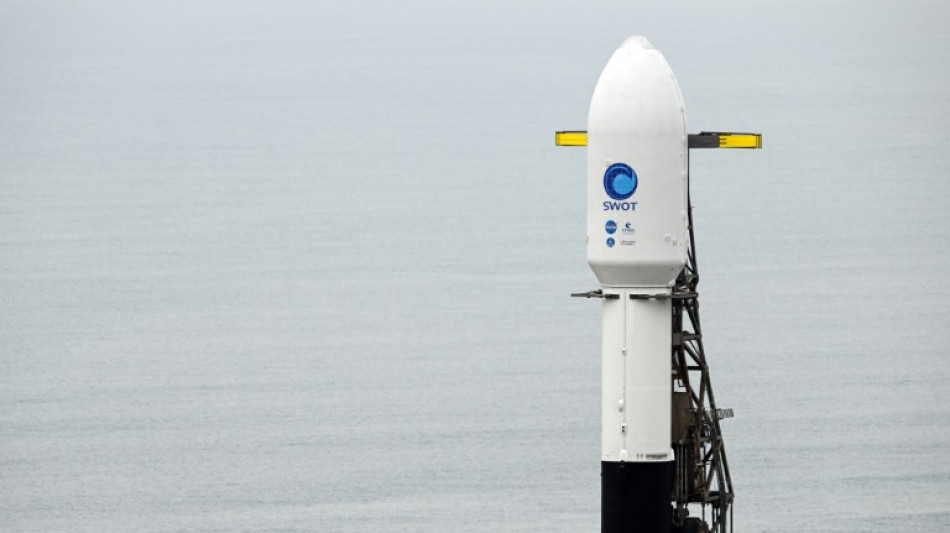
NASA launches satellite for landmark study of Earth's water / Photo: © AFP

 How young is too young as child prodigies win big at Asian Games

 UK Labour party meets buoyed by Burnham but eager for concrete plans

 Thousands protest ahead of Mexican president's report on missing students

 Bangkok floods force thousands into shelters

 AI startup urges optimism from Europe despite safety fears

 'Godlike, invincible': Japan hails 11-year-old Games history-maker

 Nepal's hydropower ambitions face climate reality check

 Power cuts, rubble: millions come home to find Sudan's capital unlivable

 Internationals keep Presidents Cup lead with late fightbacks

 Tuchel to 'keep pushing' England to reach Spain's level

 Alcaraz saves match points to keep Europe ahead in Laver Cup

 Spain success driven by hunger to improve, says De La Fuente

 Lyon collapse at Stade Francais to suffer first Top 14 loss
 Oyarzabal and Spain sink England again as Modric shines for Croatia

 Housing protesters camp in central Madrid after mass demonstration

 Louise Trotter expands her palette at Bottega Veneta

 Pope prays at Lourdes after huge Paris mass

 USA trims International lead after Presidents Cup four-balls

 Russia accuses Europe of blocking Ukraine talks, as strikes drag on

 'He said hello': Families pray with pope on Paris avenue

 Pope celebrates giant Paris mass, flies to Lourdes

 Thousands march in Madrid over eviction of 87-year-old woman

 England women back to winning ways with last-gasp defeat of New Zealand

 Trump rejects Iran proposal for deal to reopen Hormuz

 England's Cox says injured Buttler leaves 'big shoes to fill'

A satellite lifted off Friday from California on a mission to survey nearly all bodies of water on Earth, offering key insights on how they influence or are impacted by climate change.
The Surface Water and Ocean Topography (SWOT) satellite, a billion-dollar project jointly developed by NASA and France's space agency CNES, took off at 1146 GMT atop a SpaceX rocket from the Vandenberg Space Force Base.
According to a statement from NASA, it will start collecting scientific data in about six months after undergoing checks and calibrations.
"SWOT will bring us a revolutionary advance in our understanding of how water moves around our planet," said Karen St. Germain, NASA's Earth Science Division director, ahead of the launch.
"We will be able to see detail in eddies and currents and circulation in the oceans that we have never been able to see before."
She said this would help predict floods in areas with too much water, and manage water in regions prone to drought.
Selma Cherchali, of the French space agency CNES, told a press conference on Tuesday that the satellite represents a "revolution in hydrology. We are aiming to provide fine-scale observations ten times better than the current technology."
From a height of 890 kilometers (550 miles), SWOT will have the clearest view yet of the world's oceans, allowing it to track the rise in sea levels, as well as rivers and lakes.
Researchers will be able to get data on millions of lakes, rather than the few thousands currently visible from space.
"We know with climate change that Earth's water cycle is accelerating. What this means is that some locations have too much water, others don't have enough," said Benjamin Hamlington, a NASA research scientist.
"We're seeing more extreme droughts, more extreme floods, precipitation patterns are changing, becoming more volatile. So it's really important that we try to understand exactly what is happening."
The mission is meant to last for three and a half years, but could be extended until five years, or even more, said SWOT's project head at CNES, Thierry Lafon.
The US and French space agencies have worked together in the field for more than 30 years. A previous satellite developed by the partners, TOPEX/Poseidon, improved understanding of ocean circulation and its effect on global climate.
G.Schulte--BTB