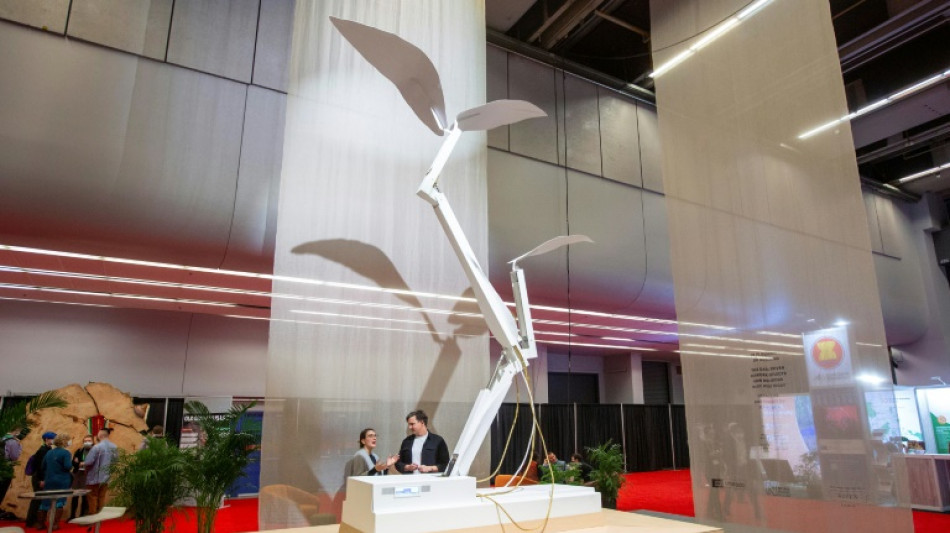
Robot plant grows, wilts on fate of UN nature talks / Photo: © AFP

 How young is too young as child prodigies win big at Asian Games

 UK Labour party meets buoyed by Burnham but eager for concrete plans
 Thousands protest ahead of Mexican president's report on missing students
 Bangkok floods force thousands into shelters
 AI startup urges optimism from Europe despite safety fears

 'Godlike, invincible': Japan hails 11-year-old Games history-maker
 Nepal's hydropower ambitions face climate reality check

 Power cuts, rubble: millions come home to find Sudan's capital unlivable

 Internationals keep Presidents Cup lead with late fightbacks

 Tuchel to 'keep pushing' England to reach Spain's level

 Alcaraz saves match points to keep Europe ahead in Laver Cup
 Spain success driven by hunger to improve, says De La Fuente

 Lyon collapse at Stade Francais to suffer first Top 14 loss
 Oyarzabal and Spain sink England again as Modric shines for Croatia
 Housing protesters camp in central Madrid after mass demonstration

 Louise Trotter expands her palette at Bottega Veneta
 Pope prays at Lourdes after huge Paris mass

 USA trims International lead after Presidents Cup four-balls

 Russia accuses Europe of blocking Ukraine talks, as strikes drag on

 'He said hello': Families pray with pope on Paris avenue
 Pope celebrates giant Paris mass, flies to Lourdes

 Thousands march in Madrid over eviction of 87-year-old woman
 England women back to winning ways with last-gasp defeat of New Zealand
 Trump rejects Iran proposal for deal to reopen Hormuz
 England's Cox says injured Buttler leaves 'big shoes to fill'
It's not always easy to make sense of the complex environmental diplomacy taking place at a UN summit billed as humanity's last hope to save nature.
That's why a scientist and artist have teamed up to build a large, data-driven robotic plant that withers or flourishes depending on countries' policy commitments: a tangible demonstration of how human actions will impact the world's threatened species.
Called "ECONARIO," the 5.5-meter (18-foot) tall artwork took a year to build from recycled steel and is currently on display in Montreal Convention Centre, keeping policymakers at the COP15 meeting on their toes as they attempt to hammer out a deal to protect ecosystems.
Its creator, Dutch artist Thijs Biersteker, told AFP the idea behind it is simple: "If the research does not reach us, then how can the research teach us?"
"Art reflects the time we're in, and it should reflect these important issues."
The plant feeds on data from the Biodiversity Intactness Index (BII) -- an estimated percentage of the original number of species that remain, and their abundance in any given area, despite human impacts.
Data scientist Adriana De Palma of London's Natural History Museum, who serves as research lead for the BII, told AFP it is based on a robust, peer-reviewed and open access methodology.
As negotiations happen, the team behind BII input, for example, how many countries have committed to implement a cornerstone pledge of protecting 30 percent of lands and oceans by 2030.
"We can then predict what that is going to mean for biodiversity in 20, 50 or 100 years," she said.
- Rooting for success -
New funding pledges by wealthy countries to assist lower income nations in protecting their biodiversity have helped to nudge up slightly the predicted global average of BII to 70.7 percent by 2050 -- meaning the average ecosystem will have that percentage of its natural ecological community left.
The current figure is 68.5 percent, set to drop to 66.4 percent if "business as usual" continues but rise to 76.4 percent in case of "real action" which the UN summit was meant to deliver.
For now, ECONARIO is cycling between the pessimistic and optimistic scenarios in order to show what could be possible -- but if policymakers fail to achieve an ambitious target, that will be reflected in a very sorry looking robotic plant.
"We shouldn't shy away from the hard numbers, it's not time to sugarcoat anymore," said Biersteker.
De Palma added they were in talks with North American museums to loan the artwork out after the UN summit concludes, and it will eventually return to Europe.
"Using a piece of art like this to really connect with people so they see the damage that individual choices, company choices and government choices are having on the world, is incredibly valuable," she said.
M.Odermatt--BTB


